




You are here
Sherdor madrasah.
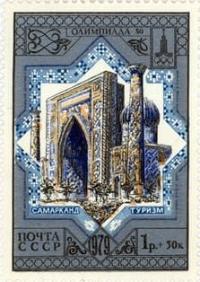
Walk on places of interest of an architectural ensemble Registan.
"The emir-commander, the just Yalangtush:
the language that can express words of praise for his perfections is a pearl,
he built such a madrasah on earth,
that the earth boasted of its height before heaven:
with a great effort of wings, the eagle of the mind will not reach the top of its lofty arch in a few years,
with a few carns* the skilled acrobat of thought will not climb to the top of its towers.
When the architect depicted the vault of its arch,
the sky, in amazement, bit the new moon, like a finger.
since Yalangtush Bahadur was its founder,
the year of its construction is called "Yalangtush Bahadur."
A poetic inscription carved on stone in Sher-Dor Madrasah.
Blackout dates in Samarkand.
The XVIIth-century Sherdor Madrasah is located at an altitude of 721 m. a. s. l. It is located in eastern part of Registan Square, in western part of Islam Karimov Square in of Smarakand.
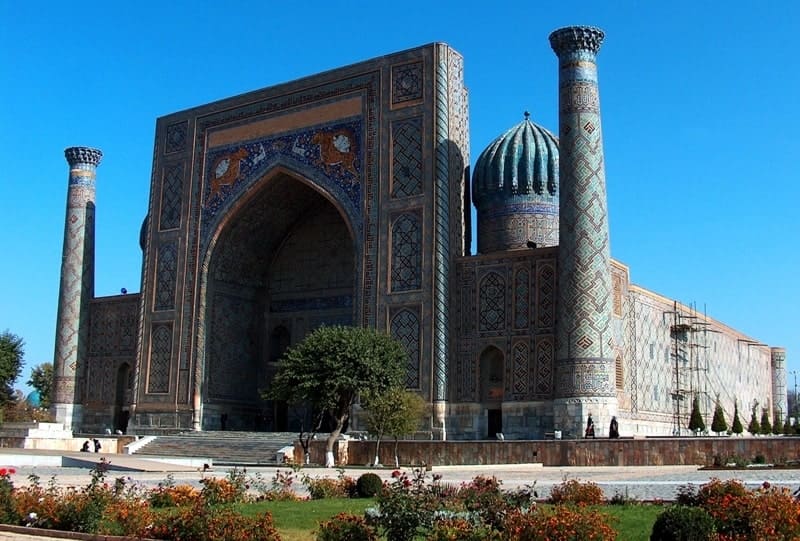
Sherdor Madrasah (Uzbek: Sherdor madrasasi, Persian: Madrasai Sherdor; from Persian: sher - lion, dor - having - literally: madrasa with lions) is a 17th-century Islamic educational, spiritual, and memorial-religious building in Samarkand on Registan Square.
Together with the Ulugh Beg and Tillya-Kari Madrasahs, it forms a coherent architectural ensemble.
History of Sherdor Madrasah.
Sherdor Madrasah was built with funds and on the initiative of the governor of the Bukhara khans (khakim) of Samarkand, Yalangtush Bahadur, who came from the Uzbek Alchin clan. The construction was carried out by the Samarkand architect Abdul Jabbar between 1619 and 1635 and 1636.
Its decorative design was carried out by the master Muhammad Abbas. The eastern part of Registan Square was chosen as the site for the madrasah's construction. For this purpose, Ulugh Beg's khanaka, built in 1424, was completely demolished.
The khanaka provided abundant building material for the Sherdor Madrasah, a fact confirmed by archaeological excavations conducted in 1956 by Soviet archaeologist S. N. Yurenev. The Sherdor Madrasah was built in the "kosh" style with the Ulugh Beg Madrasah, the elegant proportions of which formed the basis of the design.
According to the architect's concept, the main façades of the two madrasahs were to be mirror images of each other. However, the architect failed to take into account that in the two hundred years since the construction of the Ulugh Beg Madrasah, the level of Registan Square had risen by two meters.
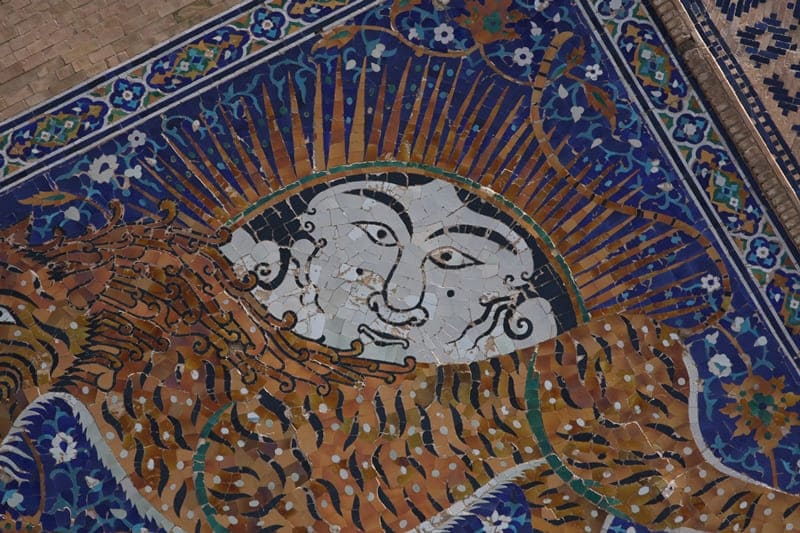
As a result, the proportions of the Sherdor Madrasah The buildings turned out to be more squat than the original. Yalangtush dedicated the Registan buildings to his spiritual mentor, Khoja Khoshim Dagbedi. The modern name, Sherdor, comes from the mosaic pattern on the tympanum of its main portal.
The decorator depicted a scene of a gazelle hunting - a fantastical feline resembling a tiger but with a lion's mane - in the rays of the rising sun. The name is translated as "having lions" or "having tigers." The scene depicted on the madrassa's portal eventually became one of the national symbols of the Republic of Uzbekistan. For nearly three centuries, the Sherdor Madrassa was a fairly well-known educational institution in the Islamic world, although its prestige was inferior to both the capital's educational institutions and the Ulugh Beg Madrassa.
Despite its impressive size, the madrassa could accommodate just over forty students at a time. Among the most Its famous graduates include the renowned Tatar theologian, sheikh of the Naqshbandi Sufi brotherhood, philosopher, and historian Shigabutdin Marjani.
During its existence, the Sherdor Madrasah survived several earthquakes, the most devastating of which occurred in the early and late XIXth century. The building survived, but was still significantly damaged: the vault of its main portal was severely deformed, the cladding collapsed in many places, and the minarets leaned.
In the early 1920s, Soviet authorities decreed that teaching at the madrasah was prohibited. The construction was discontinued. The building was nationalized, and restoration work began in 1924. The hujras were repaired, the collapsed section of the brick vault of the portal arch was restored, the carved mosaic tympanum of the main portal was reinforced, its deformed vault was dismantled and rebuilt, the domes and vaults of the hujras were rebuilt, and the facade cladding of the madrasah was restored.
In the late 1950s, archaeological excavations were conducted on the madrasah grounds, after which a new stage of restoration began. The madrasah's minarets were repaired between 1960 and 1962, and in 1962, the tympanum mosaic above the main portal arch was restored according to a design by artist V. N. Gorokhov and architect A. I. Freytag.
Restoration and strengthening work on the madrasah was completed between 1965 and 1967.
Construction of Sherdor Madrasah.
The building took nearly 17 years to construct. It was designed by the architect Abdul Jabbar. This building is a complete imitation of the Ulugh Beg Madrasah located across the street, but with distorted proportions. In the two centuries since the construction of the Ulugh Beg Madrasah, a significant cultural layer, approximately two meters thick, has accumulated on the Registan, causing the Ulugh Beg Madrasah to sink into the ground, acquiring distorted proportions.
In recent years, extensive repair and restoration work and archaeological research have been carried out: the hujras have been repaired, a collapsed section of the corduroy and brick vault of the portal arch has been repaired, the carved mosaic of the tympanum has been reinforced, and the deformed vault of the main portal has been dismantled and rebuilt (the total span of the new masonry is 12.5 meters).
Uzbek folk artisans actively participated in this complex project, dismantling and laying the vault according to ancient traditions, without using circling stones. The work was completed in 1925. Later, the domes and vaults of the hujras were rebuilt, and the wings of the madrasah's facades and courtyard facades were also refaced.
As a result of archaeological excavations in the summer of 1956, S. N. Yurenev established the madrasah's foundation to be in good condition; it is believed that the madrasah's foundation was constructed from bricks obtained during the dismantling of the walls of Ulugbek's khanaka.
Fragments of architectural ceramics from the khanaka were found. The building that stood on the site of Sherdor prior to the khanaka's construction was uncovered. Between 1960 and 1962, two minarets (each 31 meters high) on the madrasah's main facade and the carved mosaics of the large tympanum were restored.
Architecture of Sherdor Madrasah.
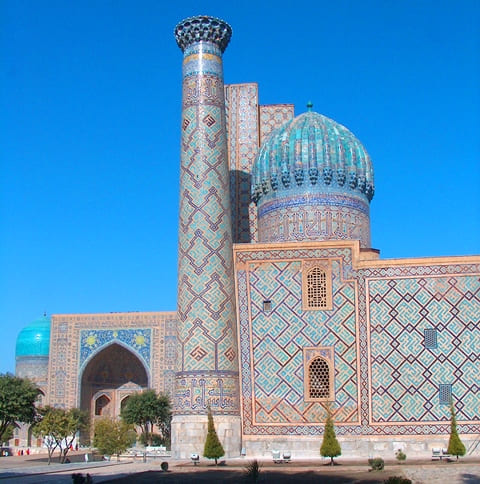
The madrasah is an architectural replica of the Ulugh Beg Madrasah. Ribbed domes on high drums flanking the main portal rise above the two-story façade. Along with geometric and floral designs, Islamic sayings are widely used in the madrasah's decor.
Particularly interesting is the filling of the tympanums of the portal arch with designs: a human face, a radiant oval sun, and the figure of a tiger pouncing on a doe. This is where the name "Sher-dor" (meaning "having tigers") comes from. This design was almost completely lost by the mid-XXth century and was restored during restoration work.
The composition of its main façade replicates that of the Ulugh Beg Madrasah, notable here are the monumental ribbed domes on high drums between the portal and the corner minarets. A khanaka for Sufis was built on the site where the Sherdor Madrasah now stands under Ulugh Beg.
The disproportionately large size of the dome likely led to the building's collapse in the 17th century. On the site of the khanaka, the ruler of Samarkand, Yalangtush-biy, began building a large madrasah, later named Sherdor (meaning madrasah "with lions").
Traditions of Central Asian medieval architecture in the Sherdor Madrasah. The Sherdor Madrasah was built in the traditions of Central Asian medieval architecture. It is a rectangular building with a total area of 70 by 57 meters. The main façade is distinguished by a powerful entrance portal – peshtak - with a pointed arch, 31.5 meters high.
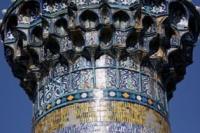
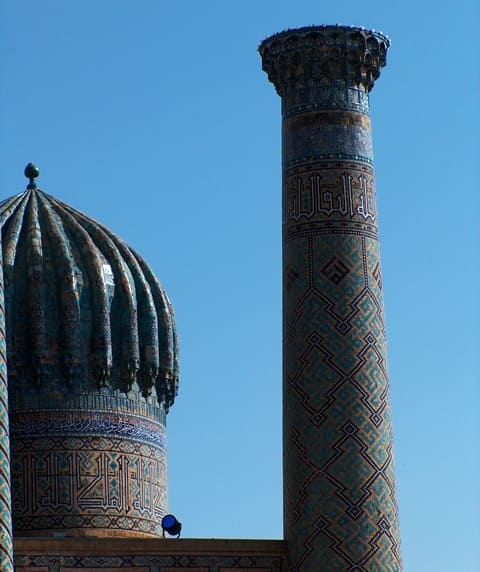
The corners of the building along the main façade are flanked by 31-meter-tall minarets topped with stalactite cornices. The eastern outer corners of the madrasah are designed as three-quarter towers, raised flush with the walls. The spacious, four-iwan courtyard of the madrasah, 30 by 38 meters in size and paved with large Chupanata slate paving stones, is surrounded by two tiers of khudjras.
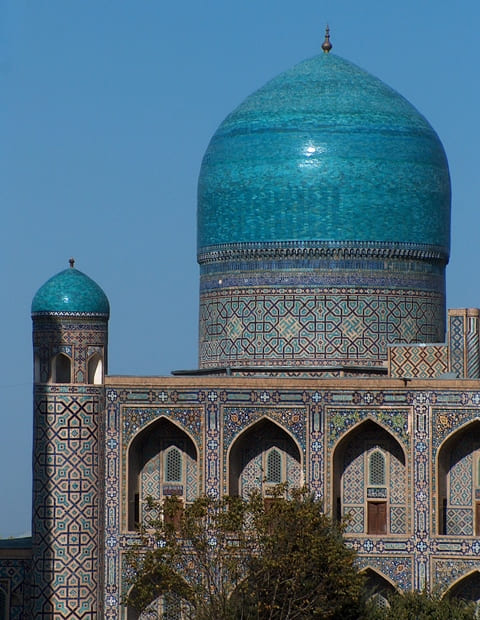
All 48 khudjras are single-room. In the corners of the courtyard are classrooms for student studies - darskhanas. Along the main façade, the darskhanas are covered with ribbed, sphero-conical domes. Tall drums decorated with turquoise tiles.
The domed darskhana to the right of the main entrance was eventually converted into a gurkhana. Several unidentified burials are located here. The domed darskhana to the left served as a mosque. The architectural design of the side iwans is interesting: their niches are vaulted in the form of a multifaceted semi-dome.
Decorative design of Sherdor Madrasah.
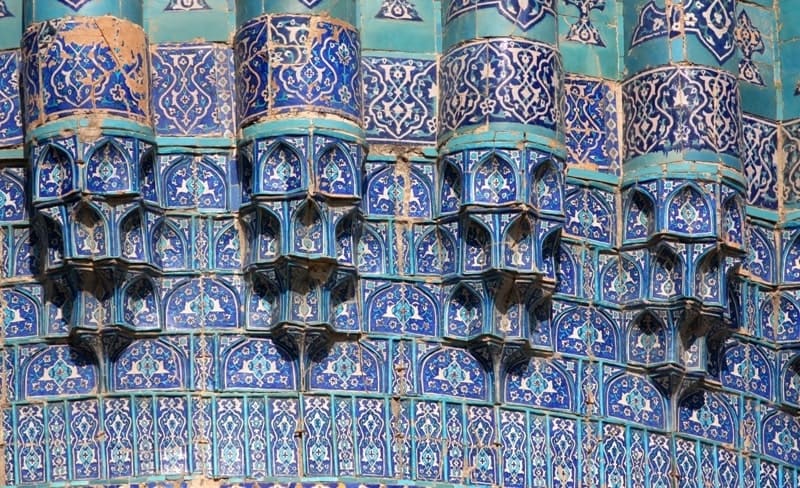
The decorative design of the madrasah makes extensive use of glazed brick sets, majolica, and kashin mosaics. Complex geometric patterns – girikhi - predominate in the decor of the exterior facades, designed to be perceived from afar. Epigraphic ornaments are found on the friezes of the minarets and the drums of the domes.
The majolica mosaic of the tympanum of the main portal is unique and is considered one of the rarest works of Islamic art. The tympanums of the arches of the hujras are richly decorated. Climbing stems with lush buds and flowers form an openwork pattern.
The mosaic panels in the niche of the western iwan are noteworthy: lush bouquets of flowers in decorative vases symbolize the tree of life. Of particular interest in the building's interior is the decorative finish of the domed darskhana. Its walls and vaults are painted in the kundal technique with a small, multicolored floral pattern, while the paintings on the dome and vaults form complex arabesque medallions.
The portal depicts fantastical felines and chamois.
Symbolism on coins associated with Sherdor Madrasah.
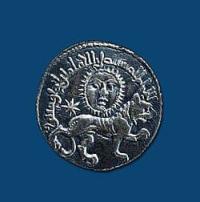
The lion and sun symbol comes from the Turkic Seljuk tradition (XIIth century). It appears on the coins of the Turkic Seljuk dynasty, from where it was adopted by the Mongols, and later by Tamerlane and his descendants, the Baburids of India. It was an astrological and zodiacal symbol.
Burials in Sherdor Madrasah.
In a small room inside the Sherdor Madrasah, near its southwest minaret, is the supposed tomb of Imam Muhammad bin Jafar Sadyk. In reality, this site was originally intended for Yalangtush's spiritual mentor, Khoja Khoshim Dagbedi, but he was buried next to his grandfather in Dagbit.
This is one of two tombs (along with that of Khoja Muhammad Katangu) located within the Registan Square and Complex, not counting the Shaybanid dakhma. In 2001, along with other Samarkand landmarks, it was inscribed on the UNESCO World Heritage List.
Geographic coordinates of Sherdor Madrasah are: N39°39'17 E66°58'35


Authority:
https://ru.wikipedia.org
Photos by:
Alexander Petrov.