




You are here
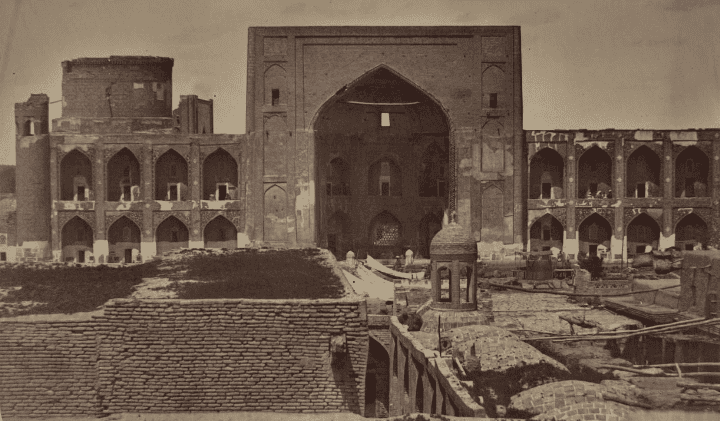
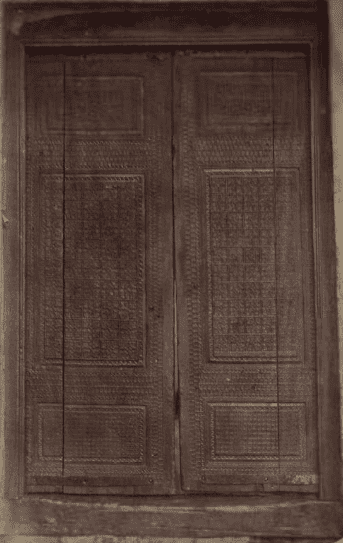
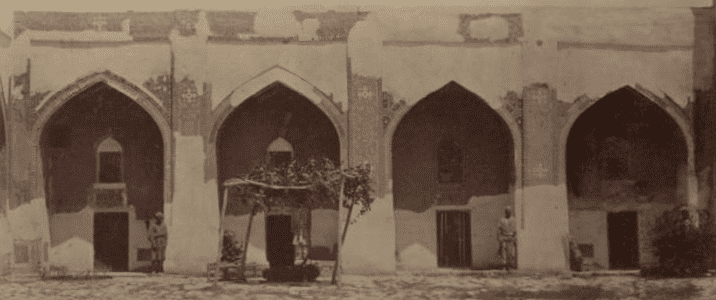
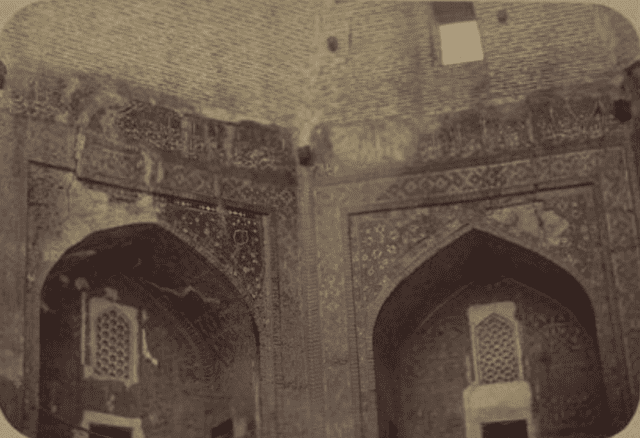
Photographs of Tillya-Kari Madrasah in Turkestan Album.
Excursion tours to Registan Square.
"Nekhoroshev's work is dispassionate documentary photography, but now it's interesting to consider how saddles were traded in 1871, how horses were bound hand and foot for shoeing, and what a summer camp and a nomadic tent looked like."
"Saint Petersburg Vedomosti." Late XIXth century.
Walk on Registan Square.
This page will feature photographs of the Tillya-Kari Madrasah on Registan Square in Samarkand from the Turkestan Album, prepared between 1871 and 1872. The Registan complex, which unites three main madrasahs (religious schools) in the center of Samarkand, is located in the center of Samarkand.
The third part of the Registan, the Tillya-Kari Madrasah, was built between 1646 and 1660. Built on the site of a former caravanserai, the entrance to the rectangular courtyard is framed by a large iwan (a vaulted hall with one end open, surrounded by walls on three sides).
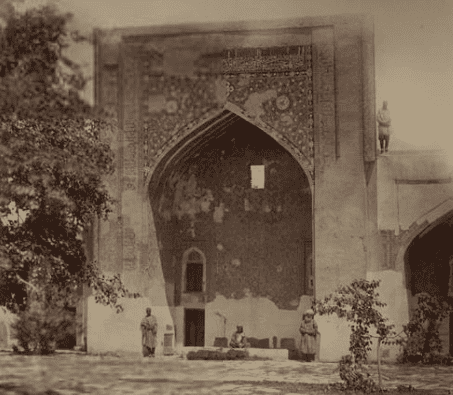
Shown here is a multicolored majolica panel at the top of the iwan's niche on the right. The main portion of the panel, set in a pointed-arched recess, contains a pattern of intertwined Kufic inscriptions. The arch is bordered by ceramics with intricate geometric and botanical patterns.
Above the pointed arch is a cursive inscription. The panel is framed by a raised decorative band with geometric figures, which terminates in another horizontal band with an inscription. A "rope" column has been added in the corner. The album was compiled by orientalists Alexandra Lyudvigovich Kun (1818-1882) and Nikolai Vladimirovich Bogaevsky (1843-1912), who actually divided the album into two parts.
Despite the large size of the volumes, the photographs themselves were small. Many were heavily yellowed, faded, and cracked. However, many interesting details could still be discerned. Some photographs had been retouched. Unfortunately, almost nothing is known about the photographers whose photographs were used in the album.
They were a group of photographers tasked with photographing everything that might be of interest for the creation of such an album. They had to carry out this enormous undertaking under extremely difficult field conditions and within a relatively short timeframe.
Most of the photographs were by photographer N. Nekhoroshev and military photographer Second Lieutenant G. Krivtsov. Nekhoroshev is also known to have founded a photography studio in Tashkent with his colleagues.
Photographers who compiled "Turkestan Album."
Konstantin Petrovich von Kaufman initiated the publication of the "Turkestan Album" in Russia, which became a major event in the history of photography. The album was compiled by the renowned orientalist and Islamic scholar Alexander Ludwigovich Kun.
The album, which the group worked on for two years, was published in 1872 in St. Petersburg. Its uniqueness lies in the fact that only six copies were printed. The album consists of four parts in six volumes: archaeological, ethnographic, industrial, and historical.
These volumes provide a comprehensive picture of the daily life of the population of the Central Asian region, its geographic and ethnic diversity, local crafts, beliefs and customs, festivals, games, and entertainment. The album reveals views of majestic architectural structures and ordinary neighborhoods with modest dwellings.
Portraits of representatives of national groups are vividly displayed, emphasizing their social status, details of costumes, and jewelry. Copies of the "Turkestan Album" were presented to Alexander II, the heir apparent Tsarevich Alexander Alexandrovich - the future Alexander III - Grand Duke Vladimir Alexandrovich, the Imperial Public Library, the Imperial Academy of Sciences, and the Imperial Geographical Society.
Unique are the collection of albumen prints included in one of the volumes of the "Turkestan Album" (1871-1872) and the "Khiva" album (1873). The "Turkestan" and "Khiva" albums are famous limited-edition publications created by order of the Turkestan Governor-General K. P. von Kaufman with the aim of introducing contemporaries to the lands that at that time became part of Russia, and the peoples inhabiting them.
The "Turkestan Album" was a multi-volume collection consisting of four parts: historical, archaeological (two volumes), ethnographic (two volumes), and "industrial," illustrating various crafts. The album's publication was carried out at the Tashkent Military Topographic Department, where the lithographic sections of each plate were printed.
The album was published in St. Petersburg in 1871-1872. Each of the six volumes of the "Turkestan Album" is a huge folio, bound in green leather, measuring 45 by 60 centimeters. Each page contains between one and eight photographs, printed using albumen printing (an egg white-based technique).
The broad thematic range, diversity of compositional techniques, and skillful work of the photographers distinguish the "Khiva" and "Turkestan" albums among examples of ethnographic photography of the early 1870s, which was becoming increasingly popular at that time.
"These two albums, 'Ethnographic' and 'Trades,' represent, as far as we know, a phenomenon completely unique among all European publications of peoples. Of course, there are many similar images in the world, but nowhere were they taken from life as here," wrote V.V. Stasov.
The publication's plan was drawn up by the renowned orientalist A.L. Kun, and the photography was carried out by military photographer Second Lieutenant G.E. Krivtsov and the owner of a Tashkent photo studio, N.V. Nekhoroshee, who printed the lithographic sections of each plate.
The Turkestan Album (1871-1872) was a collaborative project involving photographers M.T. Brodovsky, M.A. Terentiev, and N.V. Bogaevsky. Krivtsov and Nekhoroshev played key, but different, roles: one was a military organizer and pioneer, the other a professional master who completed the massive work.
Krivtsov and Nekhoroshev worked under the scientific supervision of orientalist Alexander Kun, who selected the subjects to be photographed so that the album met the strict scholarly criteria of the time. Copies of this album are currently held by the U.S. National Library of Congress, which purchased the albums in 1934 from New York book dealer Israel Perlstein, as well as by the National Library of Uzbekistan and the National Library of Russia.
Photographer Grigory Krivtsov. Turkestan Album.
Krivtsov was a second lieutenant and a military topographer, which determined the strict, documentary nature of his photographs. He was one of the first photographers commissioned by Governor-General K. P. von Kaufman to collect material.
His task was to document the population and landscape types during military expeditions. For Grigory Evlampievich Krivtsov, photography was a tool for reconnaissance and ethnographic recording. He laid the foundation for the "Historical Part" of the album.
The album "Views and Types of the Khiva Khanate" (1873) is a unique report on the Khiva campaign, where Krivtsov not only took photographs but also compiled detailed descriptions of the daily life and customs of the local inhabitants. The album of scenic and portrait photographs of the Khiva Khanate (author Grigory Krivtsov, 1873) is thematically divided into two parts: the first contains scenic and architectural photographs of the Khiva Khanate; the second contains types of inhabitants.
The photographs they created introduced Uzbeks, Kazakhs, Kyrgyz, Tajiks, Turkmens, Jews, Iranians, and other Eastern peoples, depicted in their national costumes; they also showed exotic rituals and scenes of domestic and public life.
Photographer Nikolai Nekhoroshev. Turkestan Album.
Nikolai Vladimirovich Nekhoroshev (N.V. Nekhoroshev) was a renowned Russian photographer of the second half of the XIXth and early XXth centuries, who worked in Central Asia. Unlike Krivtsov, N. Nekhoroshev was a professional photographer based in Tashkent and the owner of his own studio.
His works are a valuable visual source for the history and ethnography of the Turkestan region. A selection of albumen prints for the multi-volume "Turkestan Album" (1871-1872), created by order of the first Governor-General of Turkestan, K.P. von Kaufman.
The album "Khiva" (1873), which captured the events and scenes of the Khiva campaign. Collections of his photographs are held in major archival and museum collections, including Rosphoto and the Kunstkamera. He replaced Krivtsov during the album's primary production stage and completed a colossal amount of both technical and artistic work.
It is his name that is most often cited as the publication's primary photographer.




Authority:
Jan Zenkis. http://www.wdl.org
https://asiaplustj.info/ru/node/348969