




You are here
Memories of Samarkand.
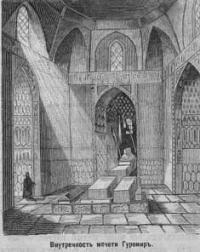
Zerafshan River in Samarkand.
"Samarkand, in its present location, arose after the Mongol invasion (13th century) and was walled in 1369 by Emir Timur. Surrounded by gardens and vineyards, situated in a vast valley bordered on three sides by mountains, cut by irrigation canals, Samarkand, with its architectural monuments, was the most beautiful city in Central Asia, and its climate was pleasant."
V. Vyatkin. "Antique Monuments of Samarkand." 1933.
Alexander Great, conqueror of Central Asia.
Country, encompassing all fertile lands along rivers and streams originating in foothills of Tien-Shan, and partly flowing into Aral Sea, has long been known as Zarafshan and today constitutes one of those remote outskirts of Russia that so preoccupy minds of foreigners, who watch our successes in Central Asia with distrust, yet which are still so little known to Russians themselves.
The central point of this country has long been considered the ancient Central Asian city of Samarkand, which became Russian property in 1868. Founded in the Vth century BC by an Arab sheikh, whose conquests led to the lush Zarafshan Valley.
From the day of its foundation, Samarkand became the central city of the Central Asian dominions and a center of scholarly and commercial activity. However, it has no written history, and all information about it is lost in the legends of the tribes that inhabit it to this day.
What is certain is that first the Greeks, then the Arabs and Mongols successively ruled it and the surrounding land, introducing their customs, traditions, and scholarship, leaving indelible traces. For example, the conquest of the region by the Greeks, who penetrated Bactria and Sogdiana during the campaigns of Alexander the Great, enabled Greek civilization to spread far across Central Asia.
To this day, ancient Greco-Bactrian coins, medals, and remnants of weapons are found in the burial mounds of Bukhara. The Arabs, as conquerors, brought a new religion and education; The Mongols spread the faith of Muhammad to the far reaches of both East and West, imprinting the country with the same influence that still dominates the Central Asian khanates.
Timur Lenk, the formidable leader of the Mongol hordes, having captured Samarkand, conceived of making it the capital of his vast kingdom and the first city in the world. For more than a hundred years, Samarkand was the site of extensive scholarly and commercial activity, as evidenced by the majestic ruins of mosques, madrassas, and other buildings that astound the traveler.
Approaching the city from the direction of Chupan-ata, the rocky heights dominating the area irrigated by the Zarofshan River, a magnificent view of the surrounding area opens up. To the right stretch the Shunkar-Tau range, spurs of the
Tien-Shan, and to the left the last branches of the Kamak-Garan mountain range, from which flow numerous streams and rivers, insignificant in size but important for the development of agriculture.
The Zarafshan River, flowing near Samarkand, encounters a rocky barrier in its path and divides into two branches, the Ak-Darya and the Kara-Darya. These two channels embrace the most luxurious valley in the world, several dozen miles in circumference, literally drowning in gardens, through the foliage of which villages (farmsteads) can be seen here and there.
Here, amid the vibrant green of fields sown with wheat, rice, and cotton, the waters of the Zarafshan flow through countless branches, branching off into irrigation ditches lined with mulberry trees, whose succulent leaves feed the local silkworm, which has recently gained such notoriety throughout Europe.
The distance from Chupan-ata to Samarkand is about seven miles, but the city and its environs are clearly visible, aided by the transparency of the air characteristic of this place. Timur's capital, little changed in its external outline to this day, is shaped like a regular quadrangle, surrounded by crenellated walls.
On the western side rises the citadel, the most extensive of all Central Asian citadels. It is about 3 miles in circumference and includes a Muslim cemetery, several mosques, and other buildings now used to house our garrison. The rest, or rather the city itself, lacks a regular layout: the streets are narrow and winding, the houses are mostly one-story with flat roofs; inside some of the courtyards Covered galleries protect the inhabitants from the summer heat.
Gardens are everywhere, and from afar, the city is literally awash with greenery: apricot, peach, pear, mulberry, and apple trees form a continuous mass, through which graceful poplars, the domes of ancient mosques with their dilapidated monors (minarets), and the enormous porticoes of madrassas and gates burst into the air.
The madrassas and caravanserais are mostly two-story, with the upper floors housing students and the lower floors for lectures. Almost all of them are built within the courtyards of mosques, at the entrance to which tower tall gates flanked by minarets.
These buildings are undoubtedly the finest adornment of Samarkand and serve as proof of the mastery of its builders. Widely curved domes, built on enormous arches, including all the requirements of architectural art, amaze every European, involuntarily peering at the inscriptions curling along the outer and inner cornices of the domes and arches, and the tiles with which they are mostly clad.
It's a shame, however, that most of these buildings are in a pitiful state: gates and minarets have collapsed, vaults have crumbled, and the destruction, begun by time, is actively maintained by people, the descendants of the builders. Of the remarkable mosques and madrassas, we can mention Khadzhi-Ograr, Guremshr, Bibi-Khanym, and several others, but the last one rightfully takes first place.
Bibi-Khanym was built, according to legend, by Timur's wife, the Chinese princess Khanym. The temple itself occupies a vast space and consists of three sections connected by a separate building housing the classrooms of the largest madrasah.
It is said that the entrance gates were once cast entirely of bronze, but now no trace remains. Only the western part of the temple remains intact, with its walls still bearing tiled mosaics, crafted with great skill and expertise. The azure and gold are so fresh that one is tempted to believe the structure was recently restored, yet no one pays attention to them, and time destroys the last vestiges of the past.
Not far from this mosque, they point to the tomb of Timur's beloved wife, but if the stories are true, only ruins remain, lacking even any form. On the eastern side of the city stands a small mausoleum, crowned with a beautiful dome and surrounded by walls with high gates, flanked by domes.
Inside, the octagonal building consists of two rooms with marble floors and walls covered in blue and gold arabesques. This is Timur's coffin, no more, no less, and there is no doubt about it. The tomb itself, located in the second room behind a transparent grating, is shaped like a truncated pyramid, three feet high and six feet long.
It is made of jasper and crowned with six banners. Surrounding it are the white marble tombs of Timur's family members and the tomb of his beloved teacher, Mirza-Sande-Berke. Various sacred books lie near the tombs, from which the mullahs constantly read.
It is said that Samarkand once housed a famous library containing a large number of ancient Armenian books. Now there is no trace of this library, and no one can say where these treasures disappeared to. Like a library, the once-famous Kalinder-Khana Higher School and the Mirza-Ulund Observatory, where astrological, rather than astronomical, observations were conducted, vanish without a trace.
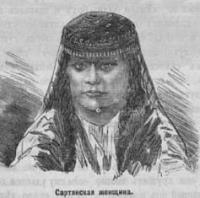
These observations, which continue to play such an important role in public life in the East to this day, continue to play such an important role. The main population of Samarkand, like other cities in the Turkestan region, are Sarts, considered the country's indigenous people.
Tradition says that the Sarts are descended from Juguists, or Jews and Persians, and anyone need only look at a Sart to be convinced that Jewish blood flows in their veins. Their terrible attraction to money, their pettiness, their timidity, their manners - everything about them resembles Jews.
A Sart loves an argument and will always try to find some excuse for it, while at the same time, they will not miss an opportunity to extract their own advantage where necessary. They lead a lazy, carefree life, spending the day at the bazaar, and come evening, they pool their savings, order pilaf, buy raisins, pistachios, and nuts, and begin to feast on each other.
If the company is large, they invite the batcha to join them. The batcha is a handsome boy, about ten years old, dressed in women's clothing and delighting the crowd with dances that send them into frenzied raptures, intoxicated by hashish or opium.
Nevertheless, he is an essential part of a Sart's life. Young and old alike court the batcha, and the gray-haired kazy is not averse to offering the batcha his hand and caressing him. Women are held in no esteem and are valued no more than household utensils; the seclusion of Sart women, which excludes them from society, naturally precludes those games and dances that so charm even the coarsest men.
It is c And then the Batcha appeared, always remarkably beautiful, lively, agile, and able to evoke thunderous applause. When the dance began, the Batcha would enter the arena, perform a bata (greeting), and begin to dance rhythmically and smoothly to the beat of the music.
Gradually becoming animated and almost frantic, the Batcha would electrify the crowd so much that everyone would begin clapping their hands and tapping their feet. When the Batcha sat down, everyone would watch his every gesture and movement, trying to anticipate his slightest desire.
Besides the Sarts, natives of the region, one can encounter a motley crowd of various peoples in Samarkand. One need only stroll down the main street on market day to spot the slender figure of a Persian with a magnificent black beard and fine, delicate features, barely restraining a stately argamak.
Behind him, in a simple cotton robe and a coarse red turban, follows a horseman with broad features. This is an Uzbek, one of those who consider themselves the dominant tribe in Central Asia. He is simple and rude in manner and possesses all the virtues of a conquering tribe.
He hates the Tajik, or Sart, and considers it shameful to speak to him. Amidst people on foot and horseback, a caravan of camels moves slowly but solemnly, followed by a short but steady gait by a line of donkeys laden with fruits, vegetables, robes, and other village produce from nearby villages.
Among the street crowds are residents of Afghanistan, Kabul, and Herat, bringing here brocade, muslin, gold thread, granulated sugar, cashmere shawls, turquoise, and precious stones. Arabs and gypsies are encountered in the outskirts of the city, but they constitute a minority.
The Jews, engaged in petty trade, live in a separate quarter and are remarkable for their extreme poverty. This crowd constantly swarms the streets, sometimes drowning out the discordant hubbub of children's voices, occasionally interrupted by a dull sound that often seems distant.
This is nothing more or less than a madrasah, where children study aloud, poring over a book for at least ten hours, trying to understand the ineffable nonsense of one hundred and twenty books that comprise the essence of every Muslim's education.
With the arrival of the Russians, life in Samarkand began to change somewhat in detail. Trade revived, but the outward appearance remained the same. The city remains immersed in gardens, over which tower the remains of ancient monuments, transporting one involuntarily to a bygone era.
And above all this, the eternally blue sky shines, and a certain tranquility and charm pervades the air.
Authority and photographs:
Picturesque Review Magazine, No. 2, 1873.