




You are here
Kuksaray Palace
Trips to Samarkand.
“In the mosques, in the temples, in the temples of the gods
They are afraid of hell, seeking heavenly dreams.
But he who knows the mysteries of creation,
I have not sown these weeds in the heart! ”
Omar Khayyam.
VIP and business tours in Uzbekistan and Central Asia.
Kuksaray Palace is located at an altitude of 712 m. a. s. l. in central part of city, immediately adjacent to ruins of Kutbi Chakhardakhum mausoleum, 602 meters west and slightly north of Registan Square, and 483 meters north and slightly east of Rukhabad mausoleum in Samarkand.
In Samarkand, the Kuksaray ("Blue Palace") was the main government palace of Amir Temur, and later of Ulugh Beg. Situated within the Kala citadel, it enjoyed a notorious reputation. Along with the state chanceries and treasury, it also housed a prison where high-ranking officials were held.
The palace was the fourth in the complex and apparently towered above the fortress walls, serving as a sort of lookout. The name Kuksaray apparently derives from the abundance of glazed tiles and bricks, predominantly blue and light blue. Architects and townspeople built the palace.
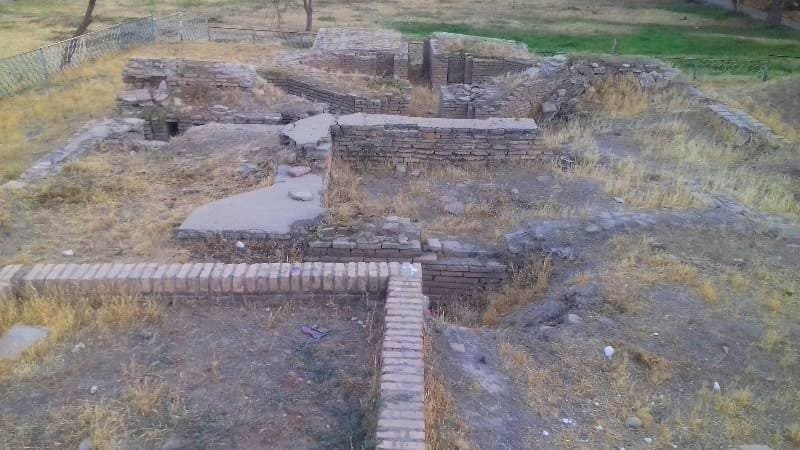
This palace, like the rest of the buildings in the kala, has not survived to this day, although tiles from the Timurid period were found here during excavation work. Kuksaray is the palace of Amir Timur (Tamerlane), which has not survived to this day, in the capital of his empire, Samarkand.
Translated from Turkic, it means "Blue Palace." According to some sources, Kuksaray was Amir Timur's main palace in Samarkand. Unexcavated remains of the palace's ruins are located in the historical center of Samarkand, presumably in the eastern part of Kuksaray Square, next to the main building (a tall 15-story building) of the Samarkand Regional Administration, near the bridge over Dagbitskaya Street.
History of Kuksaray Palace.
The Kuksaray Palace was built by Amir Timur almost immediately after his ascension to the throne in 1370. Kuksaray was a four-story structure of considerable size for its time. The palace walls were faced with glazed tiles. The palace itself is located on a hill. At that time, this hill was surrounded by walls.
Another palace, Bustansaray ("Palace Flower Garden"), was built near the palace a little later. The Kuksaray Palace was one of Amir Timur's favorite palaces, of which he had several dozen around Samarkand. In the autumn of 1404, Amir Timur stayed in Kuksaray for the last time before his campaign against China (Ming Empire).
In November 1497, Babur stayed in neighboring Bustansaray, located 151 meters to the southwest. After the death of Emperor Timur, the palace was used by his descendants. Ulugh Beg is also known to have used the palace.
Kuktash Throne Stone.
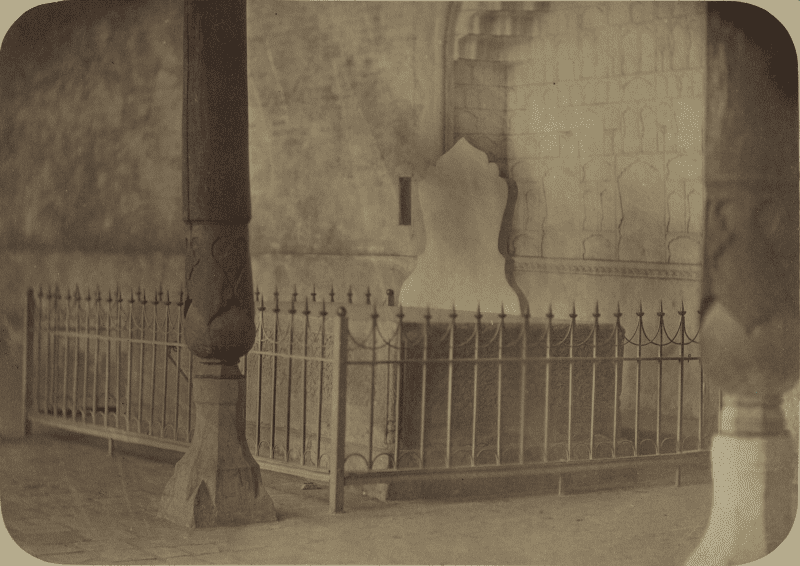
The Kuktash Throne Stone was located in the ceremonial palace of the emirs who ruled Samarkand after the expulsion of the Timurids in the early 16th century. The palace was referred to as "Kok Tash" in honor of the legendary throne of Timur (Tamerlane), who built a fortress in Samarkand.
The surviving carved throne with a high back likely did not belong to Tamerlane, but the throne area is protected by an iron fence. The rear wall is richly covered with multicolored ceramic tiles, creating geometric and botanical patterns. Visible is an arched niche framing the throne and crowned with a mocárabe (honeycomb) or "stalactite" vault.
The monolith in front of the throne also features carved ornamentation. This area is elevated, overlooking a columned courtyard where spectators gathered during official events. The columns in the courtyard, like those, are made of carved wood on a composite marble base.
Until 1868, the Kuktash throne stone (meaning "blue stone" in Turkic) was housed in Timur's later restored throne room. From the 15th to the 19th centuries, the Timurid throne stone, Kuktash, housed in the palace, hosted the enthronement ceremonies of Central Asian rulers from various dynasties, from the Timurids to the Manghit.
Although Bukhara was the capital of the Emirate of Bukhara, the Uzbek emirs of Bukhara, Haidar, Nasrullah, and Muzaffar, held their coronation ceremonies in Samarkand, on Kuktash. The last coronation ceremony took place in 1861, when Emir Muzaffar was enthroned.
Destruction of Kuksaray Palace.
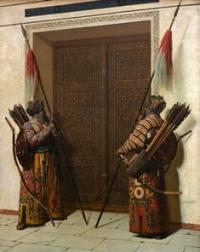
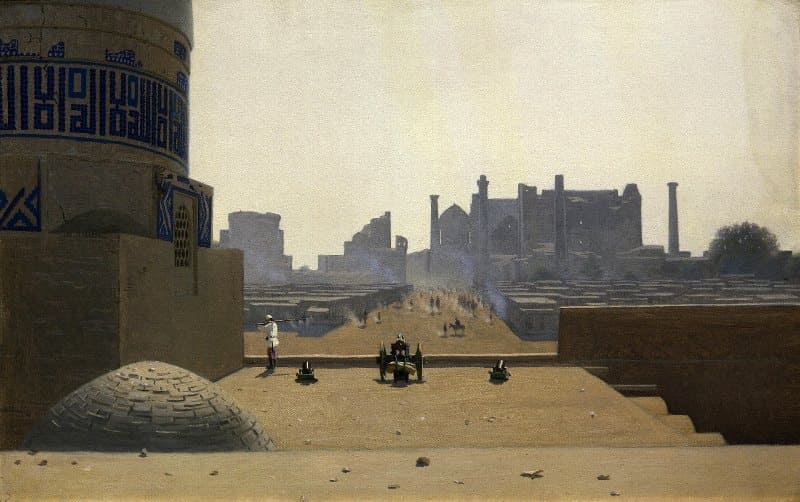
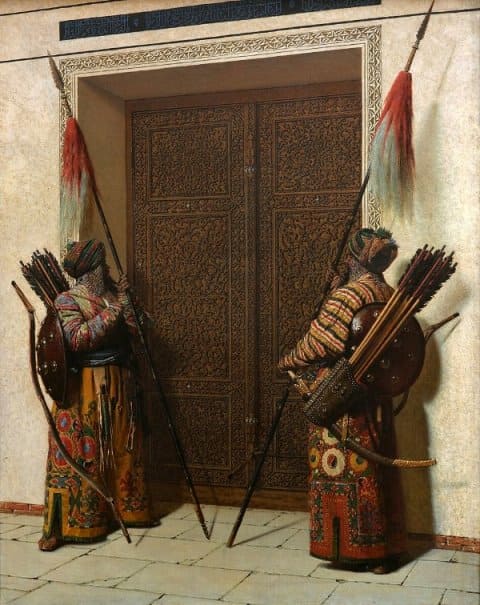
The main buildings of the palace were destroyed during the political strife and crisis of the first half of the 18th century. In the 19th century, the Bukharan emirs of the Manghit dynasty partially restored the palace. Views of the palace and its doors were depicted by the Russian artist Vasily Vereshchagin in his Turkestan series.
After the eastern part of the Bukhara Emirate lost its independence in 1868 and Samarkand was conquered and incorporated into the Russian Empire, the authorities decided to completely destroy the palace. Only the Kuktash throne stone remains today, and it is on display in the courtyard of the Gur Emir Mausoleum.
The palace itself (like the Bustansaray Palace) was covered with earth after its complete destruction and remains unexplored to this day. The city of Samarkand and its historical, cultural, religious, architectural, and archaeological monuments, including the remains of the Kuksaray Palace, are listed as a UNESCO World Heritage Site under the title "Samarkand - Crossroads of Cultures."
Geographical coordinates of Kuksaray Palace: N39°39'17 E66°58'08
Geographical coordinates location of Kuksaray Palace: N39°39'18 E66°58'07
Authority and photographs by:
https://ru.wikipedia.org/wiki/%D0%9A%D1%83%D0%BA%D1%81%D0%B0%D1%80%D0%B0%D0%
"Castles and palaces; Islamic architecture; Photographic studies; Thrones; Timur, 1336-1405"