




You are here
Mausoleum of Maral Ishan Kurmanuly.
FAM trip Kazakhstan and Central Asia.
“Maral Kurmanov was not at all a“ false prophet ”or“ inspired from above ”, but a separatist-dreamer, who stood out from the crowd of ordinary Kirghiz not so much by his mind as by the spirit of exclusivity, he planned to carry out a major reform of the everyday and political life of his people and to implement his plans he chose a convenient time - a time of turmoil and strife ... He was imbued with a sincere desire for good for his people, but for the model of his reformatory actions he took the ideal of Mohammedan isolation, alien to the nature and habits of peaceful and good-natured nomads"
Major General Nikolai Osipovich Kraft (1798-1857).
"Last summer in the Middle Horde there was one similar named Morall, who preached about various miracles, predicted the imminent enslavement of the Horde and many misfortunes." According to the sources, “Kyrgyz people from different volosts came to Maral Ishan, whom he persuaded, in order to leave the connection with Russia, to unite as people of the same land”
Fyodor German’s "On Kirghiz" is based on his official reports and dispatches, compiled in immediate aftermath of events that took place in 1820-1821 (shortly following a surge in activity by Maral Ishan in steppe during summers of 1819-1820). German’s article - which describes daily life, customs, and political unrest within steppe - was published in installments in prominent literary and scholarly journal “Otechestvennye Zapiski” ("Notes of Fatherland") in 1826 (Part 27, No. 75, September; Part 28, No. 78, October).
Sacred monuments of Kazakhstan.
Mausoleum of Maral Ishan is situated at an elevation of 103 meters above sea level. It lies in the central part of the Ishankamar cemetery, 5.6 km from the right bank of the Karaozek channel, 14.8 km northeast of the Beisenbaikum sands, 14 km east (and slightly north) of the settlement of Zhosaly, and 14 km north of the village of Abyla, in the Karmakshy District of the Kyzylorda Region.
Maral Ishan is a compelling historical figure; he emerges not merely as a religious figure, but also as a spiritual educator and a public leader in the Kazakh steppe during the first half of the XIXth century. His biography is closely intertwined with Islamic education, the complex relationship between steppe society and the Russian Empire, the migration of Kazakh clans toward the Syr Darya River, and the movement led by Kenesary Kasymov.
Sources vary regarding the dates of Maral Ishan’s life. The Kazakhstani archaeological heritage portal cites the years 1769-1841, while other publications suggest 1780 as his birth year and sometimes provide a later date for his death. Therefore, it is best not to present this contested chronology as an established fact.
There is another point to consider: while sources confirm a connection between Maral Ishan and the movement led by Kenesary, it is more accurate to characterize his role as one of spiritual and socio-political support, rather than unconditionally attributing to him the leadership of all the insurgents' actions.
An article titled "Historical Information about Maral Ishan," authored by M. M. Zhumadildayev and M. A. Alpysbes and published in 2019 by the Eurasian National University, examines not only the Ishan’s biography but also oral traditions, assessments by XIXth-century scholars, and his educational endeavors.
This work serves as a solid foundation for further, more in-depth research.
Mausoleum of Maral Ishan – spiritual educator and associate of Kenesary Kasymov.
The Mausoleum of Maral Ishan is located in an area associated with the final years of the life and work of the prominent Kazakh religious figure, Maral Ishan Kurmanuly. Maral Ishan was one of the most renowned spiritual mentors in the Kazakh steppe during the first half of the XIXth century.
His legacy is linked to the spread of Islamic education, the establishment of mosques and madrasas, the defense of the interests of the Kazakh population amidst the expansion of the Russian administrative presence, and his involvement in the national liberation movement led by Kenesary Kasymov.
In the historical memory of the Kazakh people, he is remembered not only as a religious teacher but also as a figure of significant social authority someone capable of uniting people and speaking on behalf of the communities of the steppe.
Origins and Education of Maral Ishan Kurmanuly.
Maral Ishan Kurmanuly hailed from the Kerey tribe of the Kazakh Middle Zhuz. According to information found in historical and archaeological publications from Kazakhstan, he was born in 1769 in the Kairankol area, near Kyzylzhar, in what is now the Kostanay Region.
However, some other sources cite 1780 as his year of birth. Consequently, establishing an exact chronology of his life requires further cross-referencing of historical evidence. His father, Kurman Kenzhebayuly, was a batyr (warrior) who enjoyed the trust of Ablai Khan.
According to oral tradition, his mother’s name was Fatima. Family accounts suggest that her origins were linked to the entourage of the Dzungar ruler Galdan-Tseren; such details belong to the realm of historical tradition and should be treated with caution.
Having lost his father at a young age, Maral and his mother faced difficult circumstances. In his youth, he moved to the Akmeshit region, where he was able to pursue his education. His aptitude was recognized by Kulanbay Ishan, who helped facilitate his further studies.
Biographical records indicate that Maral studied at the madrasa of Zhalanayak Ishan, located near Mount Zham in present-day Uzbekistan. His studies lasted approximately ten years. During this time, he delved into Islamic theology and Eastern literary traditions, acquiring the knowledge that would later enable him to independently engage in religious and educational work.
This education served as the foundation for the authority he would later command. Maral Ishan did not limit himself to the performance of religious duties; he served as a mentor, a preacher, a mediator in public disputes, and an organizer of the spiritual life of Kazakh communities.
Maral Ishan and Public Life of Kazakh Steppe.
The first half of the XIXth century was a period of profound political and social change for Kazakh society. The Russian Empire steadily expanded its administrative presence in the steppe regions, establishing new district administrations and fortified outposts as it sought to integrate Kazakh lands into its imperial governance system.
Of particular significance was the "Charter on the Siberian Kirghiz" of 1822, drafted by Mikhail Speransky. It abolished the authority of the khans in the Middle Zhuz and introduced a new administrative structure based on districts, volosts, and auls (villages).
In the years that followed, district administrations -such as those in Kokshetau and Karkaralinsk were established. These changes affected traditional forms of governance, the relationships between clans and sultans, and issues concerning land use and the movement of the nomadic population.
For Kazakh communities, these transformations represented more than just an administrative reorganization. The expansion of fortified lines, the emergence of new settlements, and changes in how territories were managed gradually restricted the established routes used for seasonal migrations.
Under these circumstances, religious figures who commanded authority among the population often became the spokespersons for public sentiment. Maral Ishan opposed actions that he believed infringed upon the rights of Kazakh communities and constrained their traditional way of life.
Historical records indicate that he sent appeals to representatives of the Russian administration, including the Military Governor of Orenburg, Essen, and the commander of the Separate Siberian Corps, Kaptsevich. These appeals raised issues concerning the relationship between the Kazakh population and the Russian authorities, as well as the protection of the land and communal interests of the steppe inhabitants.
It is noteworthy that Maral Ishan, despite his critical stance toward the changes taking place, also sought to utilize opportunities for negotiation. His activities demonstrate that religious and public figures of that era could simultaneously oppose colonial pressure and attempt to resolve contentious issues through diplomatic means.
Connection between Maral Ishan Kurmanuly and movement of Kenesary Kasymov.
A significant aspect of Maral Ishan’s biography is his connection to Kenesary Kasymov one of the most prominent leaders of the XIXth-century Kazakh national liberation movement. According to information found in historical and biographical accounts, Maral Ishan was a maternal relative of Kenesary.
They were linked not only by kinship, as well as a general concern for the fate of Kazakh lands and the traditional way of life of steppe society. In 1837, a large-scale movement led by Kenesary Kasymov began, aimed at opposing the further curtailment of the political autonomy of Kazakh lands and the expansion of the imperial administrative system.
The movement encompassed a significant portion of the Kazakh steppe and continued until 1847. Maral Ishan supported Kenesary and held spiritual authority among his followers. His role primarily involved religious guidance, the strengthening of unity, and providing moral support to the movement.
Accounts also mention his participation in Kenesary’s council and his role in bestowing blessings upon the warriors. It is important to note the chronology: according to the dating established in the archaeological heritage registry, Maral Ishan passed away in 1841 that is, before the conclusion of Kenesary’s uprising.
Consequently, his activities should be viewed as one of the spiritual and social factors that preceded the further development of the movement and accompanied its initial phase. Following the death of Maral Ishan, his sons and descendants continued his religious and educational work.
Among them, his eldest son, Kalkai Ishan, held a prominent position and was also highly respected by the local population. His name, along with those of other members of the family, has been preserved in the history of the spiritual life of the lower Syr Darya region..
Educational and Enlightening Activities of Maral Ishan Kurmanuly in Syr Darya Region.
A key aspect of Maral Ishan’s work was the religious education of the population. After relocating south to the lower reaches of the Syr Darya, he continued his preaching and educational efforts among the Kazakh communities. In regions inhabited by nomadic and semi-nomadic clans, mosques and madrasas served purposes that extended well beyond their role as religious structures.
They functioned as centers for literacy, the study of the foundations of faith, the transmission of written culture, and the cultivation of social ties. According to accounts found in publications concerning Maral Ishan, he is credited with the construction of several mosque-madrasa complexes in the vicinity of the Syr Darya River and its tributaries.
These sites hosted prayers, provided education for children, and facilitated the spread of the Arabic script and Eastern religious literature. Maral Ishan also urged his fellow tribesmen to put an end to inter-clan feuds and to devote greater attention to education, crafts, and the organization of their economic life.
Some sources suggest he advocated for a transition toward a more sedentary lifestyle and the adoption of agriculture a perspective rooted in the recognition that, amidst ongoing political and economic shifts, it was essential to strengthen the material foundations of community life.
In popular memory, Maral Ishan is also remembered as a healer. Such a role was common among many *ishans* (religious mentors) in Central Asia, who often combined spiritual guidance with traditional healing practices and the provision of aid to those in need.
His stature is further reflected in the oral poetic tradition. Renowned akyns (poets/bards) of the Syr Darya region including Balky Bazar, Omar Shorayak, and Turmagambet - composed works in his honor. The final years and burial of Maral Ishan Kurmanuly.
Historical and biographical records indicate that Maral Ishan spent the final years of his life in the lower reaches of the Syr Darya and the Karmakshy region. He passed away while traveling toward his home territory. According to tradition, he requested before his death that he be laid to rest in the land of Karmakshy.
Over time, the burial site became a revered center for commemorating this spiritual figure. Adjacent to the mausoleum lie the graves of his eldest son, Kalkai Ishan, as well as those of his descendants and followers Ospan Ishan, Tobagabyl Ishan, Kaus Ishan, and Amit Ishan.
Thus, the Ishankamar memorial site serves not merely as the final resting place of a single prominent religious figure, but as a family and spiritual necropolis, encompassing several generations of the Kazakh clergy.
Architecture of Mausoleum of Maral Ishan Kurmanuly.
The mausoleum of Maral Ishan is a relatively small structure, the architectural design of which is rooted in the traditions of religious construction found in the lower reaches of the Syr Darya river. As you have described it, the building is designed as a scaled-down replica of the Mausoleum of Khoja Ahmed Yasawi in Turkistan.
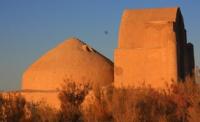
Its façade faces southeast. The structure is characterized by a restrained in its external appearance, lacking elaborate decorative ornamentation. Rising above the main structure is a pointed dome featuring a small opening. Furthermore, an architectural description published on the portal Archaeology.kz characterizes the mausoleum as a two-chambered structure built of mud brick set in a clay mortar.
Its chambers are arranged along a longitudinal axis and enclosed within a prismatic volume. The domed ceilings are spheroconical in shape, and the main façade faces southeast. Researchers highlight its particular significance as one of the most monumental mud-brick mausoleums in the lower reaches of the Syr Darya river.
Thus, the resemblance to the Mausoleum of Khoja Ahmed Yasawi should be understood primarily as an architectural allusion a respectful nod to a well-known tradition of Turkic memorial architecture rather than as an exact reproduction of the structure in Turkistan.
In May 2018, restoration work was carried out on the mausoleum. The monument is included in the register of sacred sites and historical and cultural landmarks of local significance in the Karmakshy District of the Kyzylorda Region. Adjacent to the memorial complex is a guesthouse, which includes facilities for prayer and overnight stays.
This allows pilgrims and visitors to spend time at the site, learn about the history of Maral Ishan, and pay their respects to those buried in the cemetery grounds.
Maral Ishan and his historical legacy.
The historical significance of Maral Ishan lies in his multifaceted public role. He served as a religious teacher, an educator, and an organizer of the spiritual life of Kazakh communities a man who remained actively engaged with the political developments of his era.
His activities took place during a period when the traditional world of the Kazakh steppe was undergoing profound transformation. The abolition of the authority of the Khans in the Middle Juz, the establishment of administrative districts (kruzhnye prikazy), the construction of fortifications, and shifts in land-use policies forced society to confront critical questions regarding the preservation of its autonomy, traditions, and internal cohesion.
Maral Ishan sought to address these challenges through religious enlightenment, the fostering of social unity, and the defense of the population's interests. His association with Kenesary Kasymov became part of a broader narrative of resistance against the political subjugation of the Kazakh steppe.
Today, the mausoleum of Maral Ishan in the Karmakshy District remains a site of remembrance and veneration. The presence of the graves of his son and other descendants nearby lends the memorial complex a special significance: it preserves the memory not only of an eminent figure from the first half of the XIXth century but also of several subsequent generations who upheld his spiritual tradition.
The mausoleum of Maral Ishan stands as one of those monuments in the lower Syr Darya region that sheds light on a little-known yet vital aspect of Kazakhstan’s history the role of religious educators in the life of steppe society, the preservation of cultural traditions, and the shaping of a collective social consciousness.
Geographical coordinates of Maral Ishan mausoleum: N45°31'02 E64°16'27


Authority and photos by:
Alexander Petrov.