





You are here
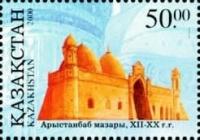
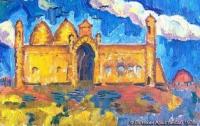
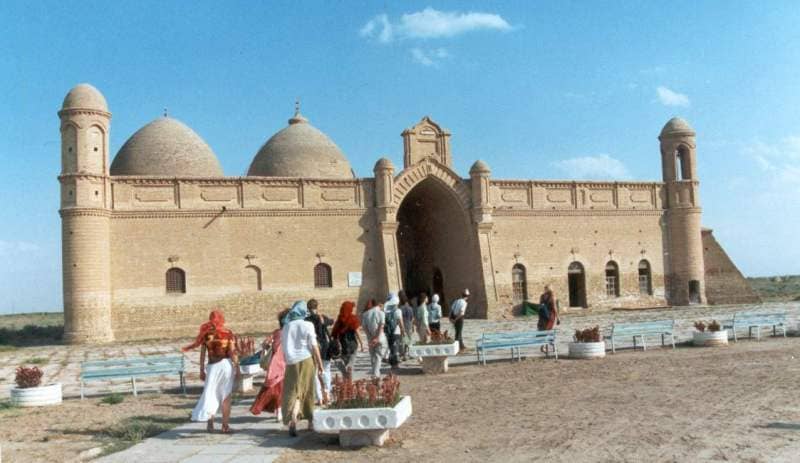
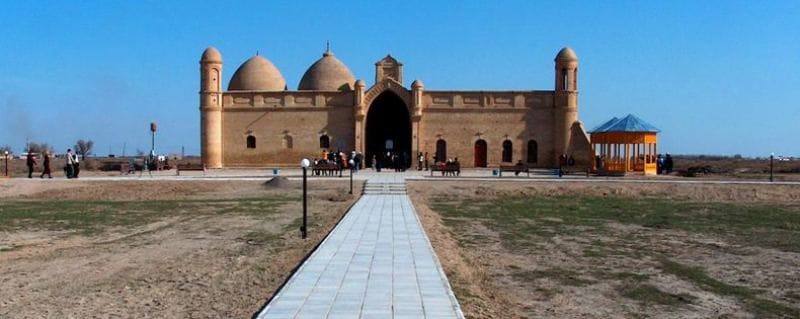
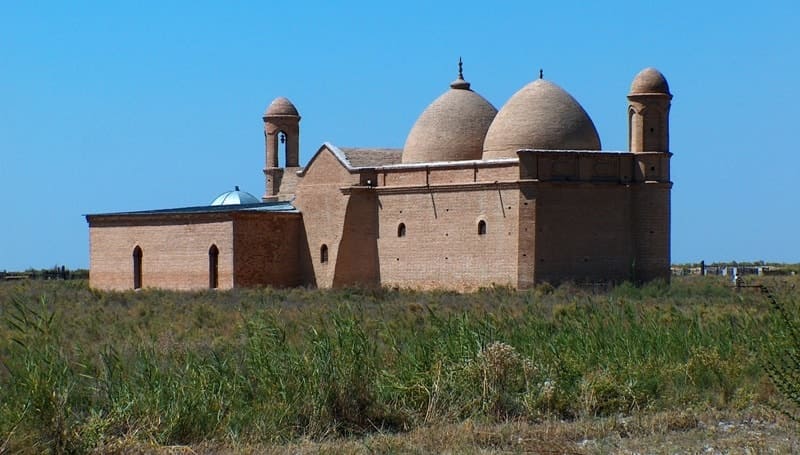
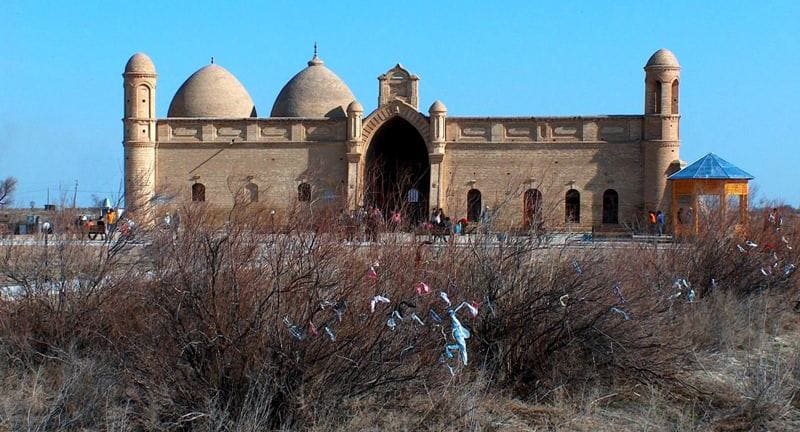
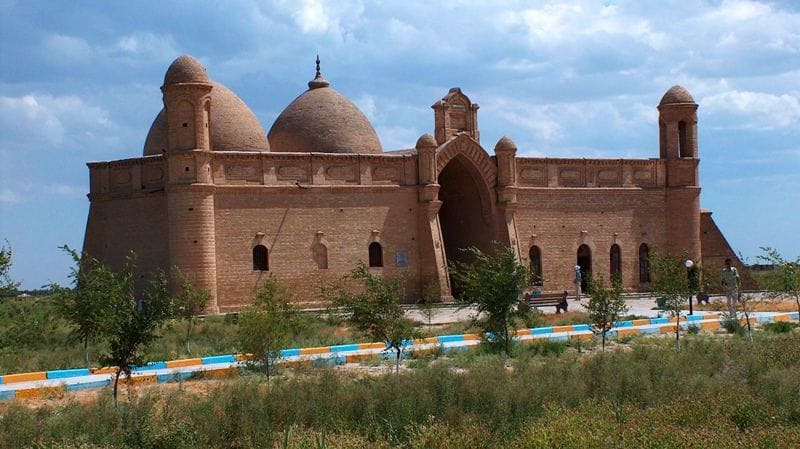
Arystan-Bab Mausoleum-Mosque.
Tours to Arystan bab mausoleum-Mosque.
"Spend the night at Arystan-Bab's, but make your plea to Khoja Ahmed Yasawi."
"When I turned seven, Arystan-Bab found me;
Having examined all my secrets, he folded them away again.
Praise be to Allah - I saw, spoke of, and cherished the path I walked.
At sixty-three, I descended into the earth.
The Angel of Death received the soul of Arslan-Bab,
And the maidens of Paradise fashioned a shroud for him from the softest velvet.
Seventy thousand angels instantly descended.
At sixty-three, I descended into the earth.
Amidst funeral prayers, he was raised from the grave,
And in a single instant, borne to Paradise.
His soul was carried to the heavens."
«Hikmets» (Wisdoms) of Khoja Ahmed Yasawi.
Cultural Journey from Turkestan to Arystan-Bab mausoleum-Mosque.
Arystan-Bab Mausoleum-Mosque is situated at an elevation of 194 m. a. s. l., It lies 5.3 km from the right bank of the Syr Darya River; 2.8 km north-northwest of the village of Kogam; 2.8 km west of the ancient settlement of Otrar; 11.8 km northeast of the village of Shaulder; and 49.3 km south of the city of Turkistan, within the Otrar District of the Turkistan Region.
Not far from the ancient settlement of Otrar, amidst the arid plains of the Middle Syr Darya, stands one of Southern Kazakhstan's most revered Muslim monuments: the Arystan-Bab Mausoleum-Mosque (Kazakh: “Arystan Baba kesenesi”). The monument is classified as an architectural site of national significance and has been under state protection since 1982.
The sanctity of this site is linked primarily to the name of Arystan-Bab - a legendary Muslim preacher and mystic whom tradition identifies as the teacher and spiritual mentor of Khoja Ahmed Yasawi, one of the Turkic world's most revered spiritual figures.
It was precisely its proximity to Otrar - an ancient center of culture and trade in Central Asia - combined with Arystan-Bab’s special place in spiritual tradition, that established this mausoleum-mosque as a vital pilgrimage site for Central Asian Muslims.
Arystan-Bab: A Saint of Legend.
Historical information regarding Arystan-Bab is extremely scarce; his image has come down to us primarily through religious tradition and numerous folk legends. According to tradition, he lived in the XIIth century and was among the first preachers of Islam in Southern Kazakhstan.
Tradition links him to Khoja Ahmed Yasawi, identifying him as the mentor to the future great Sufi master. Folk tales attribute extraordinary longevity to Arystan-Bab; some legends speak of a lifespan of three hundred years, while others extend this figure to six or even nine hundred years.
This remarkable longevity is attributed to the fact that, for a long time, Arystan-Bab was allegedly unable to pass on his “amanat” - a sacred spiritual trust or mandate - to a worthy successor. The legend concerning the transfer of this “amanat” to Khoja Ahmed Yasawi holds a particularly significant place.
According to a widely known legend, Arystan-Bab passed on the sacred "amanat" to him in the form of a persimmon pit. This story subsequently became a cornerstone of the legends surrounding the spiritual lineage connecting Arystan-Bab and Ahmed Yasawi.
Consequently, the pilgrimage tradition links two of Southern Kazakhstan’s most important holy sites: the Arystan-Bab Mausoleum near Otrar and the Khoja Ahmed Yasawi Mausoleum in Turkistan. Visiting Arystan-Bab’s tomb before continuing the journey to Turkistan was seen as a mark of respect for Yasawi’s spiritual mentor.
A well-known legend involving Timur is also associated with Arystan-Bab. According to tradition, before embarking on the construction of the magnificent Khoja Ahmed Yasawi Mausoleum in Turkistan, Timur had to restore the shrine over Arystan-Bab’s tomb.
While the historical accuracy of this story has not been proven, it has become firmly embedded in local religious tradition.
Ancient history of Arystan-Bab Mausoleum.
Tradition dates the death and burial of Arystan-Bab to the XIIth century. However, no reliable architectural evidence remains of a XIIth-century structure over his grave. Modern researchers emphasize that the current monument is the result of repeated reconstructions carried out over several centuries.
The history of the mausoleum itself is closely tied to the fate of Otrar. Following the Mongol conquest and the city's destruction in the early XIIIth century, the surrounding area fell into deep decline. It is not known for certain what happened to Arystan-Bab’s original tomb during this period.
The next significant phase is associated with the XIVth and XVth centuries. According to tradition, after the old structure was destroyed, a new mausoleum was erected on the site by order of Timur. Researchers believe that a particularly valuable feature from this period has survived: a pair of carved wooden columns that originally stood by the “avian” (vaulted portico).
The building underwent further repeated reconstructions in later times. The architectural history of the monument also highlights the 18th century, when - following the destruction of the ancient structure, an event attributed to an earthquake - a two-domed building featuring an iwan was erected.
However, the modern scholarly reconstruction of the monument's history differs somewhat from the simplified "XIIth century-XIVth century – XVIIIth century - 1909" timeline. Architectural analysis indicates that the eastern section of the *gurkhana* was fully restored in the 1860s and 1870s, followed by further construction work in the early XXth century.
Reconstruction of Arystan-Bab mausoleum-mosque in 1971.
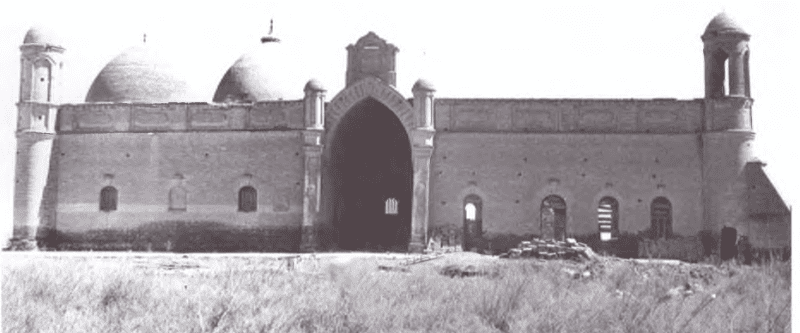
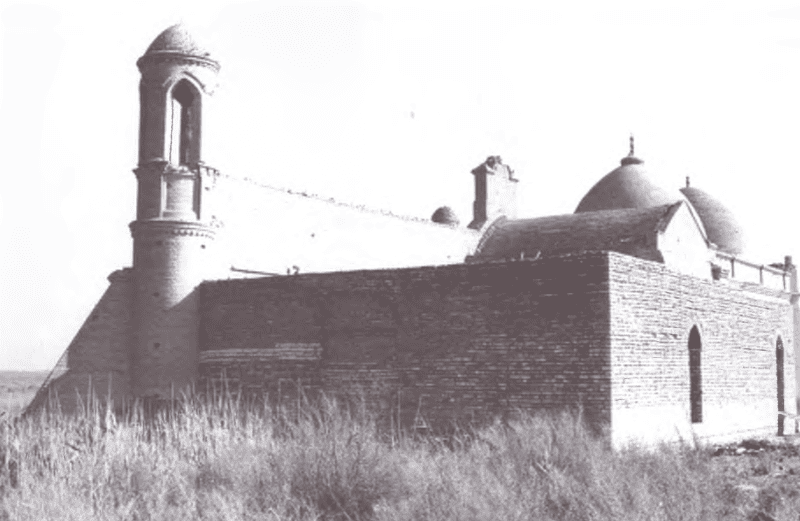
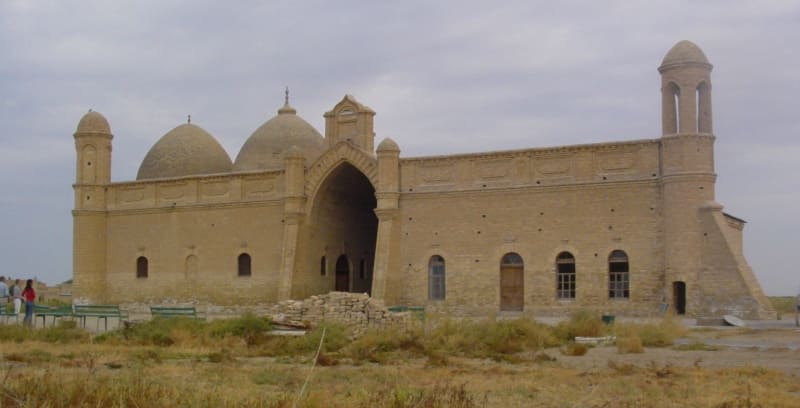
The last major stage of change in the complex was in 1971. Due to the high groundwater level, the mausoleum-mosque fell into disrepair. The old building was dismantled, after which the mosque was rebuilt. At the same time, the main historical facade was not destroyed: it was preserved, while the walls along the perimeter of the mosque’s foundation were restored from baked brick.
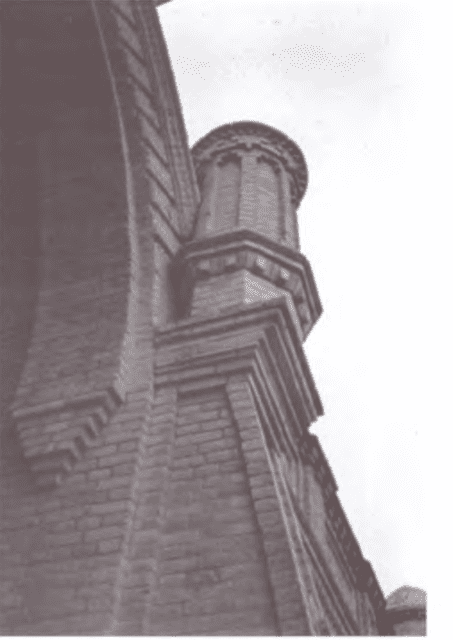
As a result, today the complex is a combination of architectural elements from different eras. It contains details associated with the 14th-XVth centuries, a part of the gurkhan restored in the XIXth century, and buildings from 1909-1911. and a mosque rebuilt in 1971.
It is this multi-layeredness that makes the mausoleum-mosque of Arystan Baba especially interesting not only as a place of pilgrimage, but also as a historical and architectural monument in which several stages in the development of the religious architecture of Southern Kazakhstan can be traced.
Memory of Arystan Baba.
The mausoleum-mosque houses the Koran, which tradition and museum descriptions associate with medieval calligraphic art. The tombstones of Arystan Bab and his students are also located here. The space of the complex itself is perceived not only as an architectural monument, but also as an active holy place.
The mausoleum-mosque is given special significance by its location next to Otrar. The ancient city, once one of the largest centers of Central Asia, today exists in the form of an archaeological site. Against this background, the Arystan Baba mausoleum is perceived as a kind of living thread connecting modernity with the spiritual and cultural history of the medieval Syrdarya.
The monument is included in the list of objects of historical and cultural heritage of republican significance; in the state list it dates back to the beginning of the XXth century.
Legend of the Green Bull, mausoleums of Ahmed Yasawi and Arstan Baba.
In the 90s of the XIVth century, the formidable conqueror Emir Timur, having crushed the Golden Horde, decided to perpetuate his greatness and strengthen Islam in the lands under his control. By his will, he ordered the construction of a grandiose mausoleum over the modest grave of the great Sufi poet and preacher Khoja Ahmed Yasawi.
The setting was the ancient city of Yasy, which the whole world would later recognize as Turkestan. The best architects of the empire, masters of baked bricks and carved majolica, were brought to the construction site. However, the daring plan of the Iron Lame ran into a mystical obstacle.
As soon as the builders completed the day's work and erected new rows of walls, a gigantic green bull appeared out of nowhere under the cover of darkness. With one blow of its powerful horns, the ferocious creature crushed fresh stonework that had not yet had time to harden, turning the work of hundreds of people into dust.
Terrible storms raged over the steppe, erasing traces of work, and not a single guard could stop the night obsession. Local sages and astrologers wondered in vain about the meaning of this sign, and the formidable ruler became furious. The solution came in a sacred dream.
The pious Sheikh Ahmed Yasawi himself appeared to the ruler. The holy spirit turned to Timur with words of reproach and wisdom, explaining that the architects were violating the unspoken spiritual order. The great Sufi bequeathed that before building a monastery for him, Timur must honor the memory of his great spiritual mentor and teacher - Arystan Baba, the legendary companion of the prophet, whose earthly life was cut short at the walls of ancient Otrar.
Timur heeded the heavenly advice. By his decree, the majestic mausoleum of Arystan Baba first grew in the Otrar oasis. Only after the debt of memory to the teacher was paid, the mysterious green bull disappeared forever, and the walls of the colossal Yasawi mausoleum in Yasy finally rushed unhindered to the heavens.
Since then and to this day, an unshakable rule has lived among pilgrims: the path to the shrines of Turkestan must begin with worship at the threshold of Arystan Baba.
Geographic coordinates of Arystan-Bab mausoleum-mosque: N42°51'05 E68°16'04
Authority:
Alexander Petrov.
Data used in the preparation of this material was drawn from:
B.A. Baitanaev and Yu.A. Yolgin, *Religious Architecture of Southern Kazakhstan...* (2013): Architectural and archaeological studies of Late Islamic monuments.
Published under the "Gylymi Kazyna" interdisciplinary program of the Science Committee of the Ministry of Education and Science of the Republic of Kazakhstan.
*Corpus of Monuments of the South Kazakhstan Region*: Architectural and archaeological heritage of the South Kazakhstan region. Produced under the "Cultural Heritage" regional program; edited by D.A. Taleev.
*Religious and Spiritual Monuments of Central Asia* by M. Khashimov. "Saga," 2001.
http://www.farsah.kz
Photos by:
Alexander Petrov.