




Вы здесь
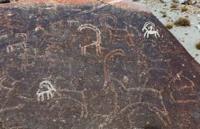
Cave painting of Bezegli-Dere.
Rock Art Tours in Turkmenistan.
"A mysterious dance of figures.
An arrow in its fatal flight.
What a picturesque picture
the rock has given to the centuries!"
Petr Korytko.
Archeology and Petroglyphs Turkmenistan.
Bezegli-dere petroglyphs are located at an altitude of 604 m. a. s. l., in the upper reaches of the Chukur Yurt gorge, on the northern slope of the Gulemya ridge, between the Sorva valley and the Altytogdan gorge, 9.4 kilometers from the right bank of the Chandyr River, 18.16 kilometers northwest of the village of Yarty-Kala (Keykodono), in the Karakala etrap in the Balkan velayat.
Petroglyphs in one of the gorges in the Chandyr River Valley, near Kizyl-Imam aul (village) were discovered in 1931 by Potseluyevskiy A.-P. in the course of field research led by the Turkmenkult Expedition in the Karakala district.
A special examination of petroglyphs was continued in 1946 by a group of members of the Institute of History, Language and Literature of the Turkmen Branch of the Academy of Sciences of the USSR in partnership with Professor Potseluyevskiy A.P. and Kurbanov A.
According to their findings, most petroglyphs were located under four overhangs, three of which are in the Kichi Bezegli-Dere Gorge (Turkmen for “small valley with ornaments”), the fourth one in Uly Bezegli-Dere (Turkmen for “large valley with ornaments”) (Potseluyevskiy 1975: 319-330).
In 2007, the site was studied by regional ethnographer Kuznetsov V.-I. who performed a photographic survey of the major surfaces of Bezegli-Dere petroglyphs. In 2009, survey and documenting (photographs and descriptions) of petroglyphs at Kichi Bezegl-Dere and Uly Bezegli Dere were carried out by archeologist Muradova E.A. (National Department of Turkmenistan for Protection, Study and Restoration of Historical and Cultural Sites at the Ministry of Culture of Turkmenistan).
Description of the Site Kichi Bezegli-Dere and Uly Bezegli-Dere petroglyphs are located on canyon cliffs of the Chandyr River at a distance of 1.5-2km from each other. Water and modest vegetation appear only in the spring flood period and last until the onset of summer heat.
Kichi Bezegli-Dere and Uly Bezegli-Dere petroglyphs occupy mostly vertical cliff faces both open and with overhangs; petroglyphs are also found on individual boulders. The common substrate is aragonite; its surface is fragile and easily destroyed.
Groups I-III feature a total of 45 surfaces with 133 petroglyphs. The sizes of the surfaces with drawings vary: from 25х20cm to 150x140cm. Two sites stand out in Uly Bezegli-Dere: groups I and II with 30 surfaces and 164 documented drawings.
The main concentration of drawings on one cliff face is nominally divided into several surfaces with temporally differing and diverse drawings. There are also drawings on the other side of the cliff and on boulders. All drawings at Bezegli-Dere are apparently made with a mineral paint (ochre) with different colors and shades: orange, maroon, maroon and purple, bright maroon, dark maroon, red, bright red, dark red, carnelian, dark brown and black.
Temporally different drawings differ in color and shape and in their degree of preservation. Outline and contour drawings are found in both locations. On average, 20cm high drawings prevail. It is important to mention the presence of palimpsests.
Schematic drawing or lack of detailed depiction of figures is intrinsic to the artistic execution of paintings at Bezegli-Dere. Repertoire Motifs are simple and show humans, animals and signs. There are isolated images of livestock: goats, horses, camels.
Goats are shown in a static position with massive bow-shaped horns and a tail pointing upwards. There are no pictures of wild horses; the horses depicted at Bezegli-Dere were used for riding. On some of them, one can see saddles as in Uly Bezegli-Dere in a scene of horse “racing”.
Both locations feature pictographs of dromedaries. The main motifs of rock paintings at Kichi Bezegli-Dere include hunting or cattle farming scenes. The rock art compositions at Uly Bezegli-Dere are of a mainly narrative nature: pasture, riders, camel caravan, hunting scene, horse races, plowing scene (?) and others.
A painting (on plane 5) of a man hunting wild goat with a primitive rifle on a bipod (multuk) is of interest. Dating It is now difficult to determine the ethno-cultural identity and age of the Bezegli-Dere drawings. Modern Turkmen (Goklens) in the Chandyr Valley relate the paintings to the traditional legends of the Gereyli tribe.
An ancient graveyard located near aul Gyzyl-Imam is called Gereyli. A vertically positioned sepulchral stone and an old Cyrillic - letter-shaped stelae in this cemetery are similar to “Kurgan stelae” or balbals (stone idols). “The latter are historically associated with Orkhon Turks who came onto the historical arena in the VIth century, while written sources provide evidence that these stone idols were erected until the XIIIth century inclusively among other Turkic peoples as well” (Masson 1949: 51- 52).
According to Karpov G.I., a well-known expert on Turkmen antiquity, the Gereyli tribe that had come from Afghanistan was driven away from the Chandyr Valley by Turkmens-Goklens in the XVIIth century. Most Gereylis resettled in Iran where their descendants still live in Khorasan and other provinces.
Others assimilated and merged with some other Turkmen tribes, mainly Goklens (tribal group Karnas in the Gayyi sub-tribe) and Ersari (in the Gunyash sub-tribe). There is also a group of Gereyli who live on Cheleken Island among Iomuds and identify with them (Karpov 1941: 23).
The presence of dromedaries in the repertoire of the Chandyr Valley cave paintings dates these compositions to after the conquest by Arabs, although there are known discoveries of dromedary bones in Turkmenistan that go back to the Parthian period (Igdy-Kala).
Finally, a depiction of a rifle on a bipod in Uly Bezegli-Dere suggests that some paintings were made no earlier than the 16th century. The presence of palimpsests is indicative of the longevity of drawings, the latest of which were made in the XVIIIth - XIXth centuries.
According to “The Law of Turkmenistan on the Protection of Historical and Cultural Sites of Turkmenistan”, Bezegli-Dere was registered on 19 February 1992 and protected by the State Historical and Cultural Sanctuary “Drevniy Dehistan” (“Ancient Dehistan”).
There is no status monitoring system. Since the site is located in the border zone of Turkmenistan, the Bezegli-Dere pictographs are inaccessible to tourists. Current Status of the Site The main threats to the Bezegli-Dere pictographs are from natural factors of destruction: many cliff faces are exposed to breaking up and wind erosion; the surface crust is spalling.
Geographic coordinates of Bezegli-dere petroglyphs are: N38°13'30 E56°01'16
Authority:
Edjegul Muradova.
Photos by:
Alexander Petrov.