




Вы здесь
Cascade of Sibinsky lakes.
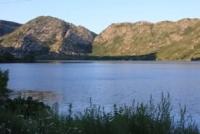
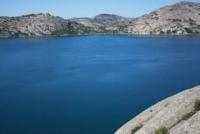
Walk on Sibinskiye lakes.
"Dusk. Evening. Mountains in the spring.
Rocks washed with fresh dew.
In the moonlight flowing dress nature -
Like a beauty under a veil"
Saken Seyfullin. "In spring." 1919. Translation by V. Vinogradov.
Sights of nature of East Kazakhstan.
Unique, largest mountain group of freshwater lakes, Sibinsky Lakes, are located at an altitude of 714.3 meters (westernmost lake, Sadyrkol) to 866 meters (easternmost lake, Karakol) above sea level. They are located in southern part of Koktau mountain range, north of central part of Kalbinsky Range, 18.5 kilometers southeast of village of Bazanbai, 28.3 kilometers southwest of village of Asubulak, and 57.3 kilometers (as crow flies) south and slightly east of city of Ust-Kamenogorsk in southwestern part of Ulansky District of East Kazakhstan Region.
Sibinsky Lakes are granite pearls of eastern Kazakhstan.
Koktau Massif is a whimsical interweaving of cliffs framed by five small lakes. The Sibinsky Lakes are also known as the Ablaikit Lakes. The cascade of lakes (from north to southeast, in order): Sadyrkol, Tortkara, Shalkar, Korzhinkol, and Karakol.
The lakes are enclosed by a high, hilly ridge to the east, north, and west. The western slope is covered with dense grass and shrub vegetation, and then, gradually descending to the lakeside trees and shrubs, a vast mountain steppe meadow extends.
The bodies of water are split by a huge geological fault. An unknown current, flowing into the Sibinka River, is present in all the lakes. The total area of the five lakes is 31 square kilometers. The Sibinsky Lakes are located 85 kilometers (by road) from the city of Ust-Kamenogorsk, a two-hour drive on paved roads.
The route to the lakes is adorned with a picturesque landscape of granite mountain ranges. The lake basins, enclosed on three sides, open to the southeast, where they are slightly dammed by the slopes of the Ablaikit graben and separated by narrow ridges.
The lakes range in depth from 2.5 to 38 meters. They store over 80 million cubic meters of ultra-fresh water. An unnamed stream flows through all the lakes; they are fed by groundwater, spring snowmelt, and small river runoff. The erosion and structural features of the granite present in this area attract tourists to explore the bizarre mountain slopes that adorn the basins around the entire circumference.
There are plans to establish a national park in this area.
Physical and geographical description of Sibinsky Lakes group.
The Sibinsky Lakes, also known as the Ablaikit or Zhamantas Lakes, are a unique natural complex of five freshwater bodies hidden among the rugged granite ridges of Eastern Kazakhstan. They are located in the southern part of the Kalbinsky Range, 55.3 kilometers southwest of the city of Serebryansk (Altai District, East Kazakhstan Region), and constitute one of the most picturesque and unique corners of the Altai region.
Location and composition of Sibinsky Lakes group.
Sibinsky lake system comprises five lakes, stretching in a chain from northwest to southeast for 6.9 kilometers:
- Sadyr Kol (Russian: "Muddy, Silty Lake"), the first lake, located at an altitude of 714.3 meters above sea level;
- Tortkara (Russian: "Four Black Lakes"), the second lake, located at an altitude of 768.7 meters above sea level;
- Shalkar (Russian: "Wide, vast lake"), the third lake, located at an altitude of 825.3 meters above sea level.
- Korzhynkol (Russian: "Lake Korzhyn" (a common Turkic saddlebag)) is the fourth lake, located at an altitude of 825.3 meters above sea level.
- Karakol (Russian: "Black lake") is the fifth lake, located at an altitude of 866 meters above sea level.
Elevations range from 714.3 meters above sea level (the westernmost lake, Sadyrkol) to 866 meters above sea level (the easternmost lake, Karakol). All lakes are of tectonic origin: their basins are formed among faults and fissures in the granite massifs of Kalba.
Topography and shores of Sibinsky lakes.
The topography of the lakes is sharply dissected and rocky. Stone walls, dome-shaped outliers, and smooth granite fields rise around the lakes, creating the impression of ancient fortresses. The shores are predominantly rocky, with some areas featuring wide sandy beaches.
The lakes are connected by channels that appear only during flood periods. During normal times, the bodies of water appear as independent basins.
Hydological Balance of Sibinsky Lakes.
The lakes exist because the influx of water (primarily from precipitation and snowmelt) exceeds its loss due to evaporation and filtration. Thus, the lakes are basins located directly on or among cliffs, which explains their clear water and unique, sometimes steep, shores.
The water is fresh, amazingly clear, with a bluish-green tint. Depths vary from 8 to 12 meters, reaching 30 meters in the central parts. The lakes are fed primarily by springs and rain. Complete freezing occurs in late October, with ice breakup in April.
Geology and Origin of Sibinsky Lakes.
The Sibinsky Lakes are a unique natural complex in the East Kazakhstan region, surrounded by picturesque granite mountain ranges. Their origin and geology are closely linked to the formation processes of these ancient rocky landscapes. The Kalbinsky Range is part of an ancient structure - the Paleozoic Altai fold belt.
The Sibinsky Lakes lie among massifs of pink-gray biotite granites, which are over 300 - 350 million years old.
Geological Foundation of Sibinsky Lakes.
The area where the lakes are located is formed by the Sibinsky granite massif. Granite is an igneous rock that forms as a result of the slow cooling of magma at great depth. These massifs are very ancient and highly durable. Essentially, the Sibinsky Lakes are giant granite basins filled with the purest water.
A distinctive feature of the area is the presence of smooth rock surfaces, which in places resemble sea boulders or ice-licked domes. This is the result of millennia of weathering and erosion.
Origin of Sibinsky Lakes.
The Sibinsky Lakes (Sadyrkol, Tortkara, Shalkar, Korzhynkol, and Karakol) are most likely of tectonic or erosional-tectonic origin:
Formation of the basins:
The lake basins were formed as a result of ancient tectonic processes - crustal movements that led to the formation of faults, cracks, and depressions in the solid granite massif.
Erosion and weathering:
- long-term erosion,
- frost cracking,
- tectonic movements,
- deep depressions formed in the granite blocks, which became lake basins.
Over millions of years, water, wind, and glaciers (during ice ages) actively eroded the weaker sections of granite, deepening existing depressions and creating a characteristic topography. Water filled these natural "bowls" and depressions.
Geological Features.
Garnet and Minerals:
The Sibinsky Lakes area is home to pegmatite veins containing various rare minerals, including red garnet (almandine), making it an interesting geological tourism destination.
Unique Landscape:
The combination of smooth granite cliffs covered with sparse vegetation and deep bodies of water creates a unique landscape that contrasts sharply with the surrounding steppe and mountain regions.
Flora of Sibinsky Lakes.
The lakes are located in a low-lying mountainous area: low mountains composed of granite, from which sparse pine and fescue trees, mountain grasses, shrubs, and colorful meadow grasses grow on the chestnut soils of the mountains. Depressions surround the lakes on three sides, opening up views from the southeast onto the rising slopes of the Ablaikit Mountains, covered in a blanket of diverse grasses.
The depressions around the lakes can be classified by their narrowness, sharpness, and sometimes low growth, almost devoid of vegetation. Occasionally, there are ruined springs, where common weeds and rare plant species grow: sedge (Carex L), oats (Gramineae juss), pondweed (Potamogenon L), duckweed (Lemna L), (Callitriche L), Vallisneria (Va llisneria L), cotton grass (Eriophorum L), lichen (Bryophyta), and many others.
Aquatic vegetation is represented by over 30 species, some of which are included in the assemblage of wetland relict plants. These include: pondweed (Potamogeton pectinatis), perforated-leaved (Potamogeton obtusifolis) and bright (Potamogeton lucens L), sea naiad (Najas marina), bladderwort (Utricularis L), duckweed (Lemna minor L) and ternate (Lemnf trisulca L), yellow water lily (Nuphar luteum), (Sparganium L), archer (Sagittaria L), bird's knotweed (Poligonum amphibium), etc.
Rare herbs include the four-cornered water lily (Nymphaea tetragona), which is on the verge of extinction, if previously they grew on all five lakes, now it can be found only on two lakes. The emerging plants of these lakes include rush (Scirpus lacustris), common reed (Phragmites cjmmunis), broadleaf and narrow-leaved cattail (Typha katifolia L.), (Typha angustifolia L.), sedge (Carex L.), and oat grass (Gramineae juss).
In addition, various types of algae are widespread in the lakes, including filamentous algae, diatoms (Diatomophyta), and green algae (Chlorophyta). The lake bottoms are primarily covered with charophytes. All these factors create a nutrient base for aquatic birds and fish.
The flora of the adjacent area consists primarily of plants native to arid regions and arid soils, so-called xerophytes. A large variety of oat crops can be found here: feather grass (Stipa capillata), common bluegrass (Poa trivialis), timothy grass (Phleum phleoides), and sedge (Carex supina).
Varieties include burnet (Sanguisorba officinalis), scabiosa (Scabiosa ochraleuca L.), (Sossurea amara), yarrow (Achillea milifolium), echinops (Echinops ritro L.), plantain (Plantago major) and lanceolate plantain (Plantago lanceolata), and geranium (Geranium albiflorium).
Rose bushes are also found here. Health centers and private cottages have been built near all accessible lakeside areas. The northern coast is very picturesque and dotted with numerous beaches accessible only by swimming or descending from the mountains.
This route is very popular with tourists. According to unwritten laws, tourists maintain order in the area.
Climate of Sibinsky Lakes.
The climate around the lakes is sharply continental. Average annual precipitation is 300 mm, of which 150 mm falls in July and August. Average wind speed in the lake area is 2-3 m/s, and the sunshine period is 2,500-2,600 hours per day. The average temperature in January is -16°C, and in July, +19°C.
The warm season lasts 210 days. A valuable health benefit lies in the vast water area (the lakes occupy 6.8% of the territory). The maximum temperature in summer is +35°C, and in winter -55°C. These climate characteristics, combined with granite mountains adorned with pine trees and colorful steppe grasses overhanging crystal-clear lakes, have earned these places the popularity and made them a favorite summer destination for tourists.
Fauna of Sibinsky Lakes.
The lakes are home to roach, Siberian dace, pike, tench, and carp. Ducks nest here, and muskrats are also found. Sadyrkol and Tortkara are home to the water lily (Nymphaea tetragona). The lakes lie in the southern part of the Koktau intrusive massif.
The Ablaikitsky Lakes are located on radial faults that dissect the Koktau massif. The average annual water level fluctuations in the lakes reach 0.5 meters. The lakes are home to roach, Sibinskie dace, pike, tench, and carp. Ducks nest here, and muskrats are also found here.
Aquatic vegetation is represented by over 30 species, some of which are included in the complex of wetland relict plants.
Legends of Sibinsky Lakes.
The Sibinsky Lakes are shrouded in numerous legends and myths, passed down orally and adding an air of mystery and magic to this picturesque place.
Legend of Monster in Sibinsky Lakes.
One of the oldest and most widespread legends claims that a huge and terrifying water monster inhabited the lakes (which, according to legend, are connected by underground channels). The ancient tribes who lived in caves around the lakes many centuries ago were afraid to fish or go near the water, lest they anger the water lord.
Mothers told their children scary tales of a monster who dragged its victims to the bottom, never to be seen again. This legend may have originated from the great depth of Lake Shalkar (the deepest of the five) and its dark waters.
Legend of Ablai Khan's Treasure at Sibinsky Lakes.
The Sibinsky Lakes are also known as the Ablaikit Lakes, which derives from the name of the ancient Buddhist monastery-fortress of Ablaikit (Ablaikit), the ruins of which are located 1.7 kilometers southeast of the original Lake Sadyrkol. According to legend, in the XVIIth century, when the Dzungars left these lands, they hid countless treasures in the surrounding mountains or at the bottom of one of the lakes.
The most coveted of these is considered to be a life-size golden statue of Buddha. This legend attracts divers and adventurers dreaming of finding the mythical treasure.
Trace of God's hand or a bear's paw on Sibinsky Lakes.
There is also a poetic legend that the five lakes are the imprint of the left foot of God, who stepped onto earth in this place. Other interpretations of this legend link the shape of the lakes to the imprint of a giant bear's paw.
Legend of origin of name "Sibinskie".
The name "Sibinskie" (from the Kazakh "sabyn," Kalmyk "sibyn," or Tatar "sapun" - meaning soap) also has its own explanation. Nomadic tribes stopped here to rest, bathe, and wash their clothes in the clear waters of the lakes and springs, hence the name, associated with purity and ablution.
Tourist information about visiting Sibinskie lakes.
Accessibility:
A good road leads to the lakes from Ust-Kamenogorsk or Ridder. The route typically passes through the village of Algabas (Tyuulikubay) or Targyn and then on to the lake of your choice. Infrastructure:
The first lake, Sadyrkol, is home to:
Recreation centers, cabins, boat and catamaran rentals, equipped beaches, and cafes.
Further on, tourist infrastructure is minimal. Lakes 2 to 5 offer a more untamed environment for camping and hiking.
Best time to visit:
June - pleasant water temperature.
July - August - the water warms up well for comfortable swimming, with warm nights and green pine forests.
September – warm autumn and golden forests.
What to see and do:
Climbing the granite domes – the views of the chain of lakes are stunning.
Kayaking and swimming (the water is cool but crystal clear).
Hiking trails between the lakes.
Photo: smooth rocks, bizarre granite shapes, clear waters.
Camping among the pine trees.
Winter hiking (for experienced hikers).
Helpful tips:
The water is cold even in summer: 16 - 20°C.
There is almost no signal at 3 - 5 lakes.
Warm during the day, but at night it can drop to 8 - 10°C, even in summer.
The rocks are slippery after rain - caution is essential.
Summary of results about Siberian lakes.
The Sibinsky Lakes are more than just bodies of water among granite. They are a world of pristine silence and majestic tranquility, where you can feel the breath of ancient mountains, the strength of granite walls, and the energy of pure water. Here, time seems to slow down, and space reveals its true voice - the voice of nature in Eastern Kazakhstan.
Geographic coordinates of Sibinsky Lakes are: N49°26'50 E82°37'42


Authority:
Alexander Petrov.
http://oskemen.info
Photos by:
Alexander Petrov.