



Вы здесь
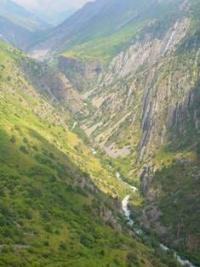
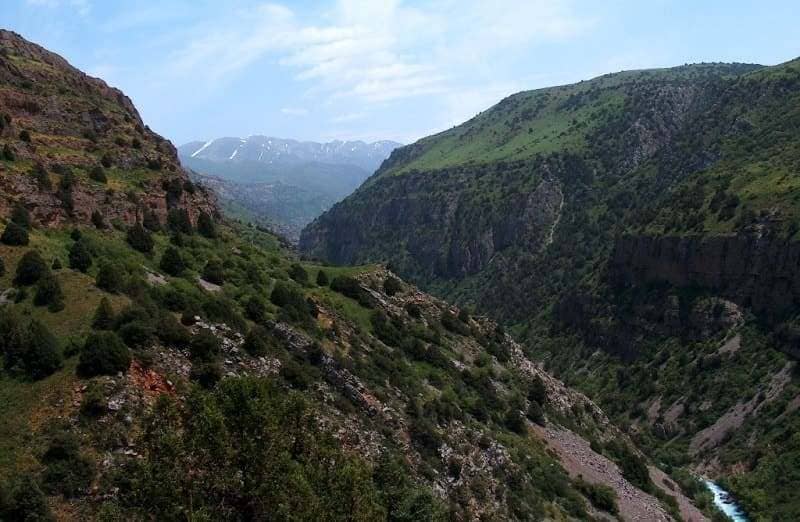
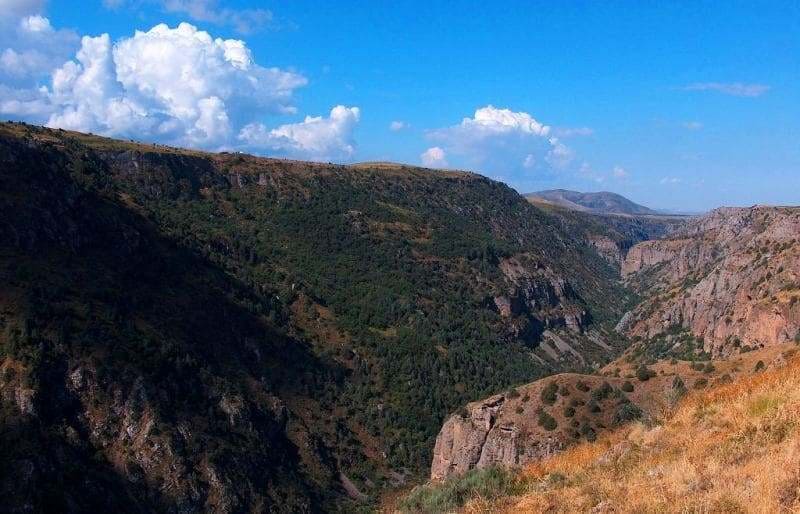
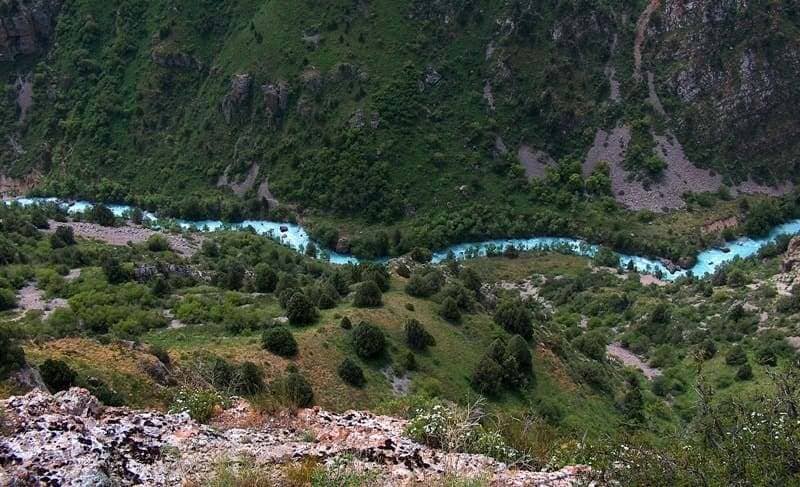
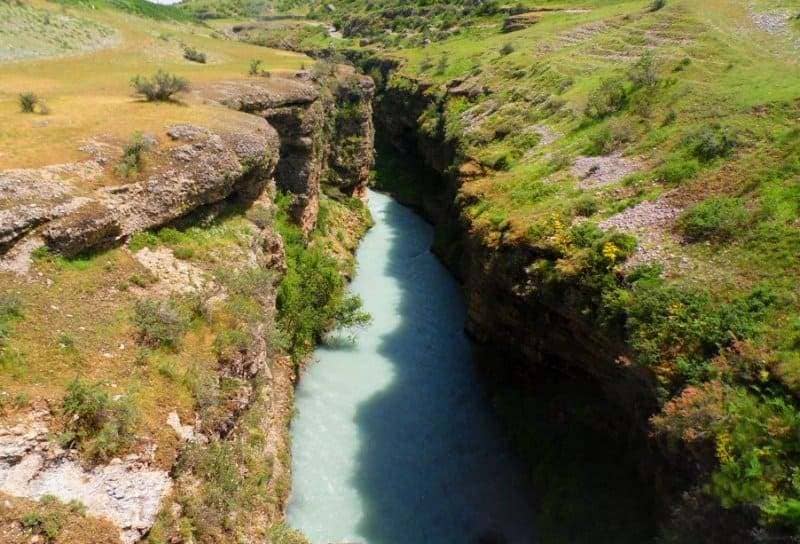
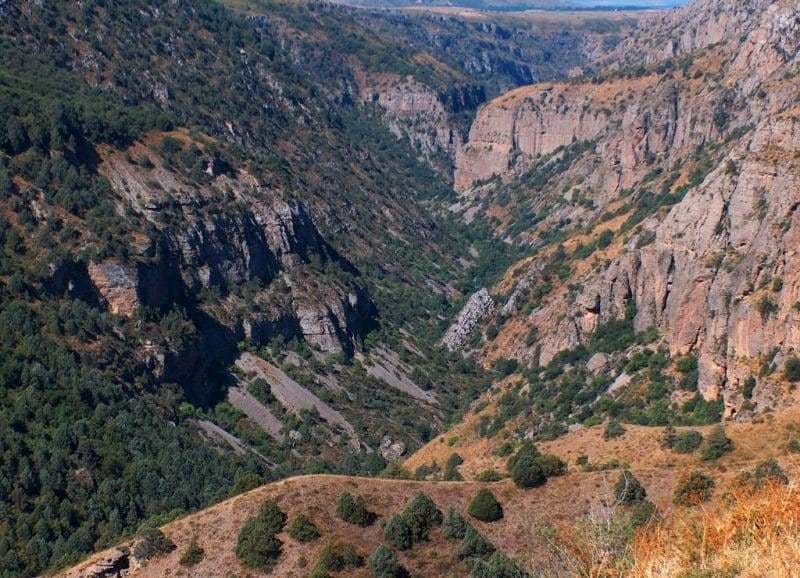
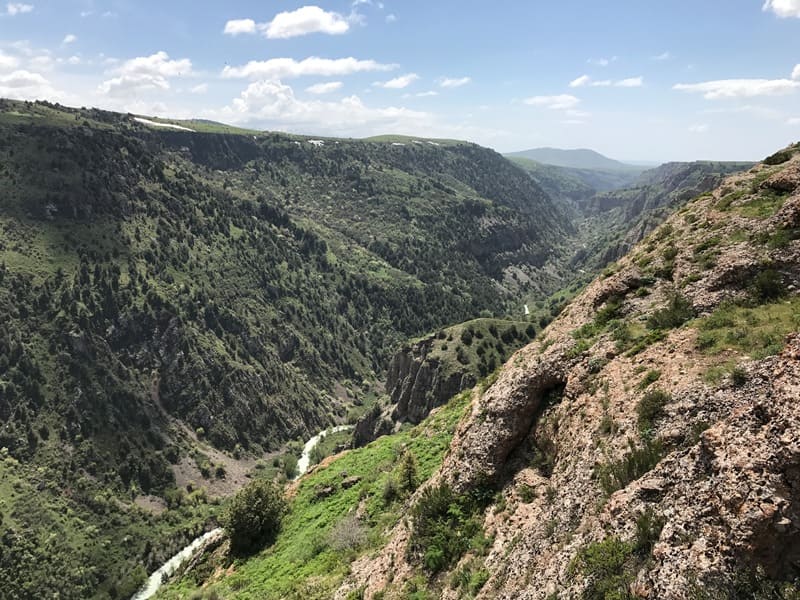
Aksu canyon in Aksu-Zhabagly.
Interesting places in reserve Aksu-Zhabagly.
"The waters of the Aksu furious and whitened by marble sand rush with a roar along the floor of the gorge. No one dares to ford them; the swift current has isolated massive conglomerate boulders from the banks, and the waves, obstructed by these giant stones, crowd around them. The canyon walls especially where they are steepest are often worn smooth and polished by the water, forming columns, while at their base lie niches and rounded hollows carved out by the current."
Soil scientist Sergey Semyonovich Neustruyev, «A Soil-Geographic Sketch of Chimkent Uyezd, Syr-Darya Oblast», from series «Transactions of Soil-Botanical Expeditions for Investigation of Colonization Regions in Asiatic Russia, Part 1: Soil Investigations» 1908.
Tours Aksu canyon Aksu-Zhabagly.
The Aksu River Canyon is situated at an elevation ranging from 1,500 to 922 m. a. s. l. It lies in the western part of the Alatau mountains bordered to the north by the Iirsu Plateau and the Mashat-Tau and Taskara mountains, and to the south by the Ugam Range within the Aksu-Zhabagly Nature Reserve, at the junction of the Tole Bi and Tyulkubas districts in the Turkistan Region.
The Aksu River Canyon is one of the most impressive natural landmarks in the Western Tien Shan. It spans an altitudinal range of approximately 1,500 to 922 m. a. s. l. It has a total length of approximately 37 kilometers. Within the nature reserve, a particularly striking section of the gorge forms a deep canyon, carved into a thick layer of conglomerate rock, stretching for about 30 kilometers.
Its stepped and in places, nearly vertical walls reach heights of up to 500 meters, while the distance between the upper rims is as little as 700-800 meters at its narrowest points. This ratio of width to depth creates the impression of a massive vertical fissure cutting through the mountain landscape.
Geological structure and formation of the canyon on the Aksai River within the Aksu-Zhabagly Nature Reserve.
The defining feature of the Aksu Canyon is the deep erosion that has cut into a substantial, thick layer of conglomerate. These rocks consist of cemented fragments of varying sizes ranging from small pebbles to large, rounded boulders bound together by a natural matrix.
The heterogeneity of the rock is clearly visible in the exposed sections: the individual fragments differ in size, color, and composition, and they possess varying degrees of resistance to erosion. The formation of such a deep gorge is the result of the river’s long-term activity; it gradually deepened its channel, eroding the rock and transporting away the debris.
This process occurred against a backdrop of regional tectonic uplift and shifts in the river network. Consequently, the river carved out a deep valley characterized by steep slopes and numerous ledges. The varying resistance of different conglomerate layers and sections has given the canyon walls a stepped appearance: more durable strata form protrusions and ledges, while less resistant material erodes and recedes more rapidly.
Processes of physical weathering, rockfall, and collapse continue to shape the slopes of the canyon. Temperature fluctuations, the wetting and subsequent drying of rock, and the impact of precipitation and wind gradually alter the contours of the canyon’s ledges.
Debris accumulates at the base and can subsequently be transported by water currents. Thus, the canyon is not a static landform, but a constantly evolving natural system. This deep gorge stands in stark contrast to the surrounding mountainous terrain.
Its upper edges form long, sheer cliffs, while the canyon floor lies far below, where the Aksu River winds through a landscape of rock and debris. From above, the contrast between the relatively level expanses of the watersheds and the sharply dissected walls of the canyon is particularly striking.
The Aksu River in the Aksu-Zhabagly Nature Reserve and its landscape features.
The Aksu River is one of the primary water arteries of the nature reserve. Over a significant stretch, its valley narrows, transforming into a deep, rocky gorge. Confined within a narrow channel, the water is in constant interaction with the surrounding rock eroding it and transporting the material away clastic material and carves out depressions in the riverbed.
Depending on the gradient, the width of the valley, and the nature of the bedrock, the current’s velocity can vary, creating stretches of rapid flow interspersed with calmer, deeper pools. The canyon’s topography is highly varied; in some places, the slopes rise as nearly vertical walls, while in others, they form a stepped landscape, alternating between rock outcrops, ledges, and scree slopes.
At certain points, the valley widens, only to narrow again, leaving the river hemmed in by steep slopes. Due to the significant depth of the gorge, its lower reaches receive less direct sunlight than the more exposed mountain slopes. This influences local moisture levels and temperature regimes.
The change in elevation also plays a crucial role: as one descends from the upper reaches to the lower sections, air temperature, duration of sunlight, moisture levels, and conditions for plant growth all shift. Consequently, natural communities typical of different altitudinal zones can be found in close proximity over a relatively short distance.
Furthermore, the steep slopes, rock ledges, and varying aspects (orientations) of the terrain create a multitude of microhabitats, each with its own unique set of environmental conditions.
Vegetation in the Aksu Canyon, located within the Aksu-Zhabagly Nature Reserve.
Juniper specifically the archa (tree-like juniper) plays a prominent role in the canyon’s natural landscape. Large archa trees can be found on the slopes, differing significantly from the low-growing, prostrate forms of juniper more commonly seen in the high mountains.
Some individual specimens reach impressive sizes, lending the slopes a distinct, wooded appearance. In his account of a visit to the canyon, the naturalist Pavel Marikovsky noted the presence of true giants among these tree-like junipers. He also cited data from botanists who studied the reserve’s vegetation: in the past, juniper forests covered much larger areas, extending beyond the canyon slopes to the surrounding hills and mountains.
Their range has since shrunk due to human economic activity. Nomadic pastoralism involved burning off vegetation to expand pastures, while settled populations used juniper for fuel and construction material. According to observations noted by Marikovsky, even a century or so after the most intense human pressure ceased, these natural communities have yet to return to their former state.
Marikovsky also noted the presence of Prangos a large, pinnate-leaved plant typical of the mountainous regions of Central Asia within the canyon’s vegetation. He further mentioned flowering mallows growing along the roadside. Such observations are significant not merely as descriptions of individual species; they illustrate the great diversity of the gorge’s flora and how strongly it depends on a complex interplay of altitude, light exposure, moisture levels, and the nature of the soil and rocky substrate.
Juniper forests are of great ecological importance. They contribute to the formation of mountain soils, retain moisture, reduce surface erosion, and provide a habitat for numerous plant and animal species. The restoration of these forests is a slow process, as juniper grows relatively gradually, and young plants are particularly vulnerable on steep, rocky slopes.
Wildlife and birds of the Aksu Canyon in the Aksu-Zhabagly Nature Reserve.
The canyon’s sheer rock faces, ledges, and crevices serve as shelters and nesting sites for many birds. In his account of a journey through the Aksu, Pavel Marikovsky described an encounter with a bearded vulture, which took flight from a nearby cliff upon the arrival of the group.
High above the gorge, a golden eagle soared, scanning for prey, while a large flock of young rosy starlings rose over the canyon. Among the other birds noted by the naturalist were a Himalayan vulture, a spotted nutcracker, a small crested tit, and a wallcreeper.
The latter is particularly interesting in the context of rocky landscapes: this bird is adapted for life on sheer cliff faces, where it moves nimbly across the stone in search of food. Its vibrant plumage stands out clearly against the backdrop of gray and brown rocks.
Marikovsky’s observations convey not only the diversity of species but also the unique atmosphere of the canyon. The calls of birds, the movement of large predators above the gorge, the flocks of starlings, and the small inhabitants of the juniper-covered slopes create the impression of a living, constantly changing natural environment.
Here, the rock faces are not lifeless precipices, but rather part of a complex ecosystem in which vegetation, wildlife, and the features of the terrain are closely interconnected. The Aksu-Zhabagly Nature Reserve, as a whole, is distinguished by its rich flora and fauna.
Its natural complexes encompass several altitudinal zones of the Western Tien-Shan, while the combination of mountain forests, meadows, cliffs, gorges, and river valleys provides a wide variety of habitats. The Aksu Canyon is one of the most striking examples of this natural diversity.
History of protection of Aksu Canyon area within Aksu-Zhabagly Nature Reserve.
The history of the canyon’s protection is directly linked to the establishment of the Aksu-Zhabagly Nature Reserve the oldest specially protected natural area in Kazakhstan and one of the first in Central Asia. The idea of creating a nature reserve in the upper reaches of the Aksu and Zhabagly rivers emerged in the early 1920s.
One of the initiators was the hydrobiologist Abram Leonidovich Brodsky, who drew attention to the exceptional natural wealth of this mountainous region. In the years that followed, the area was surveyed by scientists from the Central Asian State University, including botanists Mikhail Popov, Yevgeny Korovin, and Mikhail Kultiasov, soil scientist Nikolai Dimo, and zoologist Dmitry Kashkarov.
Their research confirmed the necessity of preserving the local natural complexes. On July 14, 1926, the Council of People's Commissars of the Kazakh ASSR adopted a resolution to establish the nature reserve. Initially, it covered an area of approximately 30,000 hectares.
The resolution specifically emphasized the need to preserve the Aksu and Zhabagly rivers, along with their woody vegetation, shrubs, herbaceous cover, and wildlife. In 1929, the Aksu River Canyon was also incorporated into the protected territory.
Subsequently, the boundaries of the nature reserve were expanded on several occasions. This was due to the need to include not just isolated sections of river valleys in the protected area, but entire natural complexes mountain forests, alpine meadows, river headwaters, and the adjacent slopes.
Today, the Aksu-Zhabagly Nature Reserve safeguards a significant portion of the natural heritage of the Western Tien Shan. The establishment of the reserve was crucial for preserving juniper forests and other natural communities that had long been subjected to the impacts of livestock grazing, vegetation burning, and timber harvesting.
The history of the canyon illustrates the deep interconnection between natural processes and human activity: while the landscape was shaped over geological epochs, its present-day appearance bears clear marks of human economic use.
Descending into the Aksu Canyon within the Aksu-Zhabagly Nature Reserve.
One of the points from which one can descend from the upper rim of the canyon toward the river is known as Sarlybayev Bridge. From here, a wide, well-trodden path leads downward. It serves as a livestock trail, used to drive flocks of sheep and goats into the canyon and down to the water.
Its width and compacted surface stand out clearly against the narrower footpaths. Such a trail serves as a reminder of how local communities have traditionally utilized these mountain pastures and river valleys. The waters of the Aksu are vital to the local economy, and the deep valley despite the inaccessibility of certain parts has long been a component of a mountain landscape shaped by human presence.
Descending into the canyon offers a different perspective on its true scale. From the upper rim, one primarily perceives the general contours of the gorge and the height of the opposing walls; once below, however, one begins to notice specific details: the structure of the slopes, exposed conglomerate rock, rocky ledges, and the character of the riverbed.
At the same time, the steepness of the slopes and the significant elevation changes require careful attention when navigating the route: travel conditions here are determined not only by the width of the trail but also by the state of the ground, the presence of rocks, and the weather.
The Aksu Canyon is more than just a striking gorge with towering cliffs. It is a complex natural ecosystem in which geological structure, river erosion, altitudinal zonation, juniper forests, and a rich variety of wildlife form an integrated whole. Preserving this environment has become a key objective for the Aksu-Zhabagly Nature Reserve, which now boasts a century-long history.
Pavel Marikovsky on the Aksu Canyon.
"The slopes are covered with large, tree-like junipers. In some places, these trees are true giants, and it seems remarkable that they have such low-growing, creeping, dwarf-like relatives. According to botanists who have studied the reserve’s vegetation, the canyon slopes as well as the surrounding hills and mountains were once entirely blanketed in juniper forests.
However, nomadic herders frequently burned down the forests to clear land for pastures, while settled populations the local population also used archa (juniper) for fuel and as a building material. About a hundred years have passed since then, yet nature has still not fully recovered its original appearanc on the canyon slopes, the lovely, feathery-leaved Prangos plant grows everywhere; the local inhabitants use an infusion of its leaves to treat scabies in their livestock. Along the road, elegant, flowering mallows have sprung up in neat rows startled by our arrival, a massive bird of prey a bearded vulture launches itself from a nearby crag. High in the sky, a golden eagle soars, scanning for prey. A vast flock of young rosy starlings takes flight over the canyon; their many-voiced chattering sounds much like the babble of a cheerful brook a sound that could easily deceive a weary traveler.
A Himalayan vulture glides smoothly above us, its shadow occasionally sweeping across our camp. From the top of a tall juniper tree comes a thin, whistling sound. Looking up, I spot the songster: a lively, cheerful little titmouse with a small crest.
Moments later, a spotted nutcracker lands on the top of a juniper near our bivouac. Suddenly, I catch sight of a wallcreeper a bird the size of a starling, with striking red-patterned wings one of the most graceful and colorful birds in our country.”
Pavel Marikovsky. In the Talas Alatau”. 1975.
Geographic coordinates of Aksu canyon: N42°19'38 E70°22'31
Authority and photos by:
Alexander Petrov.