




Вы здесь
Tillya-Kari madrasah.
Cognitive tours over Samarkand.
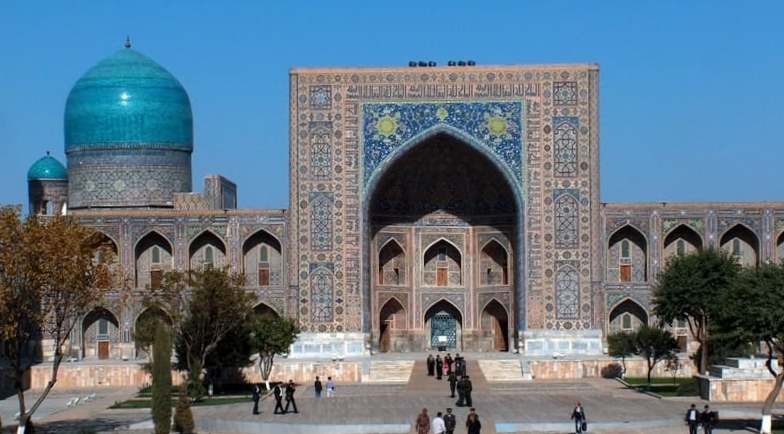
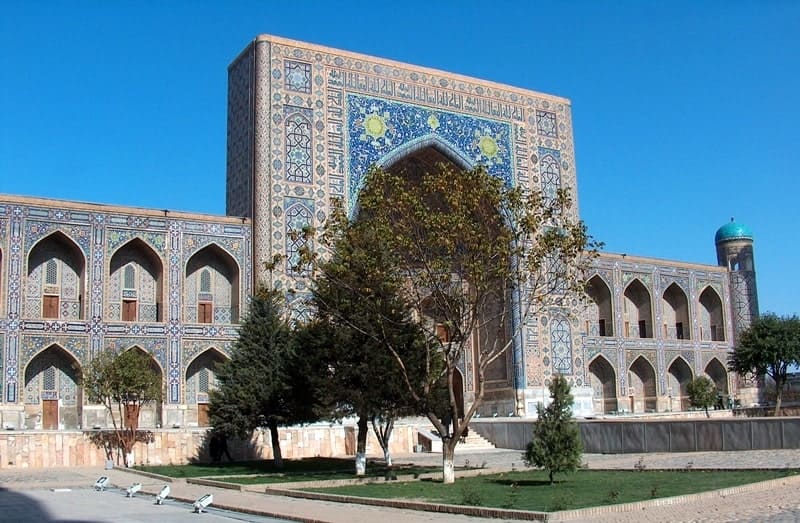
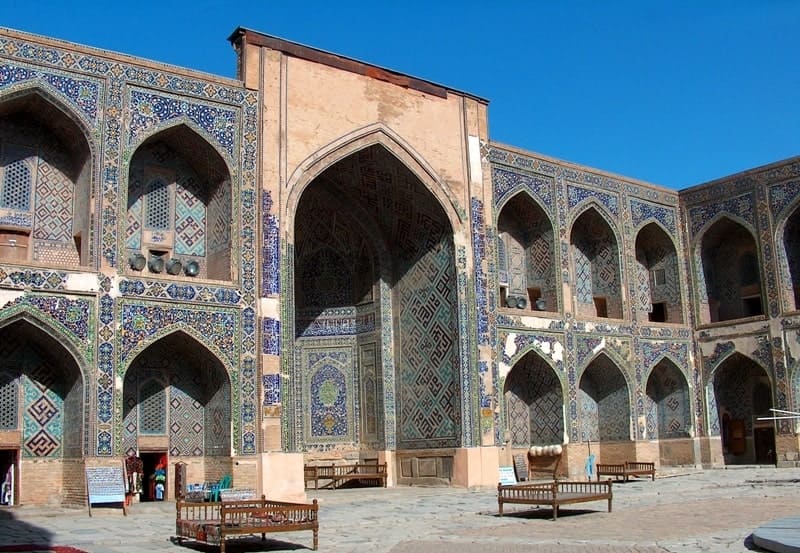
"A new approach to façade design became widespread in the 16th century in Bukhara during the construction of madrassas. The architect of the Tilla-Kari Madrasah adopted this Bukharan tradition and applied it with some modifications. The corner minarets on the front façade, designed as turrets topped with lanterns, are interesting. The courtyard lacks the sense of enclosure and isolation we noted in the Shir-Dor Madrasah. This is explained not only by the large size of the courtyard but also by the fact that the courtyard is surrounded on three sides by single-story buildings. Neighboring houses are visible beyond their walls, and street noise can easily be heard."
B. Weimarn. "Registan in Samarkand." 1946.
Travel advice in Samarkand.
Tillya-Kari Madrasah is located at an altitude of 716 m. a. s. l. on Zargaron Street, on north side of Registan Square, 25 meters north of Ulugh Beg Madrasah and Sher-Dor Madrasah in Samarkand.
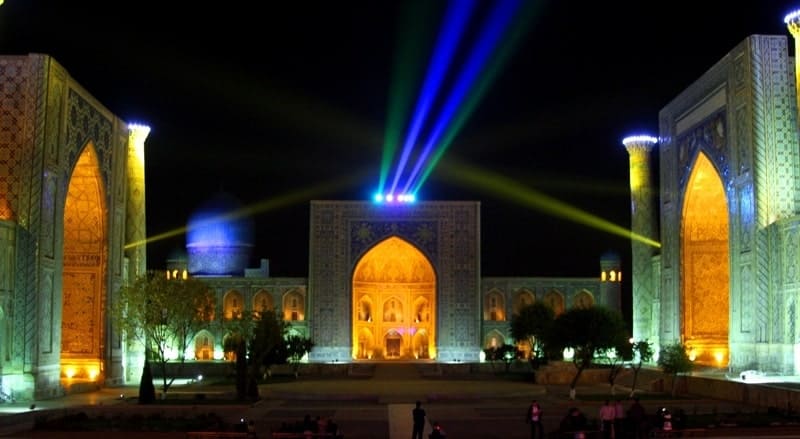
The Tillya-Kari Madrasah (Uzbek: Tillаkori madrasasi-Tillakori madrasasi - Gilded Madrasah) is a XVIIth-century religious, spiritual, and educational building in Samarkand on Registan Square. It is the most recent building on the square and, together with the Ulugh Beg Madrasah and the Sherdor Madrasah, forms a coherent architectural ensemble.
History of Tillya-Kari Madrasah.
By the mid-VXIIth century, the Bibi Khanum Cathedral Mosque lay in ruins, and a new, large mosque was needed in the center of Samarkand. Yalangtush-bey decided to build such a mosque on the Registan, where it would also serve as a madrassa.
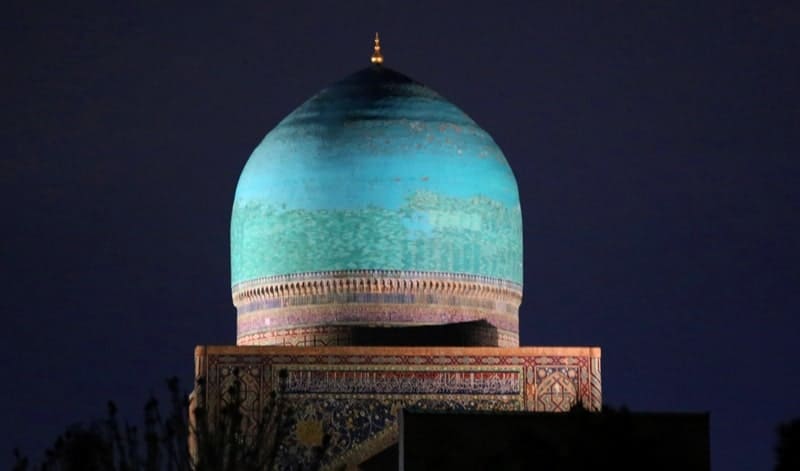
Construction of the Tillya-Kari Madrassa lasted almost twenty years and was completed only in 1660. The mosque's dome remained unfinished and was not erected until the XXth century; as recently as 1945, the dome was still missing. During the madrassa's restoration, the lost cladding was restored.
The Tillya-Kari Madrassa combined the functions of a madrassa and the city's cathedral mosque. Construction of the Tillya-Kari Madrasah began in 1646 by order of the appanage governor (khakim) of Samarkand, Yalangtush Bahadur, a descendant of the Uzbek Alchin clan, on the site of the XVth-century, now dilapidated, Mirzoi caravanserai, partially utilizing its foundations and walls.
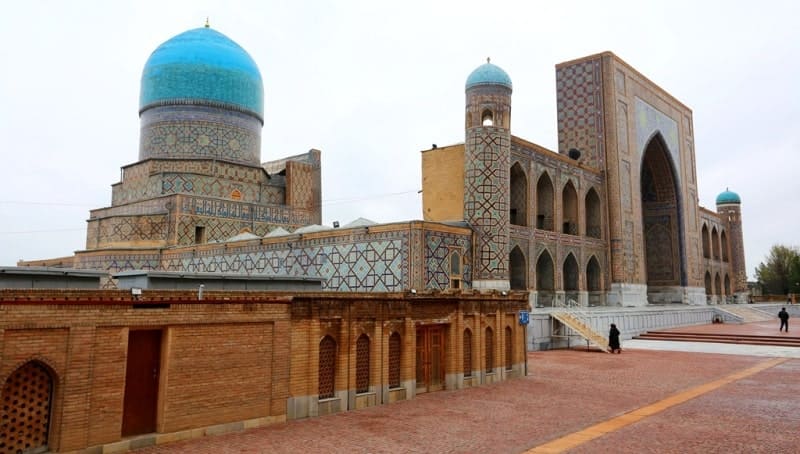
The building served as both a madrasah and the city's cathedral mosque. The mosque's multi-pillared gallery, with a high domed hall in the center, faces an arcade and portal onto a spacious courtyard surrounded by hujras. The outer dome on a cylindrical drum in the center of the mosque was unfinished; its blue skufia was added in modern times.
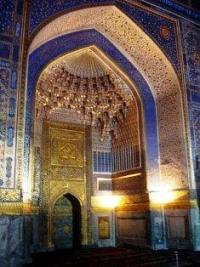
A tall marble minbar stands near the mihrab niche. By the time construction began, the Samarkand cathedral mosques (Bibi-Khanym and Alike Kukeltash) lay in ruins, and during the design process, it was decided to combine a higher theological school and a juma mosque within the madrasah building.
Construction and finishing work lasted 14 years and was completed in 1660, after the death of Yalangtush Bahadur. Perhaps for this reason, the decoration of some elements of the madrasah was noticeably careless, and the outer dome of the Tillya-Kari mosque was never completed.
The construction of the Tillya-Kari madrasah completed the design of Registan Square and gave the architectural ensemble located there a complete look. In the XXth century, the madrasah building was damaged by a strong earthquake (1817-1818). The entrance portal suffered particularly severe damage, with its upper portion collapsing along with the tympanum.
By order of Emir Haidar, the portal was restored, but without its tiled decoration. By the early XXth century, most of the madrasah's cladding had been lost. Restoration work began in the 1920s, when efforts were made to salvage the surviving fragments of decoration.
In the early 1930s, work was carried out to restore the cladding of the exterior facades. Between 1950 and 1958, the courtyard facades of the madrasah and the drum of the mosque's dome were restored. In the first half of the 1970s, the decoration of the tympanum of the main portal was restored, and a new dome was erected.
The mosque's outer dome. In 1979, restoration work on the mosque's interior paintings was completed. Currently, the Tillya-Kari Madrasah houses an exhibition of the Registan Square Restoration Museum.
Architecture of Tillya-Kari Madrasah.
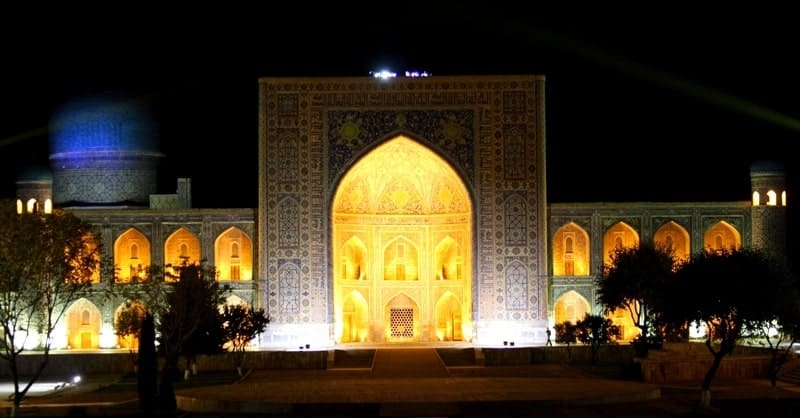
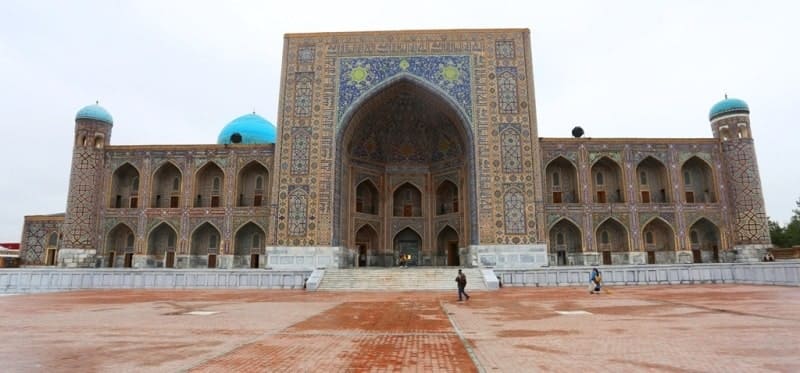
The Tillya-Kari Madrasah is located in the northern part of Registan Square and completes a south-facing architectural ensemble of three madrasahs. It is a square structure with a total area of 75 by 75 meters. The architect, clearly a member of the Bukhara school of architecture, did not blindly copy the proportions of the two other madrasahs located in the square, but solved the problem compositionally by extending the wings of the main façade, giving the square a closed appearance. The change in the proportions of the main façade had another consequence: while being the central element of the composition, the Tillya-Kari Madrasah does not appear so massive and does not draw undue attention to itself, serving as a backdrop to the two other, more monumental madrasahs.
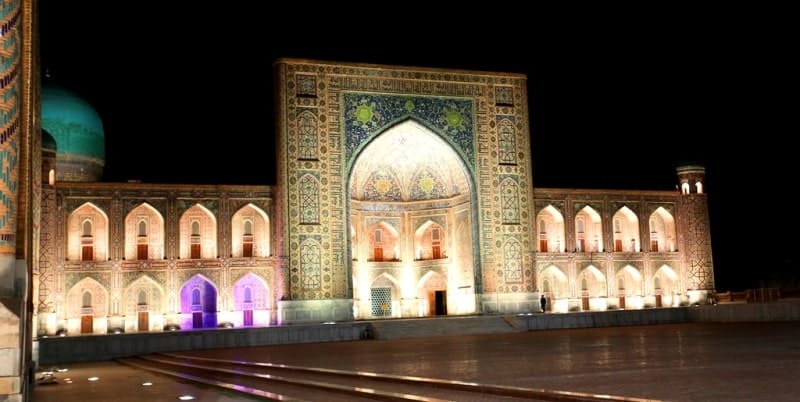
The madrasah's main façade is designed in the Bukhara style. It consists of a central portal and two-tiered frontal wings with arched niches overlooking a square with 16 khudjras (eight on each side and four per tier). The symmetry of the façade is emphasized by the corner guldasta towers, which can also serve as minarets.
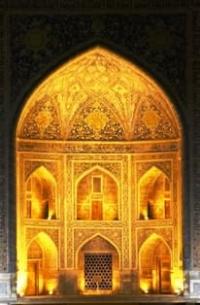
The main entrance portal is pierced by a deep pentagonal niche with three aisles. The spacious four-iwan courtyard is surrounded by khudjras, two stories high along the main façade and one story high along the remaining sides. On the western side of the courtyard stands the portal-domed building of the Tillya-Kari Mosque.
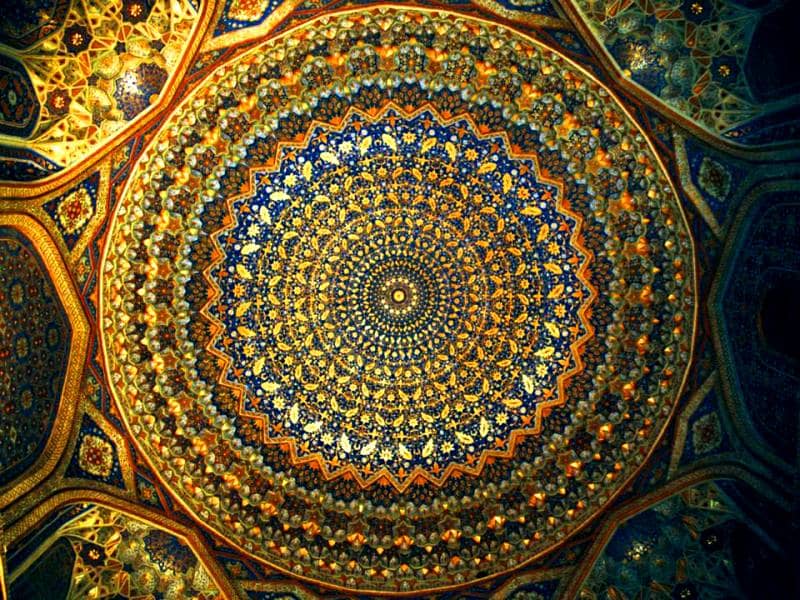
To maintain the courtyard's symmetry, additional courtyard portals were erected on its central axes. The mosque consists of three parts. In the center is a cruciform room covered by a double dome, housing a marble-clad mihrab and an eleven-tiered marble minbar.
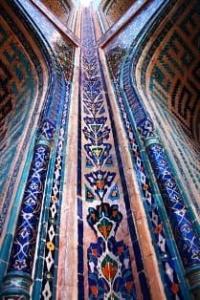
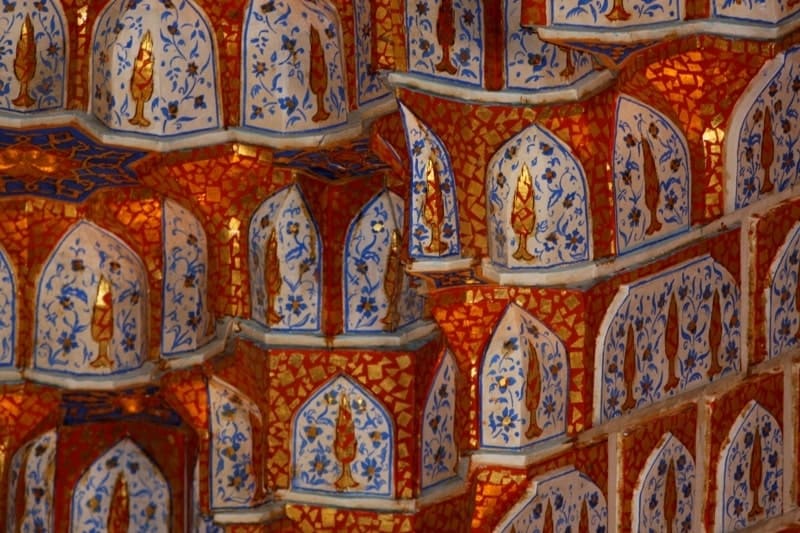
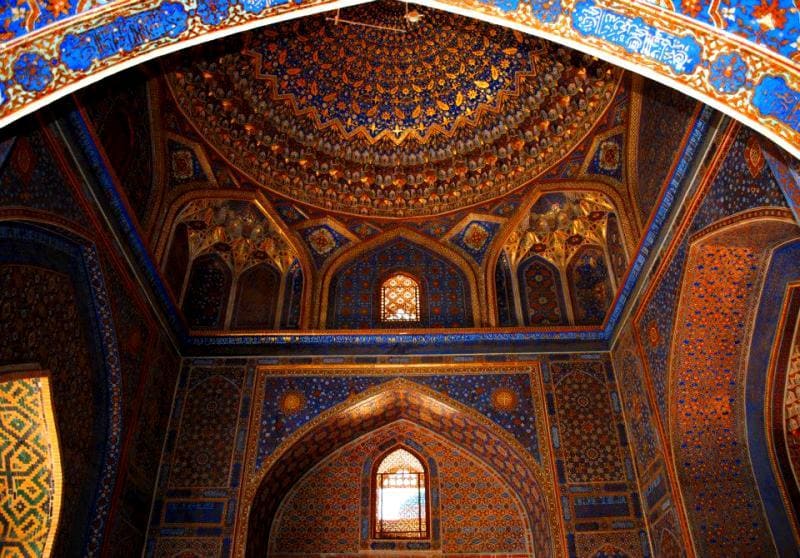
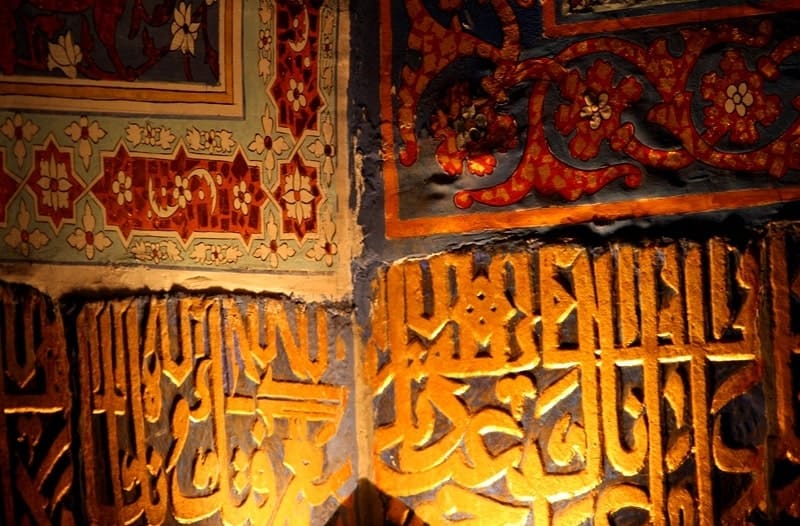
On both sides of the central hall are galleries supported by pillars, open to the courtyard. The exterior and courtyard facades of the madrasah are clad in brick and inlaid mosaics and majolica with geometric, floral, and epigraphic designs. The mosque's interior is particularly richly decorated. Its walls and dome are entirely covered in kundal paintings with generous use of gilding.
Floral and floral ornamentation of Tillya-Kari Madrasah.
The scale of gilding on the dome, walls, and mihrab of the madrasah surpasses all known architectural structures in Central Asia. For this reason, the madrassa was named Tillya-Kari (covered in gold). The mosaic decoration of this monument is dominated by yellow and green tones, characteristic of the decline of pottery.
But the mosque's interior boasts a luxurious floral and plant ornamentation, executed in the kundal technique, with abundant gilding. In 2001, it was added to the UNESCO World Heritage List, along with other Samarkand landmarks.
Vasily Vyatkin on Tillya-Kari madrassa.
The Tillya-Kari madrassa, which borders Registan Square on the northern side, was also built by Yalangtush Bahadur and is only 12 years younger than the Shir-Dor. Its façade features a tall portal with a pointed arch, a favorite feature of Central Asian madrasa architecture, almost inevitable.
On either side of this portal are two-story khudjras with arches and niches, opening onto the square. These arches, covered with tiles and mosaics, lend the façade a more lively atmosphere than the solid walls of neighboring madrasas, even though they are dissected by false arches.
The Tilla-Kari façade, thanks to its ajas, is unique and beautiful. In the corners of the façade are small minarets, their lantern-like tops rising slightly above the second floor. Too much of the tiled decoration on the portal has been lost, as its top, above the vault's heels, was completely rebuilt after its collapse in ancient times, and was partially left uncovered or covered with random tiles, making it impossible to reconstruct the composition of the portal's top.
But even the surviving ornamental tiled decorations characterize the incipient decline in art. Here, the coarseness of the ornamentation, the garishness, and the variegation are even greater than in Shir-Dor. The vast courtyard of the madrasah is occupied on three sides by single-story cells and the western cathedral mosque with its high ceiling.
A portal and beyond it a towering, vast drum, long since deprived of its crowning dome. In this madrasa, the main and most important part is the mosque, flanked by spacious chambers, the vaults of which are supported by rows of columns. In this colonnade, the small domes necessitate an excessive number of supporting structures in the form of multifaceted brick columns, which are generally very rare in local architecture.
The interior of the spacious mosque is gloomy, thereby obscuring the beautiful paintings on its alabaster plaster. Upon closer inspection, you see that the paintings are still strong, multicolored, varied, and in places feature fine floral and geometric designs.
It's a shame that light can't be let in to bring the colors to life. The deep niche in the western wall (mihraf) is finished in stone, and the stone slabs were gilded. In some places, the gilding remains on the convex parts, in others on the recessed ones.
Apparently, the stone was completely covered with gold. The black marble minbar (pulpit) with a row of steps harmonizes with the overall tone. The outer walls of the courtyard in the tympanums are often decorated with broadleaf ornamentation on spiral stems, circles, and geometric figures.
While Shir-Dor may inspire a high opinion of its builder for its time, Tillya-Kari is only a weak imitation.
Geographical coordinates of Tillya-Kari Madrasah: N39°39'20 E66°58'32
Authority:
"Religious and Spiritual Monuments of Central Asia." Author: M. Khashimov. Saga Publishing House, 2001 Year.
V. L. Vyatkin. "Antiquities of Samarkand." 1930. Uzbekistan Committee for Cultural Monuments. Khamkomstaris. Third edition.
https://ru.wikipedia.org
http://registon.uz
Photos by:
Alexander Petrov.