




Вы здесь
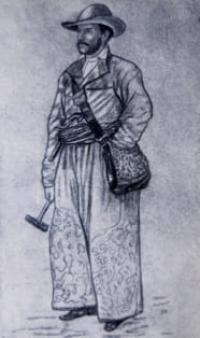
P. Semenov-Tyan-Shansky on Aksu springs in 1857.
Relaxing at Aksu hot mineral springs.
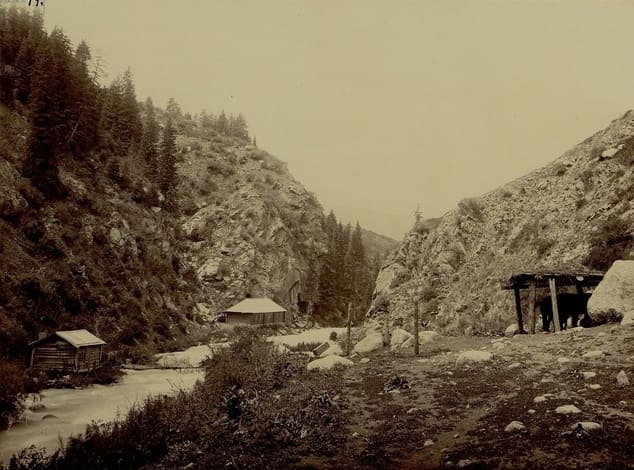
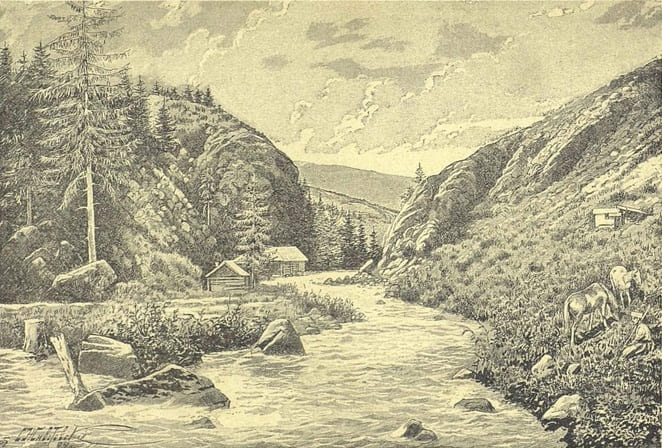
"Located 15 versts from Karakol, on the road to Muzart, the Aksu hot mineral waters are a remarkable sight. After passing the small village of Aksu and a wooden bridge over the Aksu River, the road turns right; clinging to the ledge of the river's right bank, it leads you to the mineral springs, situated in a wild and picturesque landscape. The left bank - steep, rocky, and nearly vertical - is covered with dense spruce trees, while the right bank, which is more gradual in slope, is strewn with massive granite boulders. Some of these have tumbled down and obstruct the water's flow, causing the mountain torrent to roar furiously. The first hot spring emerges from the base of a huge granite rock, shaded by apricot trees. The water is crystal clear and odorless - lacking any scent of sulfur - with a temperature reaching 30°C. The spring's pool is more than an «arshin» deep. I repeatedly dipped one foot and then the other into it, as the water initially felt hot; yet, upon immersing my whole body, I experienced a pleasant, gentle warmth that I was loath to leave."
Russian traveler Pyotr Galitsky. "From Verny to Karakol," 1876.
A trip to Aksu hot springs from Teploklyuchenka.
On the Turgen-Aksu River, just below where it exits the mountain gorge, we stopped for a midday rest amidst thickets of sea buckthorn (Hippophae rhamnoides), black barberry (Berberis heteropoda), and willow (Salix). Breaking camp around one in the afternoon, I decided - rather than heading straight for Terskey, the southern shore of Issyk-Kul - to make a detour for the night to an area that held great interest for me: a nearby gorge in the Tian-Shan mountains. This gorge housed the Alma-Arasan hot spring - renowned among the Kara-Kyrgyz for its healing properties - and was the source of the Ak-Su mountain river (a tributary of the Jargalan), which flowed out onto the Issyk-Kul plain. After leaving our bivouac on the Turgen-Ak-Su, we crossed three small rivers known to the Kara-Kyrgyz as the Jerges.
The banks of the last of these - wide and swift, though shallow - were densely lined with magnificent trees. Finally, our destination came into view: the Ak-Su Gorge. We turned toward it and ascended to a plateau at the foot of the mountains, from which we had a clear view of the blue Issyk-Kul, with its two bays and the promontory separating them.
From this plateau, we descended into the Ak-Su River gorge itself. Once there, we followed a path along the river's left bank for about five versts, high above the swift, noisy, and frothing current that justified the river's name, Ak-Su ("White Water").
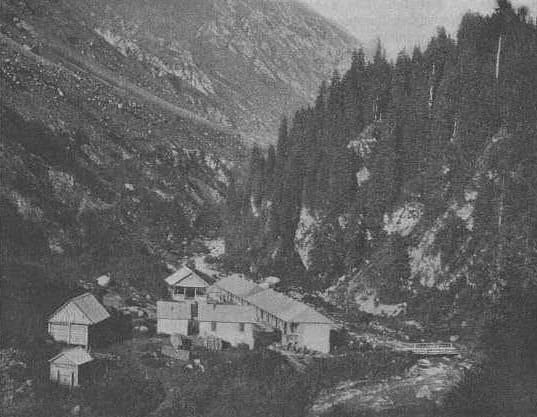
The steep mountain slopes were densely wooded with a mix of spruce and various deciduous trees - including apple trees, from which the healing spring derived its name: Alma-Arasan. Half a verst before reaching Arasan, outcrops of coarse-grained granite appeared, uplifting strata of sedimentary rock - specifically light-gray limestones - which presented a clear profile striking east-to-west and dipping north at 29°.
At that point, we left the path - along which we had been struggling high above the noisy, foaming river - and began our descent down a very steep, rocky slope toward Arasan itself. The sun had already vanished behind the mountains by the time we reached the famous spring at 7 p.m. and set up camp for the night.
The entrance to the Arasan pool was closed off by wooden doors bearing surviving Tibetan inscriptions - similar to those we had seen at Tamgaly-Tash on the Ili River, thirty versts downstream from the Ili picket. Upon emerging from the ground, the warm spring water was channeled into a fairly spacious pool - two meters long, one meter wide, and one meter deep - lined with granite.
The water temperature was 40°C. The spring had a sulfurous odor, yet no gas release or bubbles were visible; their escape was obstructed by a layer of coarse grit and gravel covering the bottom of the pool, concealing the exact spot where the spring welled up from the earth.
A stream flowed from the Arasan pool for a distance of several meters before emptying into the Ak-su River. The river rushed rapidly through the gorge, surging over massive boulders; it was highly turbulent and foamy, cascading in waterfalls in several places. At 7 p.m., the river temperature was 11°C, while the ambient air temperature was 15°C.
A hypsometric reading established the absolute elevation of our campsite at 1,810 meters. Upon waking at 5 a.m. on June 10th at our camp near the warm spring (Alma-Arasan), I eagerly set out to explore the gorge of the Ak-su River, as this was the first valley in the Central Tian-Shan I had managed to penetrate.
To examine the nature of this valley as thoroughly as possible, I decided to ascend several versts along the river's right bank, then descend along the left bank to its end and emerge onto the Issyk-Kul plateau via a highly inaccessible gorge - one that was completely impassable for my large party, pack loads, and camels.
As for my entire... I immediately sent a detachment ahead along a mountain bypass route with the artist Kosharov, intending to rendezvous with him at the point where - having descended from his encampment to the Issyk-Kul plain - he would cross the Karakol River; this was the very site where, decades later, the city of Karakol would be founded, eventually taking the name of our renowned explorer of Central Asia, Przhevalsky.
At that time (June 10, 1857) - when, apart from the Cossacks accompanying me, no other Russian had ever set foot in the area - I wished to travel as lightly as possible; consequently, I kept with me only my constant companion (a Cossack interpreter) and a Kara-Kyrgyz guide who was intimately familiar with the terrain.
The question of whether volcanic rock existed in the Tian-Shan was my primary concern; having already determined that the crystalline rocks of the Aksu Valley - which uplifted the sedimentary strata (Paleozoic limestones and shales) - were granites and syenites, I needed only to search carefully for volcanic rock among the countless boulders swept down by the turbulent river from the most remote peaks of the Celestial Mountains.
However, no volcanic rock was found among the river boulders in the valley. I was then free to devote myself entirely to studying the flora of the Aksu Valley and to making a comprehensive collection of the plants I encountered; throughout the area I surveyed, these belonged to the subalpine, forest, and - to some extent - cultivated agricultural zones.
The valley's arboreal vegetation consisted of conifers - specifically the Central Asian spruce (Picea schrenkiana), which ranges as far as the Himalayas, and «archa» juniper (Juniperus sabina), another characteristic tree of Central Asian mountain ranges - as well as deciduous species such as wild apple (Pyrus malus) and rowan (Pyrus sorbus), and the following characteristic Central Asian shrubs: black barberry (Berberis heteropoda), cotoneaster (Cotoneaster nummularia), hawthorn (Crataegus pinnatifida), two species of currant (Ribes atropurpureum and R. rubrum), and two species of honeysuckle (Lonicera hispida and L. microphylla).
As for the herbaceous flora, it partook of the characteristics of the cultivated zone of the Zailiysky region, as well as those of forest and even subalpine zones. (Here is the complete list of herbs I collected on June 10 in the Ak-su River valley, above and below Alma-Arasan: Thlaspi arvense, Sisymbrium brassicaeforme, Capsella bursa-pastoris, Nasturtium palustre, Dianthus crinitus, Silene viscosa, Linum perenne, Malva borealis, Trifolium repens, Astragalus icioides, Galium boreale, Artemisia vulgaris, Lappa tomentosa, Mulgedium azureum, Campanula glomerata, Asperugo procumbens, Verbascum phlomides, Veronica anagallis, V. biloba, Dracocephalum integrifolium, Scutellaria alpina, Sc. galericulata, Lamium album, Eremostachys sanguinea, Urtica dioica, Iris guldenstadtiana, Triticum prostratum.)
After thoroughly examining the flora of the Ak-Su Valley for several versts upstream from our campsite, we turned back and began our descent along the river's left bank. The going was difficult, as the valley resembled a wild gorge choked with lush vegetation.
Only about five versts below Arasan did the valley widen; as we followed the high ground along its left edge, a vast panorama of the entire Issyk-Kul plain gradually opened up before us.


Authority:
Pyotr Petrovich Semenov-Tyan-Shansky. «Journey to Tian-Shan». 1856-1857.