




Вы здесь
Khirgiz nomads and influence of high plateus.
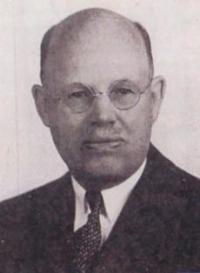
Ellsworth. Huttington. "The pulse of Asia". 1903.
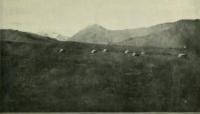
…As soon as broad ridge of the northern border is crossed the country assumes an aspect which fully justifies the term “plateau.” At Jukuchak pass, for instance, the narrow young valley which one ascends in travelling southward from Issik Kul is exchanged for a broad? open? elevated plain? bounded on all sides by snowy mountains, whose slight dissection causes them to suggest a block of marble on which the sculptor has rudely outlined a form but on which he has yet carved few details (fig.1). The treeless plain with its cover of brown or green grass has the thoroughly graded aspect and subdued slope of a region in late maturity; and such it is in spite of its elevation and potential youth. So far as erosion is concerned it only waits for some stream to cut headward through the surrounding ridges to cause it to enter upon a new cycle at the very beginning of youth….
E. Huttington «The pulse of Asia». 1903.
Chapter V.
The great physical difference between the plateaus and the floor of the Lop basin has notable consequences in the diverse human habits and character of the two regions. Apparently, the physical differences are the cause of the human differences.
In order to take the first step in bringing out this geographic contrast between the human inhabitants of the two diverse regions, I shall postpone the account of our journey from the Sanju pass down to the zone of vegetation, and shall devote this chapter to a description of the Khirghiz, a race of Mohammedan nomads inhabiting the high plateaus.
As the Karakorum plateau is for the most part too high and cold to be inhabited, we saw but a few score Khirghiz on the way from India to Turkestan. In the summer of 1903, however, as a member of the Pumpelly Expedition of the Carnegie Institution, I spent three months among the Khirghiz of the plateaus to the west and southwest of the Lop basin, chiefly in the western and central part of the Tian-Shan plateau.
During a residence in Turkey I had learned a little Turkish; and now I found that I was soon able to pick up enough of the Khirghiz dialect of Turki, a language very closely allied to Turkish, to dispense with an interpreter in all ordinary matters. A little knowledge of their language went far to put me on terms of comparative intimacy with my Khirghiz servants.
??ilitated a very pleasant acquaintance with many of people whom we met. Thus, a large part of the western Tian Shan region consists of smoothly floored basins and gently rolling uplands lying at a height of from 10,000 to 12,000 feet above the sea and therefore subjected to relatively heavy precipitation in summer.
The conditions of climate among these “pamirs” as they are generically called according to Younghusband, allow an abundant growth of thick, turfy grass full of flowers. Trees, however, are wholly absent on the main plateau, and are rare even on the lower slopes.
Schimper explains this as due to the fact that the wet season in midsummer is not long enough to favor the growth of trees, which require a growing season much longer than that of grass. Nevertheless, in the valleys, at an elevation of from six to nine thousand feet, there are some trees and a profusion of delicate flowers, rich grass, and shrubs.
It is not my purpose to discuss the vegetation. It may be worth while, however, to print here a list of the plants, so far as I happened to record them, which grow wild among the lower slopes of the mountains northeast of the Lop basin, but are cultivated in Europe and America.
They comprise the apple, apricot, plum, and olive (not the commercial species); the asparagus, onion, and rhubarb; the candytuft, chrisanthemum, crocus, heliotrope, peony, phlox, and tulip; the large blue and purple varieties of columbine; the pansy and lady's delight, both purple and yellow; and the red, yellow, and white varieties of the poppy and rose.
That there are many more than these nineteen men are needed to care for the flocks, and it would not be safe to leave the women and children far away in the valleys. Moreover, if they were left, they would have nothing to do, for there is practically no opportunity for agriculture, and the only work to be done in summer at the winter quarters is to cut a little grass for winter use.
Some of the poor families are sent down for a few weeks in July or August to do this. As a matter of fact, the shepherds move their dwellings much oftener than twice a year, for the pasture is found close below the ever-shifting snow-line. It takes but a few weeks to eat up the finest grass near to the tents, and then, either the camp must be moved, or the flocks driven farther.
Again, as the animals are brought close to the encampment at night, the ground soon becomes foul, especially during the rainy weather of summer, when there is no chance for it to dry. Thus, by force of physical environment, nomadism is the only condition under which human occupation of most of the Tian-Shan plateau is possible.
This being so, it is easy to see that the necessity for frequent migrations becomes the main fact in the lives of the Khirghiz, and determines all manner of habits and customs. For instance, dwellings must be such that they can be easily carried from place to place.
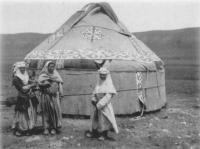
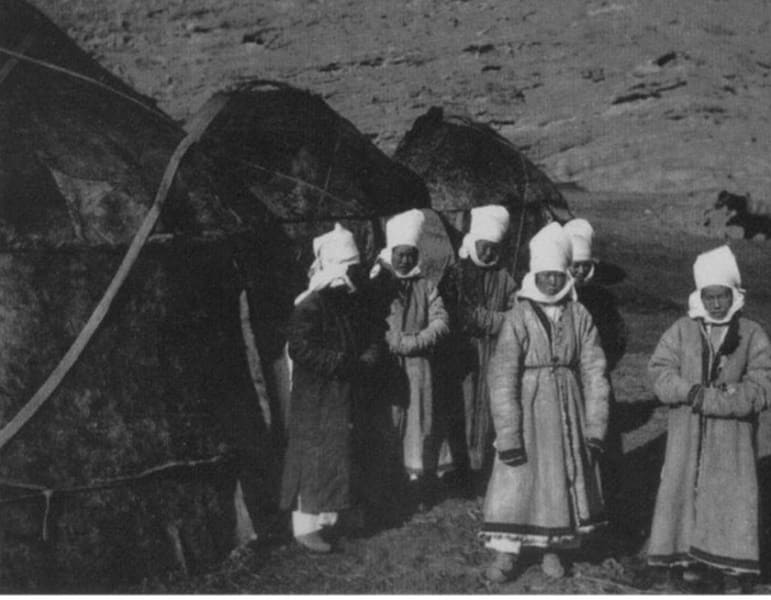
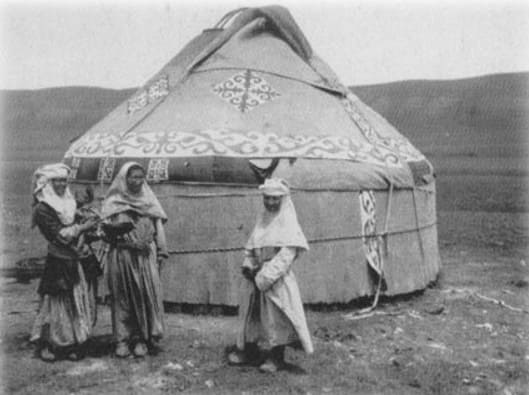
All men, whether rich or poor, must move equally often, and even the richest cannot have a very large or ostentatious habitation. The materials for houses are willow sticks and woolen cloth, because these are the most easily available. The round tent is thick and tight, in order to withstand heavy rain and snow. It has in the roof a large round hole, capable of being covered with a felt.
The whole dwelling can folded compactly into pieces of convenient size for carriage by camels or oxen whenever a migration is to take place. In similar fashion the furniture of a “kibitka” as the tents are called, is of peculiar sorts, corresponding to the materials at the disposal of the Khirghiz, and to the necessity of easy transportation.
Utensils are made chiefly of leather and wood, the most available materials which will not break. Again, the dress of the Khirghiz is adapted to the coolness and dampness of the climatic conditions under which the people live. Having described these things, we at once perceive that they in turn limit the aesthetic sense of the Khirghiz.
These people cannot know much about architecture or the ceramic art; but they can and do enjoy bright-colored rugs and felts, gaudy leather boxes, gay screens or hanging doorways and gorgeous robes or delicately embroidered head dresses for the women.
The designs which the people em-ploy are for the most part simple and highly characteristic, as appears in the drawings on page II3, which were made by Professor Davis in some of the kibitkas where we were entertained. The environment of the Khiighiz limits and controls, but by no means stifles, the aesthetic sense.
A description of some of the events of two days in early July, 1903, when Professor Davis and I traveled from the Narin River up to Son Kul (Left-hand Lake) will illustrate some of the points already mentioned, and will give an idea of the daily life of the people.
From the ford of the Narin River, an easy ride up a pretty mountain valley brought us to a group of kibitkas, set in a green amphitheatre surrounded by steep walls of gray limestone. An unusually neat kibitka, so new as to be still white, was evidently being prepared for us at the suggestion of the Khiighiz guide, who of his own accord, had ridden ahead to see that all was ready for our reception.
The kibitka had been picked up bodily, and, as we approached, was being carried to a cleaner spot away from the unpleasant neighborhood of the other kibitkas and of the flocks and herds. A dozen men and women had gone inside, and picked up the kibitka by the lattice-work fence.
Under the direction of a man on the outside, who acted as eyes for the rest, they were carrying it blindly to the designated spot. It looked like an enormous beetle, walking across the turf with a dozen pairs of human legs. The household goods which the kibitka had sheltered - the piles of rugs, felts, quilts, skins, boxes, bags, wooden bowls, and leather buckets - were left exposed in a sorry heap, which the women good-naturedly removed to another tent.
In the evening, our Khiighiz village was in perfect order. Ten or fifteen kibitkas were scattered on a fair green slope between the steep gray cliffs. On one side, hundreds of stupid sheep were trying to push their way into the centre of the flock; on the other, herds of neighing, kicking horses, fat mares, and frisky colts were interspersed with stolid cattle and with camels - awkward two-humped beasts, strangely out of place among the lofty mountains, and ridiculous in felt coats put on to keep them warm and, especially, dry. In the morning, the village was in dire confusion.
Kibitkas were lying in pieces on the ground with household goods strewn around them. A migration was to take place, and men, women, and children were busily making preparations. The slow-moving, pattering flocks of sheep had already been sent away at dawn, but the rest of the animals disported themselves among the ruins of the tents, waiting to be packed or ridden.
The men of the community were clad in big top-boots, black conical hats of heavy felt with brims of Astrakhan, and long quilted cotton gowns, which had been wet so often as to appear dark and oily. Their chief business seemed to be to load the animals, or to catch those which were still loose.
When a horse was to be caught, a man seized a pole like a fishing-rod with a loop of rope at the end, and jumped bare-back on another horse which was already bridled. Violent kicking and lusty shouting started both horses into a fine gallop, and it was sometimes half an hour before the loop was thrown over the animal's head.
The women wore heavy boots and quilted gowns much like those of the men. Many, however, had takn off the outer garment, and were dressed in loose gowns of white cotton, or, in the case of the rich, of gorgeous silk, red, purple, and yellow.
The sleeves of the garments of both sexes extended five or six inches below the hands, and took the place of gloves as a protection against cold, especially in riding horseback. The headdresses of the women, often a foot high, were wonderfully constructed of fold after fold of white doth wound into a cylinder.
One fold hung over the ears and under the chin in such a way that it could be drawn up over the lower part of the face, although this was rarely done. From below the huge headdress the black hair hung in silver-studded braids, pieced out with cords or strings of leather.
At the ends of the braids, one or two silver roubles and the keys of all the family chests dangled close to the women's heels. When one of the kibitkas had been tied up ready for packing, a tiny girl of six led up a camel ten feet high, and in spite of the creature's horrible grunts and roars, made it kneel meekly by twitching the rope fastened to a stick in its nose.
The largest, finest camel was adorned with a long red fringe, which hung over the saddle and over the animal's long, curved neck to its head. When two men had tied a load ot pots, pans, boxes, felts, and parts of a kibitka securely to the camel, I saw a silk-gowned mother lay her baby in a wooden cradle without rockers.
After covering it well she tied one rope over its legs and around the cradle, and a second over its chest. Then, in spite of its lusty crying, she lifted the cradle unconcernedly to the top of the load of the kneeling camel, lashed it on, and covered both baby and load with a large rug.
She did not mean to neglect her baby, but though she was one of the ridiest women of the community, she, like every one else, had to work that day. Cradles of the sort in which this mother laid her child figured sadly in a scene which I saw later.
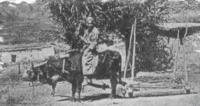
Out on a lonely hill-top among the great mountains we came upon a group of graves. Beside each of the six smallest heaps of earth, there stood an empty, weather-beaten cradle. Camels were not the only baggage animals that morning. Horses are esteemed too highly to be often burdened with loads, but frequently we saw a man on one side of a stout ox and a woman on the other, each with the right foot braced against the animal's side while they drew taut the ropes which bound the load of kibitka poles.
A monkey-faced dog slunk behind one such pair, while dose by, a girl of ten in figured red and purple silk waited to be helped on to her horse. Beside her a tiny imp of three stood motionless; his round, astonished face, long gray dress, and boots so high that he could not bend his knees, all sunk into insignificance under the immense dome of his black sheep-skin hat.
Even he could ride a horse, as we soon saw. At last, when all was ready, we started on a delightful ride up a steep gorge. The road zigzagged among fine spruces, almost the only ones that we saw in Central Asia. We passed first a man on a cow, then a heavily loaded camel with two small boys perched high on top of the load, and two ridiculous baby camels, too small to carry even a roll of felts, running awkwardly in the rear.
Next two fat cows with wooden rings in their noses walked placidly along with loads of straw-matting and poles. In front of them an old gray-beard with a black hat and a wadded gown rode proudly on a spirited horse. His gloved right hand rested in a wooden crotch at the upper end of a short stick which stood in a little stirrup, and on his wrist perched a hunting-eagle with a leather hood over its eyes.
Behind the man a four-year-old urchin, a miniature of his grandfather, planted his feet sturdily on the horse, while his hands firmly grasped the old man's shoulders. Ahead of this pair a ragged lad, mounted bare-back on a yearling steer, jogged along contentedly behind a herd of horses and colts. In spite of his rags, be looked happy, well-fed, and warm.
So, too, did all the people on that day's march; and, indeed, all the pastoral nomads whom I have ever met seemed to be comfortable. When their flocks diminish and they grow poor, they are obliged to seek new homes, and to betake themselves to agriculture, leaving only the rich to continue the nomadic life.
As might be expected from their surroundings, the food of the Khirghiz is very limited in variety, and is eaten in the simplest way. A typical meal, such as one in which I shared and many at which I was a spectator, is likely to prove unpleasant to civilised nerves.
One day, as I sat cross-legged with a circle of Khiighiz on the gay felts which carpeted moat of the floor of a rich kibitka, our host came in, holding on the skirt of his gown full of dried dung. With this he kindled a pungently smoky fire on the stones in the middle of the kibitka floor, and on the flameless conflagration put some tea to boil.
When this began to simmer, he took from the lattice-work of the kibitka a cloth heavy with grease and dirt, and spread it before me, questioning the entire circle meanwhile as to the advisability of serving cream with the tea. After much discussion, a boy was sent to fetch both milk.
After much discussions? a boy was sent to fetch both milk and cream, while the host placed on the dirty cloth a metal tray containing small pieces of bread and sugar. The bread was in the form of cubes half an inch in diameter, such as I had seen the plump, red-cheeked women cooking like doughnuts in hot fat at the bottom of enormous iron bowls, the sole cooking utensils.
Among the strictest nomads bread is a great rarity, and I have had the pleasure of giving a piece to children who had never tasted it before. After the tray was in place, our host took some china bowls from their nest in a round wooden box, and having wiped them with another greasy cloth, filled them with tea.
By the time this had cooled, the boy returned with news that his quest had been successful. At his heels followed a fat Khirghis house- wife, who dived into the small woman's sanctum behind the ornamented screen of reeds which invariably stands on the right as one enters the door, and with a wooden ladle scooped almost solid cream from a large wooden bowl into a small china one, and then poured milk from a leather flask into another smaller wooden bowl.
As she handed the milk and cream to one of the men, she saw that bread was needed on the tray. Kneeling before a red and green leather-covered box, she reached behind her heels for the silver-loaded bunch of keys suspended from her long braid of straight black hair, and, finding the proper key, took from its safe repository a handful of carefully treasured bread.
Now the tea-drinking began, and it continued till the supply was exhausted. Each guest had three or four bowls, but even that was not enough, so each one finished with a wooden bowl of ‘kumiss’, the fermented milk that still remains one of the important articles of Khirghis diet.
Then when the servants had smacked their lips over the remains of the meal, each man with a look to see that his neighbors were ready, raised his hands to his face, and all in unison stroked their beards, with a mattered prayer to Allah. During the next hour or two, big stories of brave deeds and travel were told, or less praiseworthy talk of quarrels and women kept the party animated at first, but soon the kumiss took effect, and drowsiness began to prevail.
At length, to the relief of all, the host appeared, and we knew dial the real meal was at hand, for the tea-drinking is, after all but a new-fangled Russian notion. In his hand, at the end of a spit, he bore a small piece of roasted fat from the kidney-shaped tail of the sheep that we were to eat.
Putting his big knife from his girdle, he cut off morsels and placed one in the mouth of each guest as an appetizer. Behind the host came his boy, bearing a basin and a copper urn of water, from which in the oriental way he poured water over the hands of one after another of the squatting circle, beginning, of course, with the foreigner as the moat honorable.
As the Khirghiz put out their hands to wash, they made a peculiar gesture in throwing back their long sleeves. The washing over, dinner followed promptly - an enormous quantity of boiled mutton in a huge wooden bowl, flanked by two smaller bowls full of the broth in which the meat had been cooked.
The host waved his hand over the bowl and cried, ‘Eat;' someone else cried, "Eat;'* and then each cross-legged Khirghiz cried, ‘Eat,’ and, whipping his knife from his girdle, plunged his hand into the dish. The scene that followed was like the feeding of wild animals in a menagerie.
Each man grasped a bone» and with his knife and teeth ripped off huge chunks of meat or fat, and with a mighty sucking and smacking drew them into his mouth. The daintiest portions, the head and liver, were offered to the elders of the feast, who skillfully gouged out an eye and yanked out the tongue.
When the edge of appetite had been appeased with two or three pounds of meat and a pound or two of fat, most of the guests took a drink of soup, and then, with idly hanging greasy hands and greedy eyes, watched while the epicure cracked and sucked a bone, and one or two of the more skillful carvers prepared a delicate hash.
The fat tail, which is really delicious, a selected portion of the liver, and a good supply of other fat and meat were most cleverly sliced into fine fragments and mixed with soup in the bottom of one of the bowls. When the mixture was ready, each man rolled up a handful and sucked it noisily into his widely distended mouth, or, as a mark of respect and affection, put it into the mouth of his neighbor.
The meal was over in an incredibly short time - the last bones were cracked and thrown to the edge of the kibitka; bowls of soup, followed by kumiss, were again passed around; the big top-boots were oiled by cleaning the greasy hands upon them; the beards were stroked; and the main business of life was over.
Day after day, the diet is the same as at this feast, except that the amount of meat is less and of kumiss more. The mutton is occasionally fried or boiled in its own fat, or roasted on a spit. Sometimes a young colt is killed, and is eaten as the greatest of delicacies.
The meat, the one time that I ate it, tasted like a cross between the best grades of veal and lamb, and was fit for the table of the most exacting epicure. Just as the Khiighis habits of eating are the result of an environment which compels the people to live on animal food, so their hospitality is the result of that same environment, which isolates them, and at the same time compels them to travel.
Habitations are so often moved that special accommodations for wayfarers do not exist. Yet the nomad, in his search for stray cattle, in his business of exchanging animals, or in his rides between the shifting summer camp and the lower valley where he cuts the winter supply of grass, must often spend the night far from home.
Everywhere the people are in the habit of receiving guests, and the custom is to pay nothing for entertainment. In spite of his lonely life the Khirghis meets the traveler with less suspicion that does the less cosmopolitan villager who lives near a large city.
Usually, when I arrived at an encampment, the chief man, who had ridden out a mile or two to meet me, jumped off his horse and gave it to an attendant. Then he led my horse as close as possible to the kibiika which I was to occupy. As I dismounted, he put his hand under my shoulder to assist me.
When I touched the ground he raised his cap, a habit learned, probably, from the Russians. Then he took my right hand softly between both of his, and finally stroked his beard, suggesting a prayer to Allah. Often when we met strangers on the road, they turned and rode with us, to do us honor, and to get the news.
The isolation of the Khirghiz accounts for their eagerness in this latter respect, and the abundant leisure of the nomadic life accounts for the unconcern with which a man puts off his work for half a day. These chance encounters on the road were often most interesting.
One day, as I was crossing the Jukuchak glacier south of Issik Kul, five men appeared on the ice above me» one mounted on an ox, one on a cow, and three on horses, with a loaded camel bringing up the rear. All these five strangers dismounted from their slipping animals and, walking across the treacherous ice, gravely shook hands with me.
Another hospitable Khirghiz habit appears to be a direct result of the nomadic life and the abundance of animals. On entering the main Tian Shan plateau, I found that each day fresh horses were brought for me and my men, and even for our baggage.
At first I understood the servants to say that our horses were tired and needed rest, which was true, but when I offered to pay the hire of the supplementary horses, I discovered my mistake. In these regions, it appears, the traveler is theoretically supposed to start from home, and to return thither by the way that he went.
The first day he rides his own horse, and at night turns it out to feed with those of his host. In the morning he does not take his own animal, but a fresh one from among those of his host. This he again leaves at night, and so on day after day. On the return journey, he picks up at each place the horse that he left there and returns it to its owner. In practice, the scheme is not so simple. In our case, we were furnished daily with from six to ten horses belonging to various people at the camp where we had spent the night.
At the end of the day's march, or occasionally in the middle of the day, we gave up the animals to one or two men who had come with us for the purpose of driving them back. For all this the people would take no pay whatever, though it was often offered.
So freely does one man make use of another's horses that not infrequently, when we passed a new herd, some one would say:
“My horse is bad,” and would dash off to catch another with a fish-pole.
I do not know how universal the custom is, but during our journey the changing of horses played so important a part that the stock remark was not about the weather, but:
How is your ‘animal’ to-day? Has he a good gait?”
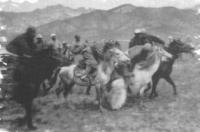
The sports as well as the labors of the Khirghiz result from the physiographic conditions which induce nomadism. Horses and horseback riding are the one idea of these people, and their greatest sport is the “bagai.” I saw this interesting game in the Alai valley, close to the border of Bokhara.
As we came down the hillside to the smooth plain, a of distant horsemen seemed to be standing motionless, onto one darted out, and the whole fifty or sixty dashed after him. Evidently, they were chasing a leader in some game, and the leader kept changing.
Drawing nearer, we saw that two galloping horsemen had detached themselves from the crowd and, as they rode toward us, were struggling for a large black object bigger than a sheep. Suddenly one of them threw his leg over this, gave it a jerk which nearly dismounted his rival, wheeled his horse to the left, and, dashing up to me, threw the thing at my horse’s feet. It was a black calf, headless and footless, and partly skinned.
At once three or four men who galloped up behind the leader leaned from their moving horses and attempted to pick it up. Two grasped it, twenty or thirty others surrounded them, and all struggled to seize the calf and carry it off. In the melee, the horses jumped and turned this way and that while all the riders tried to force a way to the middle of the fight, whipping their own and other people's horses, taking horses by the head and turning them suddenly round, and themselves leaning far out of their saddles as they grabbed madly at the black calf.
At last one man captured it, threw it over the front of his saddle, put both legs over it, and was off at a dead run with fifty others after him. They could not catch him, and, making a great sweep as huge as the terrace allowed, he returned in triumph to throw the beast before me and get the customary reward.
Then began another scrimmage, in which one over-zealous rider was knocked from his horse and apparently trampled on, but when the kicking, surging crowd of horses had passed, his horse was still with him, and he mounted and galloped off with a grin.
After half-a-dozen scrimmages, one daring rider seized the prize and went over the terrace, down a hundred-foot slope so steep that a footman could scarcely climb it without zigzagging. At the foot, the bold rider, hard pressed by his pursuers, cantered across a broad arm of the river, and away across the plain beyond, trying as he went to skin the calf, for he who carries off the skin wins the "baiga."
We rode away with the "Deyem Bai," the giver of the entertainment, who was homeward bound to inspect the cooking of the sheep for the feast that was to follow. It is the custom, I was told, for men of wealth to furnish a goat or calf for the " bagai," and to invite all the men of one or two villages to join in the sport, and at the end to indulge in a feast, or better, a carnivorous orgie. Among the occasions for a ‘baiga’ are a marriage, the birth of a son, the erection of a new kibitka, and a death.
Possibly this struggle for a dead animal is a relic of the time when the ancestors of the Khirghiz really fought to get the prey from one another. Whatever its origin, it is a wonderful training in horsemanship. For some reason, no woman is allowed to see the “baiga” or, naturally, to join in the subsequent feast.
The completeness with which Khirghiz life and character are determined by natural surroundings makes the relation between physiography and life far more evident than in the ease of more highly civilized people. If the nomad is to be successful, the keenest of eyesight is necessary to detect cattle or encampments at a distance. I was amazed one day to hear my guide say:
- “Do you see those cattle off there at the foot of the mountain? They are Chinese animals - yaks.”
After a long search I found them, mere tiny specks of black, so far away that even with a strong field-glass I could barely distinguish them from ordinary cattle. That my guide should recognize them as yaks shows a keenness of sight equal to that of the most skillful hunting tribes of savages.
Other Khirghiz showed equal quickness in detecting smoke, kibitkas, men, and animals at a distance, so that the trait seems general. His mode of life makes the Khirghiz able to endure hunger, thirst, and fatigue, for these are the necessary accompaniments of long rides in search of strayed cattle.
He has no fear of raging fords or slippery passes, and despises the Chanto or Sart of the city, who shrinks from crossing a ford what his horse may lose his footing and be washed downstream. In such rough experiences the Khirghiz learns to be self-reliant, and his frequent meeting of strangers under all sorts of circumstances gives him an air of readiness and self-possession.
The talk of the Khiighiz is full of roads and travels. If you ask a man how far it is to a certain place, he at once begins to tell you all the intermediate stages and their difficulties. These people have the knowledge of their plateau that comes from experience, but book knowledge is very rare.
As my escort, a proud, influential Khirghiz, said one day:
- “Why should the Khirghiz learn to read? It is enough for us to know about sheep and horses and cattle. What more do we want?”
If there were no outside world with which to come in contact, such a view of life might perhaps be wise. As it is, the Khirghiz cannot stand against the hard realities of civilization. The coming of the Russians, who now rule most of the native tribes, has done them an immense amount of good in making the country peaceful and safe, and in providing good markets for the products of the flocks. It has also added to their happiness by making such luxuries as tea, sugar, bread, and cheap cotton cloth accessible to all, but it will harm them if it leads them to abandon the pastoral life for that of the day laborer.
The delightfully gentle and gracious courtesy of the Khirghiz cannot offset their laziness, if that term can be properly applied to a quality which is a necessary outcome of the nomadic life. A nomad is justified in being often idle, for his great exertions at certain times compel him to rest at others, but the qualities so engendered are of no use when steady work is required day after day.
Thus it comes to pass that those Khirghiz who have come into dose contact with the Russians seem to be deteriorating. Laziness leads to dishonesty, and both tend to insolence and vulgarity. A change of habits, too, causes greater uncleanliness, for customs that may be harmless where a camp is shifted every month or oftener, lead to filthiness where a kibitka stays for six months or a year in one place.
Change of any kind is always difficult, especially for people like the Khiighiz, who have adapted themselves completely to a type of physiographic conditions so unusual as those of the Tian-Shan plateau. Not only the outward habits of life, but also certain mental and moral qualities of the Khirghiz are due largely, if not entirely, to physical environment.
We will now take up one or two among the many subjects where such a relation does not at first sight appear, although I believe that it exists. In determining the mental and moral character of a people, do factor is more important than the position of women, and the resulting character of the homes in which the grow up.
If the position, and hence the character, of women is materially affected by physiographic environment, it follows that a host of other characteristics must be indirectly affected through the tremendous agency of the home and of early training. I freely admit that religion, heredity, tradition, and perhaps other unknown factors play an immense part in determining the character of a race, but these, too, in their origin and growth have probably been greatly influenced by physical environment.
With that, however, we are not now concerned. It will be enough to point out certain ways in which the physiography of the Tian Shan plateau, working through the institutions of nomadic pastoralism» affects the position of women. If our conclusions are correct, all character is influenced, more or less, by physical environment, and hence is one of the subjects with which geography b concerned.
Mohammedanism, as every one knows, inculcates the seclusion of woman, and makes of her nothing but a stupid drudge to do man's work, or a light plaything for his pleasure. Wherever people of Muslim faith gather in towns and cities, as I have seen them in Turkey, Persia, India, Asiatic Russia, and Chinese Turkestan, this ideal prevails.
In the crowded villages and cities women can do their work behind high mud walls, and can be confined to certain unseen rooms when male guests visit the house. The support of the family does not depend upon them, and their activities are almost wholly dependent on the will of their husbands.
It is but rarely necessary that they should leave the house, and when they do, there is usually no work to be done and it is easy to keep their faces covered. Even the peasant women, who must work in the fields, keep aloof, and come in contact with men but little.
Only the very poor, or those who are confessedly immoral, go about in public with unveiled faces. The evil effect of all this has been often described, and needs no comment. Among nomads the case is different. The women of all races, so far as I know, both Mohammedan and non-Mohammedan, go about unveiled, and have a strong influence in the affairs of the community.
Their relative strength of character is evident from the notable fact that when a Turkoman woman is married to a Persian, or a Kurdish woman to a Turk, the wife from the nomad stock, so it is said, usually rules the harem, and often rules the whole house.
The universality of the contrast between the position of woman in nomadic and non-nomadic Mohammedan populations goes to show that the contrast is not the product oi racial differences, but of nomadism. The house of a nomad must of necessity be small, and cannot contain two rooms, save under the most exceptional circumstances.
A visitor must enter the room where the women are at work, or else the women must work outside; and there, of course, they cannot be prevented from being seen by men other than those of their families. Then, again, at the time of migrations there are no shelters left standing, and the women cannot possibly be kept concealed.
Moreover, they cannot be made to veil their faces. No one can work with a cloth hanging down over her face. The village woman bakes and brews and washes, and milks her few sheep and goats, in the seclusion of her own courtyard, where she can throw off her veil in the assurance that no strange man will see her.
The nomad woman must work in semi-publicity, and cannot be bothered with a troublesome veil, especially when both hands are more than occupied in milking some of her many sheep. Accordingly, while the Khirghiz woman is very particular about her headdress, she makes no attempt to conceal her face.
She is in the habit of meeting strangers, whether men or women, and die does it modestly, though without timidity. Indeed, she a most admirable hostess. Her freedom from seclusion does much, both morally and mentally, to elevate her shove her less fortunate sisters of the villages.
Another side of nomadic life tends to strengthen the character of the women. They are obliged to rely more or less upon themselves, and to take the initiative at times. In their care of the flocks and herds, it often happens that the men are all far away throughout the whole day, and at certain seasons, when the grass must be cut in the valleys, many of them are away for several days.
At such times, the women are responsible for everything. I have come to an encampment of seven or eight tents where no one was left except a few girls and one or two old women. The smaller girls, not unnaturally, were afraid of us; but the newly wedded wife of the chief man, a pretty giri of sixteen, entertained us most graciously, and by the time that her husband and the other men arrived, had supper ready for them and us.
A veiled village woman would have screamed and ran away at our approach. Besides all this, the occupation of the men with the horses and larger animals leaves to the women the care of the sheep when the flocks are driven home at evening.
And, finally, it is always the wife who has the responsibility of taking down and packing the kibitka, and setting it up in a new place, while the husband takes care of the herds. All these differences between the women of Tian Shan and those of the villages are the direct results of nomadism, and all of them tend to make the Khirghiz wife stronger, more capable, and more self-reliant, and hence a better mother.
In view of all this, is it going too far to say that the relatively free, warm-hearted, and affectionate spirit shown by the Khirghiz in their relation to one another is, in part at least, a geographic fact, the result of physical surroundings? In Karategin, at the eastern corner of Bokhara, I had a most pleasant glimpse of the inner life of a Khiighiz family. As we entered the village of Kichik Karamuk, I spied a villager making a rude sledge of the sort which the semi-agricultural Khirghiz use for hauling grain and hay, and style “arbas,” or carts.
Of course I wanted to photograph it, and told my servant Sherif to ask the carpenter to sit out farther into the light. Sherif, for some reason that I did not catch, said that it was impossible, but as another servanl put the man in the right place, I took the picture before asking any questions.
The sledge-maker proved to be Sherifs brother, whom he had not seen for seven years. Out of sheer politeness, the brothers remained silent till the picture was finished, then they embraced each other gently, as wrestlers might clinch before a struggle, first on this side and then on that, repeating very often and very fast the greeting, “Salaamet, salaamet, salaamet” (“Peace to you, peace to you, peace to you “).
Later, I saw Sherif meet another brother, the oldest of nine, and an older sister, who had been like a mother to him. The gray-bearded man, who was some twenty years older than Sherif, literally fell of his brother's neck and wept. The story of the Prodigal Son seemed very real just then.
Meanwhile the wet-eyed sister stood silent till her turn came. As she fell on her brother's neck, she wept aloud for a moment, and then, still clinging to him, began to chant a song of thanksgiving; and so she continued for some minutes, first weeping and then singing.
Feeling out of place, I went into the kibitka and sat down on the floor. After me came a chubby little urchin of three, with a rosy, dirty face and a single scanty garment. A vague idea possessed him that some one had come whom he must welcome, so with a charmingly friendly smile he came and put his fat arms around me.
In this sketch of the Khirghiz I have tried to take some of the chief facts in their life and character, and to show how they are related to the physiographic facts of the Tian Shan plateau. Beginning with the grosser, more material aspects of life, it appears that the nomadic pastoralism of the Khirghiz is due to the climate and vegetation of the region that they inhabit.
On this is dependent the form of their houses, furniture, utensils, and dress, which in turn leads up to and determines the nature of their art. Again, the food of the Khirghiz is narrowly limited by the nature of their occupations, and this in its turn controls the large number of habits which centre about the necessity of taking nourishment.
Another line of thought leads from the frequent movements of the Khirghiz to the character of their hospitality and to their politeness. Once more, the hardships of the nomadic life result in certain mental and moral traits, such as bravery, hardihood, and, unfortunately, laziness.
Finally, the conditions of nomadic life determine the position and character of the Khirghiz women, and lead to certain of the higher moral traits, such as morality in the stricter sense, self-reliance, and even family affection.
Authority:
Ellsworth. Huttington «A Geologic and Physiographic Reconnaissance in Central Turkestan» book chapter from “Explorations in Turkestan 1903. vol.1”