




Вы здесь
A review article about Lake Alakol.
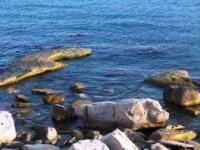
Lake Alakol at Dzungarskiy Gate mountain pass.
"...we found a certain sea, not very large, whose name... is unknown to us. On the shore of this sea there is a certain small mountain, in which, they say, there is a small opening, from which such violent storms and winds arise in winter that people can hardly pass by, and only with great danger."
Giovanni del Plano Carpini. "History of the Mongols, Whom We Call Tatars." 1245-1247.
Islands of Lake Alakol.
Alakol is the deepest lake among the endorheic lakes of Kazakhstan, with intense wind-driven waves. It is located in a tectonic depression, within the Dzungarian Gate. Its absolute height is 347 meters. In terms of its fullness, it is only slightly inferior to Lake Balkhash.
Fifteen rivers flow into it: the Yemel, Urzhar, Katynsu, Zhamanty, Yrgaity, and others. The lake's waters are fresh only at the river mouths, and at some distance from the shores, they are bitter-salty. Salinity increases toward the central, deep part and varies from year to year.
The water is sodium chloride, sodium sulfate, or sodium chloride-sulfate. Increased levels of heavy metals and pesticides have been noted in the water, zoobenthos, and fish. Alakol is commonly referred to as a salt lake, but existing classifications classify it as slightly saline or brackish.
Freezing of the lake is slow and difficult due to its deep water, rugged shores, intense waves, and wind distribution and movement. The total freezing period is two months. The first ice formations appear in the third ten-day period of November, and freeze-up over the entire surface is not completed until January or early February.
The average ice thickness is 55 cm. The lake breaks up in late March – early April. Lake Alakol is unique in its size and the frequency of strong wind-driven waves. Its wave height surpasses that of larger bodies of water and large reservoirs.
Origin of word Alakol.
The name is usually associated with the Kazakh word "ala," meaning "motley." However, there are other interpretations of this hydronym. Among them, the adjective "large" deserves the most attention. After all, the lake is indeed the largest in a group of local lakes.
There is also Lake Alakol at the southwestern end of Lake Balkhash, and it is also the largest there. In the Karaganda region, the largest lake in a group of small lakes is also called Alakol. In general, the word "motley" in this case doesn't convey any important information; "large" is a completely different matter. And there's one more consideration in favor of this interpretation.
Some researchers believe that the word "ala" derives from the Turkic and ancient Turkic "ulug," "uly," or "olo," meaning "large" or "great." During the time of Timur (14th century), Alakol was called Ulugkol. It is known that during the era of the Kimak Turkic state (IXth-XIth centuries), sailboats plied the lake.
The Kimaks called the lake Gagan, after the city located on its shore. It is possible that the word "gagan," in Arabic, derives from the Tajik or Sogdian "gardan," meaning "mountain pass." Alakol is located in the Dzungarian Gate mountain pass. In the Middle Ages, one of the caravan routes passed by the lake.
Two other large lakes, Sasykkol and Uyaly (Koshkarkol), adjoin Alakol to the northwest. They are freshwater lakes and are connected by a strait. The Tentek, the most abundant river in the area, flows into Sasykkol. In places, the water stagnates in the dense coastal vegetation of Sasykkol, emitting an unpleasant odor.
Therefore, it is called "Rotten Lake," or Sasykkol. To the southeast of Alakol lies the small lake Zhalanashkol. Its water is slightly brackish. The local lakes - Alakol, Sasykkol, Uyaly, and Zhalanashkol - and a vast number of smaller lakes, in the distant past, merged with Lake Balkhash and Lake Ebinur, creating a vast water basin - the Lesser Sea of the area. Three islands lie on Alakol. The largest, Ulken Araltobe (Big Island-Village), is in the center. Its area is 20 square kilometers.
All three islands and the Tentek River delta are part of the Alakol Nature Reserve. It was founded in 1998. Its total area is 21,000 hectares.
Winds on Lake Alakol.
The climate in the Alakol group of lakes is continental. Average annual temperatures are close to 7°C. Winters are light on snow, but southeasterly hurricane winds often rage. Evgey (Ebi, Ibe, Yu-Be). It is especially characteristic of winter and spring. Wind gusts sometimes reach speeds of 72 m/s.
Evgey is occasionally replaced by a less powerful westerly wind, the saikan. Saikan (Saihan) are low mountains 55 km west of Alakol. Saikhan means "beautiful" in Mongolian. But nowhere else in Kazakhstan are there winds comparable to the Evgey.
The world first learned of it from Plano Carpini. The Pope's envoy to the Mongol Khan, he passed by Alakol in 1245 and wrote in his work: "...we found a certain sea, not very large, the name of which... is unknown to us." On the shore of this sea, there is a small mountain, said to have an opening, from which such powerful storms and winds emerge in winter that people can barely pass by, and only with great danger."
The names of the winds derive from Lake Ebinur, from which the hurricane-force wind blows. "Ebi" means "transparent" in Persian, and "nur," or more correctly "nuur," means "lake" in Mongolian.
Flora and Fauna of Lake Alakol.
The waters of Alakol warm up to 26°C in summer, and in winter, as mentioned, it freezes. The ice thickness in some years reaches 80 cm. The main landscape of the Dzungarian Gate is desert. However, along the shores of lakes and rivers, especially near Sasyk-Kul and Uyala, various grasses and shrub-tree associations grow in abundance.
Among the riparian and floodplain plants, we note reeds, cattails, sedges, water lilies, and water lilies. Marshy areas are widespread in the Tentek Delta. Poplar-willow forests grow along them. Occasionally, Semenov's maple, oleaster, and isolated birch trees are found.
Dense bramble thickets are very characteristic. Common shrubs include rose hips, honeysuckle, and tamarisk. The Tentek Delta is a kingdom of birds. Dalmatian and Great White pelicans, swans, great cormorants, spoonbills, night herons, herons, black-headed gulls, terns, bitterns, crakes, and many others have long nested here.
A relict gull nests on the Alakol islands. It was discovered here by Kazakh ornithologists several years ago. The Alakol group of lakes is a paradise for waterfowl and semi-aquatic birds. It's no coincidence that one of the local lakes is called Uyaly, meaning nesting ground.
In the neighboring mountains - the spurs of the Dzungarian Alatau and Barlyk - chukar partridges, or rock partridges, usually nest on the scree slopes. When threatened, they prefer not to fly away, but rather quickly run up the slope. Chukars are champion egg-layers.
In some years, after mass bird deaths during harsh and snowy winters, females lay up to 22 eggs in a single "sweep" in the spring. Chukars are game birds, a favorite hunting target. The reed beds of the lakes and delta are home to wild boar, muskrat, spotted cat, and water rat.
In ancient times, about a hundred years ago, tigers roamed the area. The surrounding steppes and mountains are home to Siberian roe deer, foxes, badgers, corsac foxes, tolai hares, and hedgehogs.
Explorations of Lake Alakol.
The study of the Alakol group of lakes and their surroundings was initiated by the botanist A. I. Shrenk, who visited the area in 1840 and 1841. His work refuted many assumptions based on the information provided by merchants and diplomats who visited the area.
Shrenk, for his time, thoroughly studied the vegetation, geological structure, topography, hydrography, and other natural features of the region. His considerations regarding the meaning and origin of geographical names are interesting. Shrenk notes that on many old geographical maps, Alakol is called Alaktu-gul.
This is no coincidence. In his opinion, the toponym is a distorted form of "Alataukol," meaning "lake of the Alatau Mountains." It should be noted that Alatau was the commonly accepted name for the Dzungarian Alatau in the first half of the 19th century and earlier.
This logical explanation for the origin of the lake's name should remain among the most acceptable interpretations today. Interestingly, he reported that, in addition to the toponym Alatau, another name for these mountains – Koktau - was also common in these areas.
In Kazakh, it means "heavenly mountains," not "blue mountains," as Schrenk interpreted the toponym. Based on his study of the geology of Araltobe Island, located in Alakol, the explorer definitively refuted the then-popular notion of its volcanic origin.
Even the renowned German geographer A. Humboldt believed in the island's volcanism. Schrenk conducted a number of important observations while visiting lakes Alakol, Uyaly, and Sasykkol. He formed the first accurate picture of the hydrography of the area, provided the first information on the distribution of rock formations, discovered tiger tracks on the muddy shore of the lake, and described the region's topography and vegetation in great detail.
Another very important discovery was made by Schrenk. While visiting the gorges of the Dzungarian Alatau on his way to Alakol, he was the first to describe a species of spruce previously unknown to science. Schrenk called it red. Following his research, this new species of conifer became known as The Schrenk spruce (Picea Schrenkiana) was named after him.
Today, another common synonym is the Tien Shan spruce. It adorns many mountain ranges of the Tien-Shan, including the Zailiskiy Alatau. Schrenk was told fantastic stories about the hurricane-force wind, or ebi, supposedly emanating from caves, and that attempts had been made to close them, but nothing came of it.
The explorer, of course, didn't believe these fables and correctly attributed its origin to the terrain. Interestingly, 600 years had passed since the journey of Plano Carpini, who first reported the wind and cited the local residents' absurd notion of its nature, but the myth persisted even in Schrenk's time.
Barlyk-Arasan Mineral Spring.
In the immediate vicinity of Lake Alakol, 25 km from its eastern shore, lies the Barlyk-Arasan mineral spring and resort, famous in Kazakhstan. Its waters are used to treat the nervous, cardiovascular, and musculoskeletal systems, as well as certain skin and gastrointestinal ailments.
A. Schrenk visited here in 1840. According to his measurements, the spring's water temperature was 34°C. Even then, it attracted many patients.
Authority:
"From Altai to the Caspian." Atlas of Natural, Historical, and Cultural Monuments and Landmarks of Kazakhstan. Alakol Nature Reserve. Volume 2.
https://lib.yessenovfoundation.org/atlas-tom-2/files/assets/basic-html/index.html#page25
Photos by:
Alexander Petrov.