




You are here
Ancient settlement Sozak.
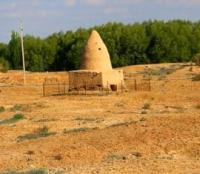
Tours in medieval cities of Southern Kazakhstan.
"On the road to Suzak, we found a great many turtles. At dawn in late September, the caravan stopped four miles from the city. I, along with officials and sultans, was invited to the ruler, or governor, of the city; he treated us to tea, grapes, and melons; plied us with smoking tobacco, and then allowed us to explore the city. Suzak contains up to 500 stone houses, built so closely together that, upon entering the street, you imagine it surrounded by a stone fence. The windows of the houses face the courtyard; in the entire city, there is only one circular street (designed like a labyrinth). This city stands on a high spot, surrounded by a high stone wall, and within it abounds with keys; A garrison of up to 200 people guards the city. On its outskirts are arable lands and scattered yurts of poor Kyrgyz; the inhabitants are industrious, farming and bartering goods with the nomadic Kyrgyz on the Sarys and Chuya rivers. Their women are very kind and so accommodating that many of them came to our caravan. The brother of the ruler of Turkistan, Sultan Shai-Temir, governs this city.
Filip Nazarov. "Notes on Some Peoples and Lands of Central Asia." 1813.
"Khan Mazar," where the khans Abulkhayr and Zhanibek are buried. Further confirmation was found in the book "Tarih-i Kipchak-khani" by Khajam-kuli-bek Balkhi, which states: "Abulkhayr Khan made Dasht-i Kipchak the capital of the state." Finally, in 874-1469-1470, he hastened to the eternal world. His body was buried in the city of Suzak near Tak-Khan."
National Encyclopedia of Kazakhstan.
A trip from Turkestan to village of Sozak.
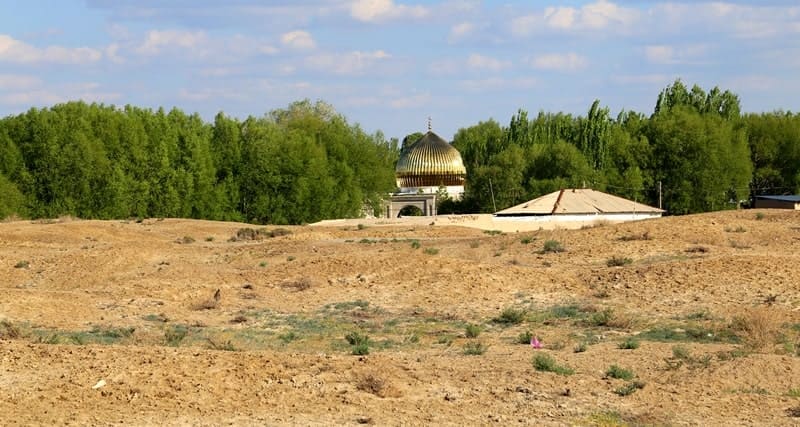
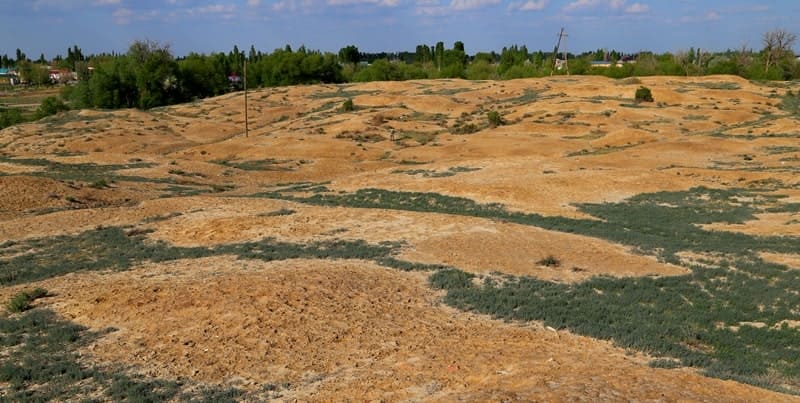
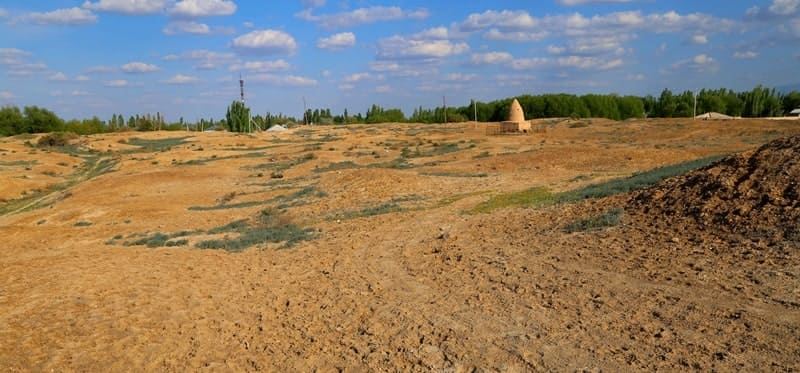
Sozak settlement (Xth-XVIIIth centuries) is located at an altitude of 318 m. a. s. l., in the valley of the small Suindyksay River, a spring-fed river, on a natural elevation. It is located in the central, ancient historical part of the administrative center of the Sozak rural district, the village of Sozak, in the district of the same name in the Turkestan region.
History of Sozak ancient settlement.
In written sources of the XIIIth century, Sozak is mentioned under the name Khuzak, then in XVIth-century sources, in connection with the struggle between the Kazakh khans and the Timurids and Shaybanids for the cities along the Syr Darya, where it appears under the name Suzak.
Surveyed by the Central Kazakhstan Archaeological Expedition (A.Kh. Margulan) in 1946, the South Kazakhstan Archaeological Expedition (A.N. Bernshtam) in 1947-1948, and the ShPI archaeological expedition (A.N. Podushkin) in 1982-1983. The remains of the settlement cover an area of approximately 19 hectares.
Topography of Sozak ancient settlement.
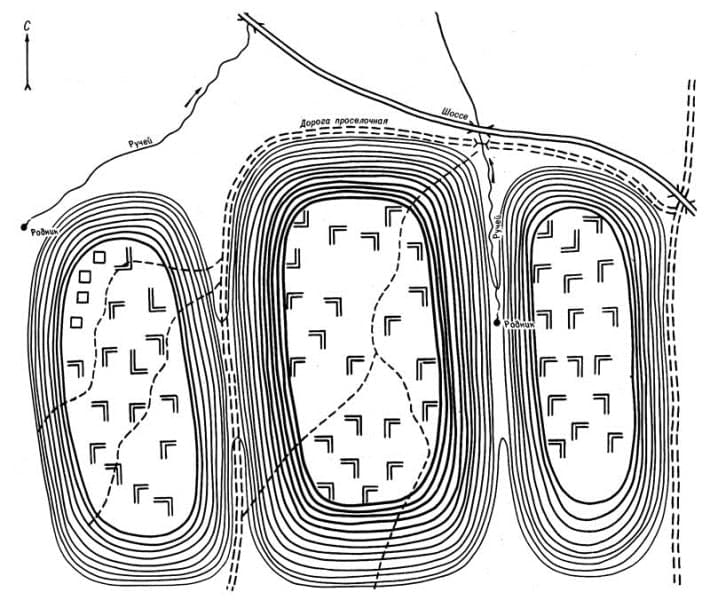
The site is divided into three rectangular platforms, the largest of which, the central one, is 22-25 meters high. The north-south and west-east sides are 350 meters long and 200 meters long. The two other sites adjacent to the central site to the west and east are approximately equal in size: 15-18 meters high, with sides measuring 300 x 200 meters.
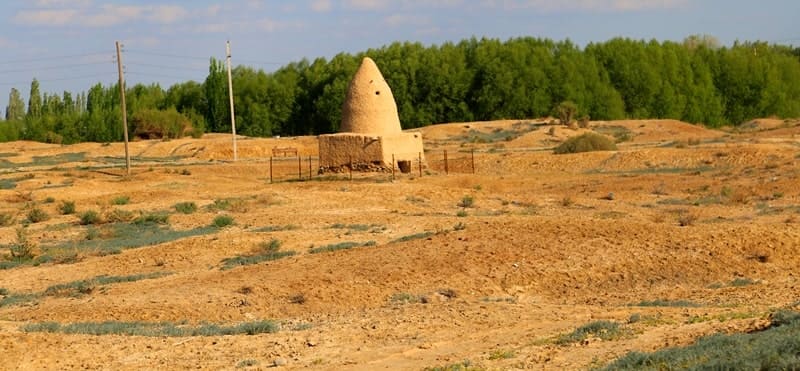
Remains of a gate and supports for a bridge over a small river have been preserved. On the surface of the settlement and the surrounding area, remains of structures in the form of earthen mounds have been identified in various places. Exploratory excavations at the settlement (A.Kh. Margulan) revealed five construction horizons, the oldest of which dates back to the Xth-XIth centuries, and the latest to the XVIIth-XVIIIth centuries.
The most interesting materials are from the horizon dating back to the XVth-XVIth centuries (the cultural layer is approximately 2 meters thick). Excavations revealed parts of courtyard rooms and areas with tandoors, grain storage vessels, cesspools, etc. Several copper coins minted in the XVth-XVIth centuries were also found.
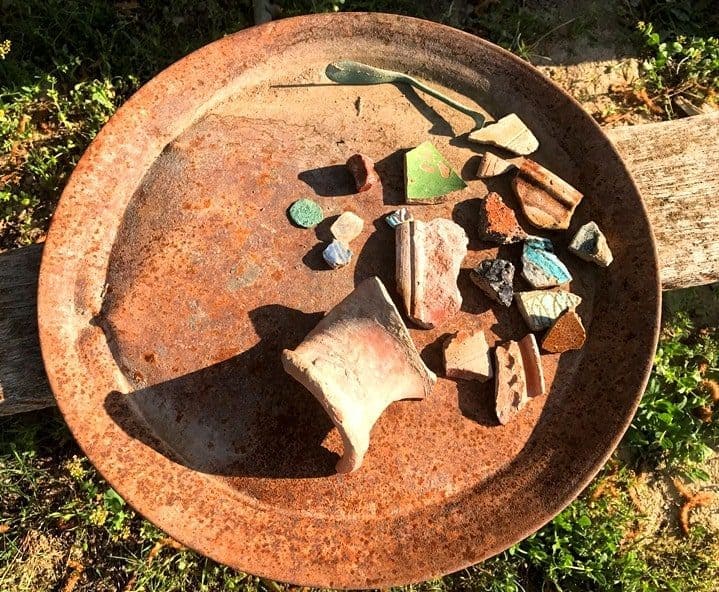
The ceramic material from the settlement is represented by a variety of hand- and machine-made vessels (hums, jugs, tagoras, jugs, bowls, cups, lamps, etc.). A significant portion of the table-type ceramics is covered with white, green, and blue glaze; the ornamental motif is stylized and floral.
Overall, the archaeological material testifies to an active economic and cultural life at the settlement during the high and late periods. Middle Ages. No excavations were carried out.
Authority:
D. A. Taleev. "Code of monuments of the South Kazakhstan region." Architectural and archaeological heritage of the South Kazakhstan region. In the framework of the regional program "Cultural Heritage".
http://www.farsah.kz
A. Margulan on Old Suzak settlement.
The Old Suzak settlement consists of three rectangular platforms with truncated corners, of which the central platform is the highest. It measures 350 meters from north to south, 200 meters from west to east, and is 35 meters high. The eastern platform measures 300 meters from north to south, 200 meters from west to east, and is 20 meters high.
The western platform is approximately the same size. The ruins of Old Suzak are located in the southern part of the ancient settlement, a modern village, on a high mound representing a thick cultural layer, which is bordered to the north by the bed of a small river fed by numerous springs originating on the northern slope of the Syrdarya Kara-tau.
A large dirt road crosses the settlement, running from north to south. The surface of the platform. The streets and courtyards are literally strewn with fragments of ceramics of varied types. Pots, jugs with vertical corner handles, bowls, and others are found here.
All of them were made on a potter's wheel from a dense, well-fired clay, free of organic impurities. The red dough is broken into fragments. Fragments of large cauldron-shaped vessels and hand-molded khums, as well as fragments of a tandoor, can be found here.
Geographical coordinates of Sozak settlement: N44°08'15 E68°28'00
References:
Margulan A.Kh. "From the History of Cities and Construction Art of Kazakhstan." Almaty-Ata, 1950, pp. 51-53;
Ageeva E.I., Patsevich G.I. "From the History of Settled Settlements and Cities of Southern Kazakhstan." Proceedings of the Institute of Atomic Energy of the Academy of Sciences of the Kazakh SSR. Alma-Ata., 1958, T. 5, p. 111;
Erzakovich L. B. “About the late medieval settlement of Suzak.” "Izvestia of the Academy of Sciences of the KazSSR". Ser. societies, sciences, 1966, V. 3. p. 81-91;
Baipakov K. M., Erzakovich L. B. “Ancient cities of Kazakhstan.” Alma-Ata., 1971, p. 175-186.
Authority:
A. X. Margulan. "Archaeological exploration in Central Kazakhstan." 1946
Photos by:
Alexander Petrov.
Sozak is a medieval city.