




You are here
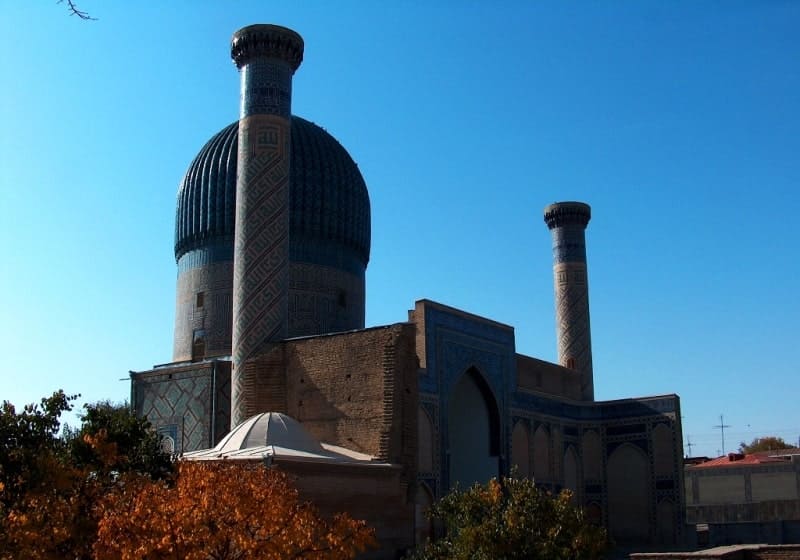
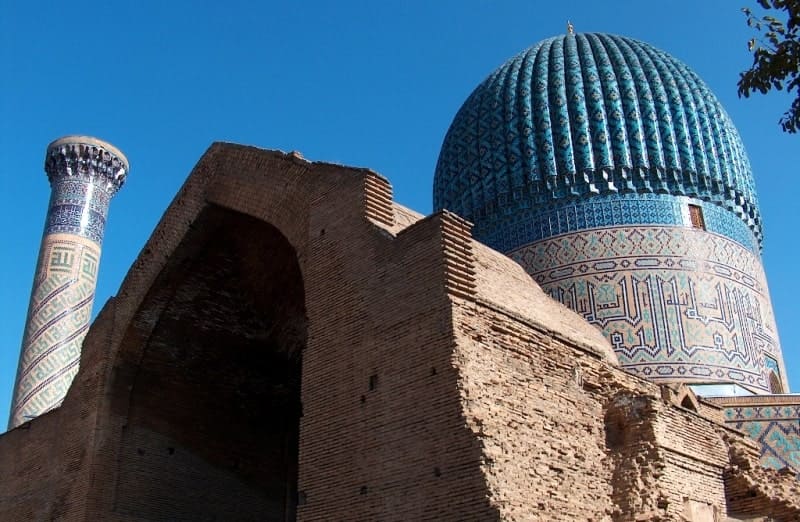
Gur Emir mausoleum.
Ancient monuments of Samarkand.
"Allah, the blessed and exalted, said: Whoever enters here will find salvation!"
"This is Paradise, which is promised to us – enter it, and abide therein forever!"
"Allah, the blessed and exalted, said: admit the pious into Paradise and to the streams of Paradise, prosperous and tranquil. Allah, the Most High, is Truthful!"
"The Prophet, peace be upon him, said: Death is a bridge connecting friends with friends."
"The Prophet, peace be upon him, said: Happy is he who renounces the world before the world renounces him; prepares his grave before he enters it; pleases his Lord before he meets Him."
Inscription at entrance to Gur-Emir Mausoleum.
Shopping tour in Samarkand.
Gur-Emir Mausoleum is located at an altitude of 718 m. a. s. l. on Bustonsaray Street in central part of city, 424 meters southeast of Amir Temur monument in Samarkand.
Gur-Emir (Uzbek: Goʻri Amir / Гўри Амир from Persian: گورِ امیر "Tomb of the Emir") is the mausoleum of Tamerlane (Amir Timur), his mentor Mir Sayyid Barak, and several members of Timur's family (the Timurids) in Samarkand, Uzbekistan. It is also interpreted as "Guri Mir" - the tomb of the worlds, referring to Mir Said Barak.
In 2014, by decision of the Interparliamentary Assembly of the CIS Member States, it was added to the list of "Pearls of the Commonwealth" landmarks.
History of Gur-Emir Mausoleum.
Built at the initiative and expense of Timur in 1404, this masterpiece of Persian architecture (Azeri style) from the Timurid era occupies an important place in the history of world Islamic architecture. The chief architect of the mausoleum was Mahmud Isfahani, a native of the Iranian city of Isfahan.
The Timurid Mausoleum (official name since 2009) served as the prototype for famous architectural monuments of the Mughal era: Humayun's Tomb in Delhi and the Taj Mahal in Agra, built by Timur's descendants, who were once the ruling dynasty of Northern India.
Construction of Gur-Emir Mausoleum.
In 1403, after a military campaign against the Ottoman Empire, Timur's heir to the throne, Muhammad Sultan, died. Returning to Samarkand in the autumn of 1404, Timur ordered the construction of a mausoleum for his grandson, which became the Gur-Emir family tomb.
The mausoleum was built in the southeastern part of medieval Samarkand, next to the madrasah and khanaka of Muhammad Sultan. Timur died during a campaign in China. In January 1405, he arrived in the city of Otrar (its ruins are located near the confluence of the Arys and Syr Darya), where he fell ill and died (according to historians, on February 18; according to Timur's tombstone, on the 15th).
The body was embalmed, placed in an ebony coffin covered with silver brocade, and, contrary to Timur's wishes, who had requested burial in his native Kesh, was taken to Samarkand at the instigation of his grandson, Khalil Sultan. Tamerlane was buried in the Gur-e-Amir mausoleum, which was still unfinished at the time.
Official mourning ceremonies were held on March 18, 1405, by Timur's grandson Khalil Sultan (1405-1409), who seized the Samarkand throne against the wishes of his grandfather, who bequeathed the kingdom to his eldest grandson, Pir Muhammad.
During the reign of Ulugh Beg, the mausoleum became the Timurid family crypt, and a doorway was built to provide entrance.
Tombstones in Gur-Emir mausoleum.
This architectural complex contains the tombs of Timur himself, his sons Shahrukh (died 1447 in Herat) and Miran Shakh (killed April 21, 1408, near Tabriz), and his grandsons – Ulugh Beg (1394-1449) and Muhammad Sultan, as well as the Timurids Abdullah Mirzo, Abdurahmon Mirzo, and Timur's teacher and mentor Mir Said Baraka.
According to the will of Timur's youngest son, Shahrukh, Mir Said Baraka's remains were buried in the Gur Emir mausoleum. Timur was a Muslim and a follower of Sufi orders. Timur's main spiritual mentor was Sheikh Mir Said Baraka, a descendant of the Prophet Muhammad.
It was he who presented Timur with the symbols of power: the drum and banner, when he came to power in 1370. Mir Said Bereke predicted a great future for the emir. He accompanied Timur on his great campaigns. In 1391, he blessed him before the battle with Tokhtamysh. In 1403, they mourned the unexpected death of the heir to the throne, Muhammad Sultan.
According to the Arab historian Ibn Arabshah, Timur constantly said:
"Everything I have achieved in the state and the powerful countries I have conquered - all of this was achieved through the prayer and blessing of Sheikh Shams al-Din al-Khaworiyya, and all the good fortune I have found is due to Said Baraka."
Therefore, Timur himself was buried at his feet. Ulugh Beg brought two pieces of jade to Samarkand for Timur's tombstone as trophies from his campaign through Central Asia to Yulduz in 828 AH (1425). According to N.I. Veselovsky, Timur also ordered three pieces of jade to be brought to Samarkand, but was only able to bring one.
The other two were taken by Ulugh Beg. The tombstone is essentially a cenotaph, as Timur's remains are buried in an underground crypt located beneath the tombstones. In 1447, the remains of Shahrukh, who died in Herat, were brought to Samarkand by his daughter, Payanda Sultan Begim.
On the elevated platform of the mausoleum, behind a marble fence, is an unknown tombstone of a descendant of the Prophet Muhammad, Sayyid Sayyid Umar. According to T. Saidkulov, this could have been Sheikh ad-Din Kulyal. Also buried in the mausoleum is Muhammad Sultan, the son of Abu Said, a Timurid and grandson of the Uzbek Khan Abulkhair Khan by the daughter of Khan-khade Begim.
Crypt in Gur-Emir Mausoleum.
"An inconspicuous staircase, descending beneath the floor, leads to the crypt. The crypt is gloomy and damp. The vault of the crypt is built boldly, almost horizontally. The white joints of the masonry, protruding against the brown background of ground bricks, form a veritable web. The corners of the crypt's base unfold like pendentives. Tombstones covered with inscriptions lie on the floor of large stone slabs.
Vasily Lavrentyevich Vyatkin. "Antiquities of Samarkand." Third edition. 1927.
As V.V. Radlov reported in 1868, "Near the entrance to the mausoleum, there is a hatch in the floor, from which a staircase leads to a spacious crypt beneath the mausoleum. It is built of rough bricks, perfectly preserved, but without any decoration and unplastered.
In this crypt, just beneath the mausoleum's tombstones, lie seven more tombstones, flat marble slabs."
Subsequent centuries of Gur-Emir Mausoleum.
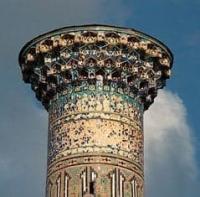
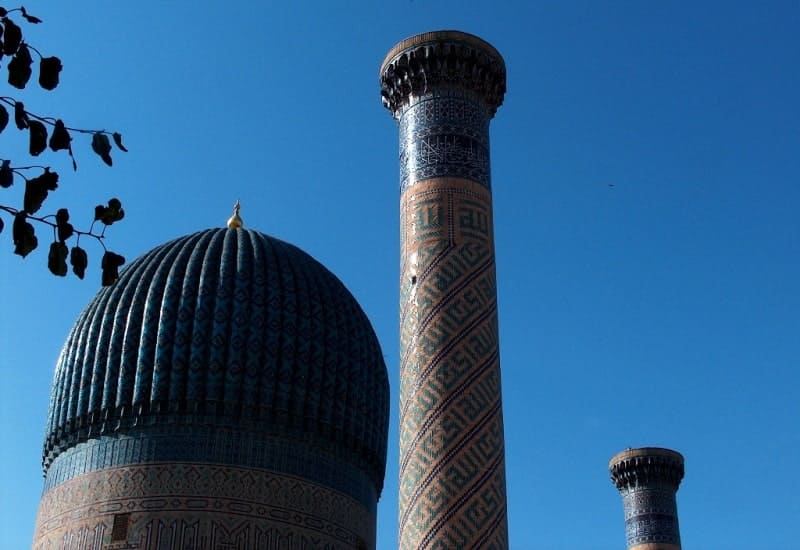
"The best-preserved is the tomb of Timur-Leng, the conqueror of the world, Tyurbeti-Timur. It is built of brick, glazed on the outside, so that the outer walls are decorated with artistic mosaic arabesques. The mausoleum is octagonal, with a melon-shaped dome covered in blue glaze. Two tall, powerful brick columns rise on either side of the dome. A spiral staircase once led up to them, but now it is perilous to climb. The columns are also covered with a mosaic pattern of glazed brick."
V.V. Radlov. 1868.
In the autumn of 1404, the Gur-Emir Mausoleum was visited by the Spanish ambassador, Ruy González de Clavijo, who gave a brief description of the building. During the Central Asian campaign of Nader Shah (the first Shah of the Iranian Empire from the Afshar dynasty) from 1737 to 1740, his troops attacked and captured Samarkand.
In 1841, Russian envoy N. V. Khanykov wrote following about Gur-Emir:
"The coffin of Amir Timur. It is housed in a tall octagonal building covered with a lofty dome; the interior of this structure consists of two rooms: the first, a kind of aisle of the mosque itself, contains the tombstone of Timur, its floor is paved with white marble."
The slab walls are covered with inscriptions from the Koran and, in places, very well-preserved gilding. In the center of the second room, on a marble pedestal surrounded by a lattice carved from the same stone, stands Timur's tombstone, shaped like a truncated tetragonal pyramid, three feet high and five to six feet long, resting on its upper section.
Its color is dark green, fading to black, and it is very well polished. When Nadyar Shah captured Samarkand, he ordered it brought to him, and on that occasion it was split in two. Around this monument are slabs of white marble, constituting the tombstones of Amir Timur's family.
Beneath the room we've described is a crypt, into which one descends almost on all fours. It contains the coffins of the aforementioned individuals, and their burial sites are marked with marble slabs bearing inscriptions.
Hungarian orientalist Arminius Vambery, who visited Samarkand in 1863, wrote following about Gur-Emir:
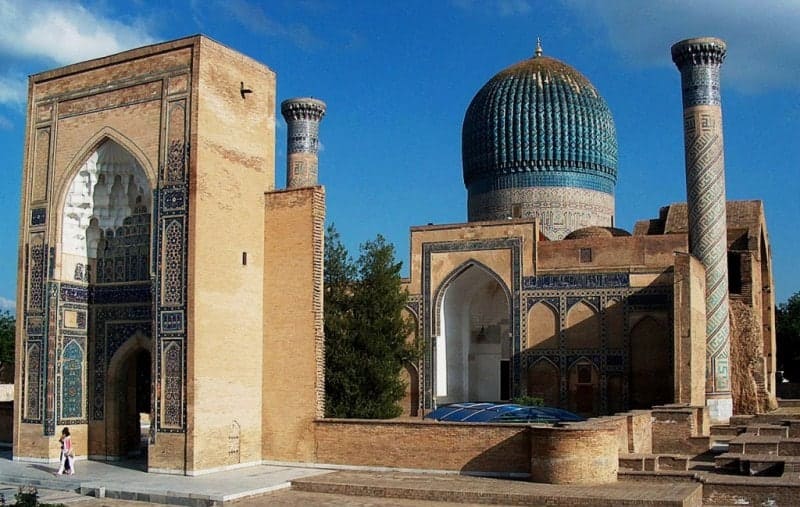
"Turbati Timur (Timur's tomb) is located southeast of the city. Here stands a beautiful mausoleum with a magnificent dome, surrounded by a wall. On either side of the rather high gate are two small domes, similar to the larger one. The space between the wall and the mausoleum is planted with trees; it must have been a garden, but now it's all in terrible disrepair.
The entrance to the mausoleum is from the east, and its pediment, as prescribed, faces Mecca (the qibla)."
In 1868, Russian troops under General N. N. Golovachev captured Samarkand. Soon after the fall of Samarkand, the powerful fortress of Katta-Kurgan was captured, and on June 2, 1868, the emir suffered a final defeat at the Zerabulak Heights and sued for peace.
Under the peace treaty of June 23, 1868, the Bukhara Khanate ceded the Samarkand, Katta-Kurgan, Penjekent, and Urgut beydoms to Russia. According to A. A. Kersnovsky, when A. E. Baranov's battalion entered Samarkand, the emir requested aman.
Bukhara recognized Russia as a protectorate, ceding Samarkand and all lands up to Zerabulak.
In the summer of 1868, Turkologist V.V. Radlov visited Samarkand and described the Gur-Emir as follows:
"The best-preserved mausoleum is that of Timur-Leng, the conqueror of the world, Tyurbeti-Timur. It is built of brick, glazed on the outside, so that the outer walls are decorated with artistic mosaic arabesques. The mausoleum is octagonal, with a melon-shaped dome covered in blue glaze.
Two tall, powerful brick columns rise on either side of the dome. A spiral staircase once led up to them, but now it can only be climbed with danger. The columns are also covered with a mosaic pattern of glazed brick."
In 1871, military engineer Z. E. Zhizhemsky built a road to the mausoleum, connecting this monument with the fortress and the new city that was beginning to be built at that time. By the early 20th century, only the foundations of the madrasah and khanaka, the main entrance portal, and part of one of the four minarets remained.
Architecture of Gur-Emir Mausoleum.
Exterior of Gur-Emir Mausoleum.
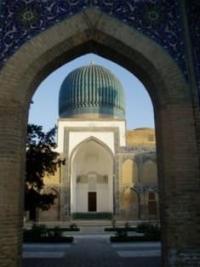
The Gur-Emir Mausoleum is a single-domed building with a crypt. It is distinguished by the simplicity of its design and the solemn monumentality of its architecture. A huge ribbed dome (15 meters in diameter, 12.5 meters in height) dominates, slightly overhanging the cylindrical drum.
The lower part of the building is octagonal, almost hidden by numerous later additions. A small portal faces north. The dome and drum account for more than half the building's total height. In Gur-Emir, only the main building of the mausoleum dates to the Timur period.
The tiled decoration of the mausoleum is dominated by large mosaics of square and oblong glazed bricks - dark blue, light blue, and white. However, only the ribs of the dome and the stalactite transition from the drum to it were completely covered with glazed bricks.
On the drum, ornamental motifs and inscriptions are executed against a background of yellow terracotta facing bricks.
Items removed from Gur-Emir mausoleum.
"This is the tomb of the Sultan of the World, Emir Timur Guragan..." Lieutenant General Baranov, who was passionate about history, decided to take with him a small piece of fencing discovered in 2015 in Yekaterinburg. For this find, he even received a large silver medal at the Ural-Siberian Exhibition, with the citation "for a historically rare monument."
Until 1905, a beautifully executed tiled mosaic inscription in white letters on a blue background stood above the side entrance door: "This is the tomb of the Sultan of Peace, Emir Timur Guragan..." A copy of it is now displayed above the carved door.
In 1905, the slab with the inscription was broken by thieves, and in 1906 it was purchased in Constantinople for 10,000 francs for the Friedrich Museum in Berlin. Thanks to the participation of Russian diplomats and the sum of 6,000 marks, the artifact was brought to St. Petersburg and is now kept in the Hermitage.
Carved juniper doors (built around the turn of the XIVth and XVth centuries) with bone and mother-of-pearl inlays (with a floral design complemented by a vase, a bouquet of flowers, stars, half-crosses in a square frame, and an Arabic inscription above) were also brought from Samarkand to St. Petersburg.
Interior of Gur-Emir Mausoleum.
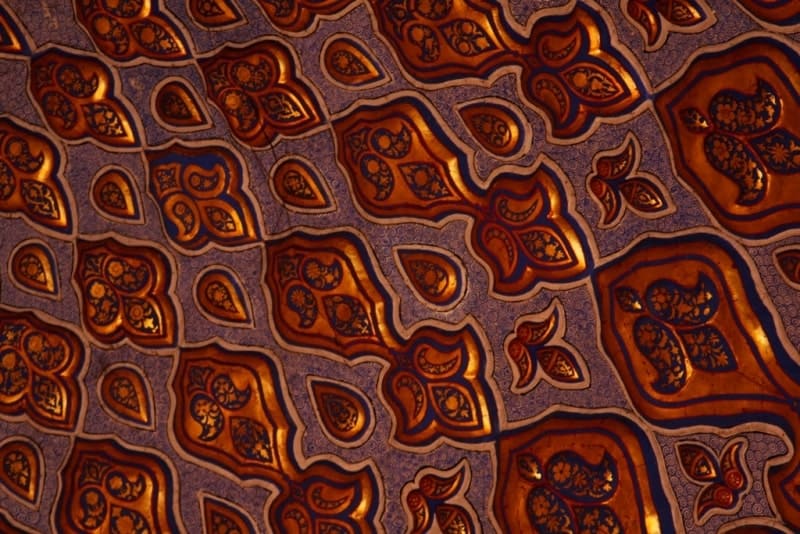
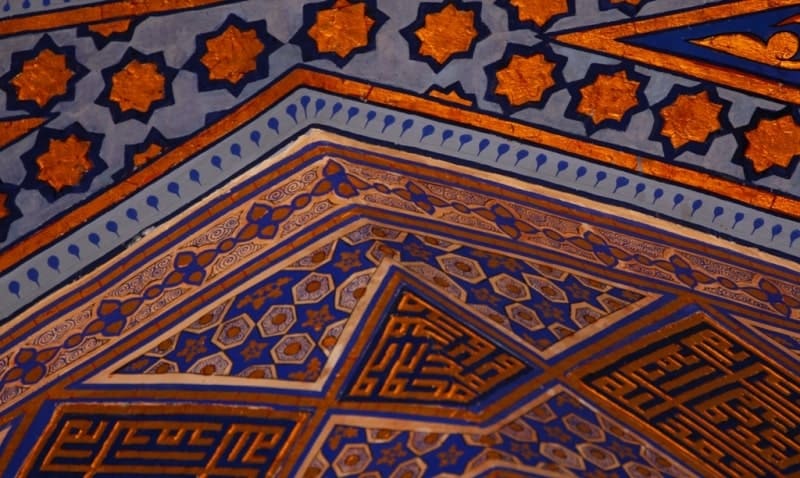
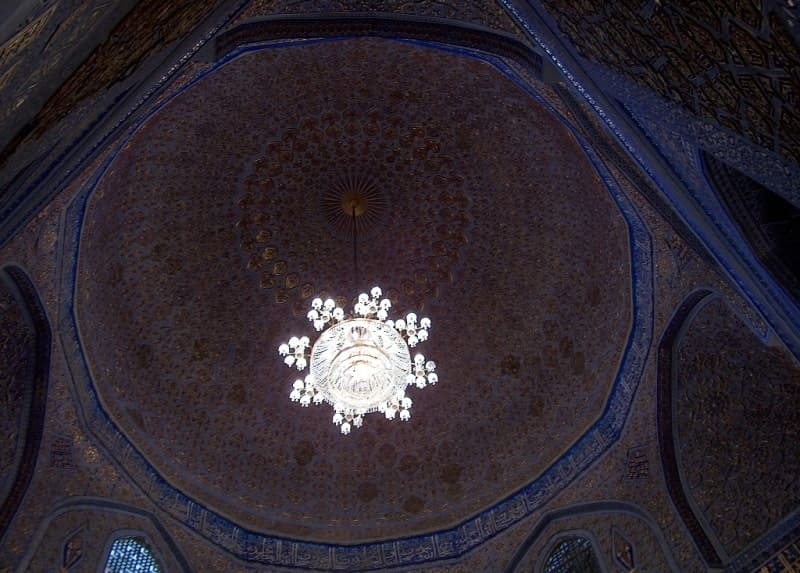
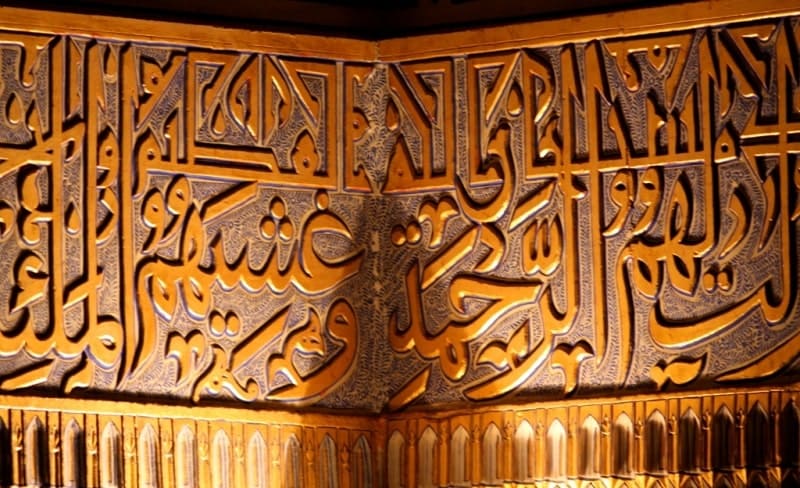
Inside the building, the walls are decorated with marble panels with green serpentine inserts and friezes of carved inscriptions at the bottom, and painted with blue paint and gold above. The relief rosettes on the dome's ceiling imitate a starry sky.
The decorative elements include openwork window grilles and a marble railing around the tombstones, but these are merely decorative; the real ones are in the basement. In the first years after Emir Timur's death, the mausoleum was richly furnished with weapons and utensils.
The crypt, located in the mausoleum's basement, has a low, unadorned ceiling, unlike the upper room. It contains the actual graves of Timur's spiritual mentor, his children, and grandchildren, arranged in the same manner as the decorative tombstones on the upper floor.
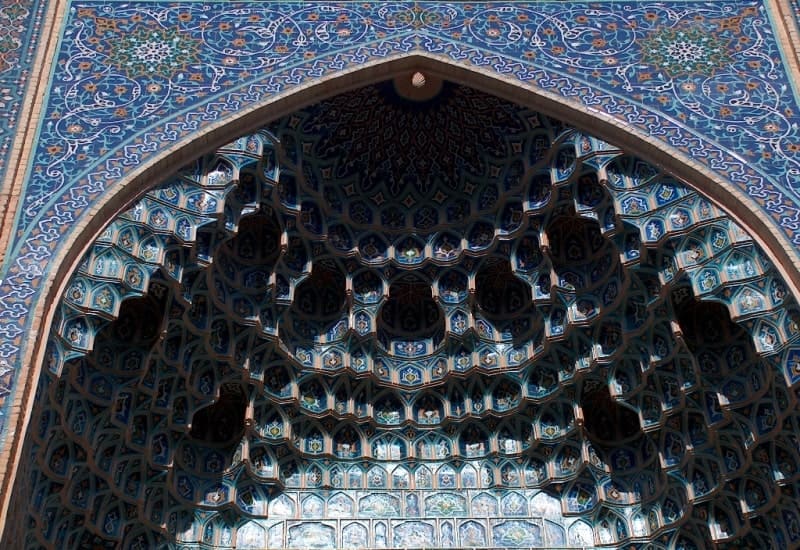
In the depths of the entrance portal niche, the name of one of the monument's creators, the architect Muhammad ibn Mahmud Isfahani, is inscribed among a mosaic pattern.
Inscriptions on walls and doors of Gur-Emir Mausoleum.
"The interior, completely painted walls on alabaster plaster, represent meager remnants of their former splendor, and only a careful examination can evoke the artist's good taste. The painting is dominated by greenish paints, matching the panels. The vault and the arches in the corners beneath it were completely lined with embossed palmettes and rosettes made of silk cloth, painted gold and other colors. The tops of the niches where the vault meets the gable wall are filled with stalactites, which have the appearance of... Behind the marvelously crafted marble latticework, with its varied ornamental motifs on the frame and columns, delightful in the flexibility of the chisel and the breadth of imagination, are the tombstones and pedestals of Timur himself, his two sons, two grandsons, and his spiritual father, the teacher."
Vasily Lavrentyevich Vyatkin. "Antiquities of Samarkand." Third edition. 1927.
The ornamentation is dominated by inscriptions, sometimes heavily geometricized. On the drum, "eternity to God" is written several times in a circle in huge letters, and "praise be to God" in smaller letters in the top line.
And on the side and rear faces of the main octagonal building, three words alternate, sometimes tilted in different directions, sometimes upside down:
"servant of God Muhammad."
On the doors of the mausoleum, displayed in the Hermitage exhibition, is the inscription:
"Truly (this) world and wealth (are) a loan to the king."
Another door of the mausoleum bears the inscription:
"Sovereignty belongs to God. May its completion be successful!"
Allah, the blessed and most high, said:
"Whoever enters here will find salvation! This is Paradise, which is promised to us – enter it, and abide in it forever!"
The Prophet said:
"Peace be upon him: happy is he who renounces the world before the world renounces him; prepares his grave before he enters it; pleases his Lord before he meets Him."
Kuktash Throne Stone in Gur-Emir Mausoleum.
Until 1868, the Kuktash throne stone (meaning "blue stone" in Turkic) was housed in Timur's later restored throne room. From the 15th to the 19th centuries, the Timurid throne stone, Kuktash, housed in the palace, hosted the coronation ceremonies of Central Asian rulers from various dynasties, from the Timurids to the Manghit.
Although Bukhara was the capital of the Emirate of Bukhara, the Uzbek emirs of Bukhara, Haydar, Nasrullah, and Muzaffar, held their coronation ceremonies in Samarkand, on Kuktash. The last coronation ceremony took place in 1861, when Emir Muzaffar's coronation ceremony took place.
In the 1920s, the former palace of the Bukhara emirs was finally destroyed by the Soviet authorities, and the throne stone, Kuktash, was moved several times until it was finally placed in the courtyard of the Gur-Emir Mausoleum in the 1960s, where it remains today.
Opening of graves in 1941 at Gur-Emir Mausoleum.
In June 1941, the USSR government decided to open the grave of Timur and his relatives. The official occasion was the anniversary of the Uzbek poet Alisher Navoi. The expedition included the Deputy Chairman of the Council of People's Commissars of the Uzbek SSR, as well as historian and expert on ancient languages, Professor T.N. Kara-Niyazov, writer S. Aini, orientalist A.A. Semenov, sculptor and anthropologist M.M. Gerasimov, and archaeologist M.E. Masson.
The expedition included archaeologists V. A. Shishkin and Yahya Gulyamov, literary scholar Khadi Zaripov, writer M. I. Sheverdin, and anthropologist L. V. Oshanin. Young cameraman M. Kayumov was entrusted with filming the opening of the graves.
According to another version, in 1941, during the construction of the Intourist Hotel near the Gur-Emir Mausoleum (built in 1970 next to Amir Temur's tomb), water flooded the crypt, causing the destruction of Timur's remains. In an attempt to prevent the burial site's destruction, a team of scientists led by anthropologist Mikhail Mikhailovich Gerasimov began excavations.
The special Government Expedition of the Uzbek SSR, established by T. N. Kary-Niyazov, aimed to establish the authenticity of the burials, elucidate the funeral ritual and other circumstances surrounding the burial of Timur and his descendants, conduct a thorough anthropological study of the remains, verify the legendary stories preserved in oral traditions and ancient chronicles, and create sculptural portraits of the deceased.
Excavations gave rise to legend of "Spirit of Tamerlane."
Restoration work at the Gur-Emir Mausoleum. The first restoration work was carried out by the Timurids of Maverannahr. Beginning in the 17th century, the Baburids of India, in memory of their ancestor Timur, annually donated substantial sums for the repair of the mausoleum.
For example, in 1621, an envoy from the Baburid Jahangir (1605-1627) arrived in Samarkand, bringing 30,000 rupees, 5,000 of which were intended for the tomb of Amir Timur. In 1924-1926, the vault over the crypt was rebuilt and the stone floors were redone. In the 1950s, the outer domes and glaze were restored.
In 1967, in preparation for the celebration of Samarkand's 2,500th anniversary, large-scale restoration work began on the initiative of Sh. Rashidov. After the republic's independence was declared in 1991, at the initiative of the first president of Uzbekistan, Islam Karimov, two minarets were restored in 1996 for the 660th anniversary of Amir Timur's birth, using photographs and measurement drawings made in the XIXth century.
Rukhabad Mausoleum and Aksaray Mausoleum.
Near the Gur-Emir monument are two small structures: the Rukhabad Mausoleum and the Aksaray Mausoleum. All three mausoleums are often considered a single complex due to their proximity. Also nearby was the Kutbi-Chaardakhum Mausoleum of Sheikh Nuruddin Basir, built by Timur in 1371.
According to V.L. Vyatkin, the Nuruddin Basir Mausoleum in the Samarkand citadel was called a khanaka and was destroyed during Russian rule. According to V. Vyatkin, the mausoleum above the Kutbi Chaardakhum mazar "was destroyed by the Russians during the construction of the current fortress."
The transfer of Ulugh Beg's body, killed in October 1449, to Gur-Emir occurred during the reign of Abdullah (1450-1451). After this, no burials are known to have taken place within Gur-Emir, although the Timurid dynasty ruled Samarkand for another half-century.
Legends of Gur-Emir Mausoleum.
According to legend, in 1740, the Persian military commander Nadir Shah removed Tamerlane's tombstone, crafted from a single block of jade.
Tamerlane's Spirit in Gur-Emir Mausoleum.
"The Spirit of Tamerlane" is an archaeological legend that the Great Patriotic War began with the opening of Tamerlane's tomb, which released the spirit of war. The myth is based on the fact that excavations of Tamerlane's tomb began on June 16, 1941, in connection with the construction of the Intourist Hotel near the Gur-Emir Mausoleum.
The hotel's construction workers blocked one of the irrigation ditches, and water flooded the crypt. The destruction of Timur's remains began - they were covered in gypsum crystals. In an attempt to prevent the destruction of the ancient ruler's burial site, a team of scientists led by Mikhail Mikhailovich Gerasimov began excavations.
When the sealed coffin was opened on June 19, 1941, aromatic vapors filled the tomb, giving rise to the legend of the "spirit of Tamerlane." The originator of the myth about the outbreak of war being caused by the opening of the tomb is Soviet cinematographer Malik Kayumovich Kayumov, who was present at the time.
Other participants in the expedition included archaeologists Tashmukhamed Niyazovich Kary-Niyazov and A. A. Semenov, anthropologist M. M. Gerasimov, writer and philologist Sadriddin Aini, and his son Kamal. On January 1, 2004, director Alexander Fetisov's documentary "The Curse of Tamerlane" aired on television.
On November 30, 2012, the online publication Pravda.Ru published an article by Anton Yevseyev, "The Curse of Tamerlane's Tomb Does Not Exist."
Geographic coordinates of Gur Emir mausoleum are: N39°38'54 E66°58'09




Authority:
https://ru.wikipedia.org/wiki/%D0%93%D1%83%D1%80-%D0%AD%D0%BC%D0%B8%D1%80
Photos by:
Alexander Petrov.