




You are here
History of Gur-Emir Mausoleum and its restoration.
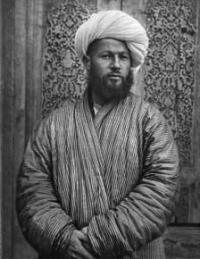
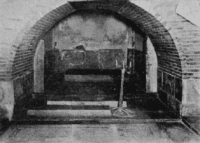
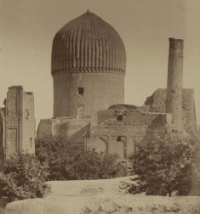
Researchers of Gur-Emir Mausoleum.
"One night, (Tamerbek) attacked a flock of sheep, and at that moment people (rom Seistan) arrived, rushed at him and his accomplices, killed many, and knocked him off his horse and wounded his right leg, after which he remained lame, as well as his right hand, after which he lost two small fingers; and they abandoned him, thinking him dead. (Tamerbek) began to move as best he could and crawled to the tents of some (people) wandering in the field, from where [he soon] left, and, having recovered, began to gather his people again. This Samarkand emperor was disliked by his subjects, especially the common people, the townspeople, and some nobles. They told Tamerbek to kill the emperor and [then] they would install him in power. And things got so bad that one day, when the emperor was heading to a town near Samarkand, Timur Beg attacked him. He fled to the mountains and asked a man he met to shelter him and heal him (of his wounds), promising to make him rich, and gave him an expensive ring he was wearing. But the man, instead of sheltering him, told Timur Beg about him, who immediately appeared and killed him."
Ruy González de Clavijo. "Tamerlane." Moscow, 1992. Page 303.
Construction of Gur-Emir Mausoleum.
Amir Temur Mausoleum, restored by restorers, attracts and will continue to attract thousands of tourists. The grandeur and lightness of its architectural lines and forms, the richness of its multicolored mosaics and stone carvings - all of this has made the Gur-Emir a unique monument, a true masterpiece of Central Asian architecture.
In 1404, by order of Amir Temur, construction began on the Gur-Emir mausoleum ("tomb of the emir"). It was intended to house the remains of his beloved grandson, Muhammad Sultan, the son of Jahangir and Suyun-Aga, granddaughter of Uzbek Khan.
However, conceived as a personal mausoleum for his favorite grandson, it eventually became the Temurid family tomb. Scholars have good reason to believe that the choice of site for the mausoleum was motivated by the cult of two sheikhs. 550 meters to the north stood the tomb of Sheikh Nur ad-Din Basir, who died in 1249.
120 meters south, in a place called Rukhabad (abode of the spirit), was the burial place of his admirer, Sheikh Burkhan ad-Din Sagarji (born in 1380). Time has undoubtedly taken its toll on the monument's preservation. As the renowned archaeologist M. Masson noted in the early XXth century, compared to other architectural monuments in Samarkand, Gur-Emir was in better condition.
Several decades before the Russian conquest, according to elders, the mausoleum's dome was repaired, albeit not entirely successfully. Immediately after Russian troops settled in Samarkand in May 1868, the military administration ordered the monument's repair.
According to the Turkestan News, 1870 edition of the mausoleum's repairs, undertaken by order of Governor-General K. P. von Kaufman, 3,000 rubles were allocated to restore the monument. However, in the fall of 1868, the northeastern minaret collapsed, with the local population scavenging many bricks from its base for their own use.
By winter, preliminary repairs to the roofs and interior were completed, and they continued into 1869. Master stone carvers were brought in from Nurata. They created two spans of openwork marble latticework using old models. Photographs in the Turkestan Album, compiled by A. Kun in 1871-1872, clearly show traces of repairs on the dome and new ganch lattices installed in the openings of the baratesh.
Somewhat later, the monument was enclosed with a brick lattice, and a small garden was laid out, leading to an alley lined with poplars from Abramovsky Boulevard. From 1895 to 1897, an archaeological commission conducted surveys and artistic and architectural sketches at the mausoleum.
This resulted in the publication of a beautiful album dedicated to this monument in 1905. One copy of the publication remains in the library of the Institute of Archaeological Research of the Academy of Sciences of the Republic of Uzbekistan, and two others are in the collections of the Samarkand State Museum-Reserve.
The measurements were taken by the renowned architect A.V. Shchusev, and the drawings of the glazed sections of the walls and dome were made by the artist-restorer P.P. Pokryshkin. On May 18, 1903, the second northwest minaret collapsed unexpectedly, and in 1916, a sharp sag became apparent.
The crypt vault structure. Therefore, in 1924, a special agency for the protection of Samarkand's ancient monuments carried out extensive preliminary work: tombstones were moved, the flooring was removed, and the foundations were uncovered.
Archaeological, architectural, and artistic research was conducted at the monument for two years. Valuable material was obtained for expanding our knowledge of Gur-Emir itself and the historical architectural monuments of Central Asia in general.
In the spring of 1926, under the supervision of architect M. F. Mauer, the work to lighten the crypt vault was completed. A reinforced concrete platform was installed between it and the floor, which now distributes the pressure of the tombstones, which were replaced in their original locations.
To structurally strengthen the mausoleum, which was torn apart by cracks along its axes and diagonals, ring iron ties were installed in the drum and the lower half of the dome. Despite the war, in 1943 the Council of Ministers of the Uzbek SSR adopted a resolution on the general restoration of the Gur-Emir ensemble.
Of the many projects submitted, the following were completed: restoration of the minaret (architect Samoilov, 1944), the eastern gallery (architect Zasypkin, 1944), the eastern half of the southern wall of the courtyard (architect Zasypkin, 1945), engineering support and restoration of the dome cladding (engineer Nelle and architect Lazarev, 1947), the portal design of the southern iwan (architect Zasypkin), the entrance portal (architect Atanasova, 1950), the entrance niche in the Ulugbek gallery (architect Notkin, 1951), strokes on the entrance portal (architect Vinogradov, 1952), and the walls of the courtyard (architect Notkin, 1955).
The mausoleum's dome cladding was carried out by veteran masters A. Umarov, M. Yunusov, Sh. Gafurov, and K. Jalilov. Restoration of the marble latticework inside the mausoleum was carried out by experienced stonecutter Mirumar Asadov, who was awarded the title Hero of Uzbekistan in 1996 for his many years of valiant work.
In 1955, restoration work was carried out on the courtyard walls of the ensemble. Since the layout of the madrasah, located within the Gur-Emir complex, was unclear, its remains were built up with several courses of brickwork, and the entire area between them was paved with concrete slabs.
Between 1994 and 1996, extensive restoration work was carried out on the mausoleum. The reconstruction project was designed by Egamberdi Nurullaev, who later received the A. Navoi Prize. According to the project, the interior of the mausoleum was restored, including the onyx panels, paintings, and gilding of the walls and the interior surface of the dome.
The glazed coating of the mausoleum's dome was restored. The entrance portal was tiled. Restorers from the Institute of Archaeology of the Academy of Sciences of the Republic of Uzbekistan preserved and treated with special compounds the surfaces of the long poles above the upper tombstones of the graves of Seyid Omar and Seyid Bereke, which had been eaten away by woodworm.
In addition, general landscaping was carried out both within the monument and in the surrounding area. It is now open to the view of travelers along the road leading to the Registan...
Authority:
Marina Reutova, Head of the Laboratory of the National Archaeological Center of the Academy of Sciences of the Republic of Uzbekistan.
https://sv.zarnews.uz/post/gur-emir-istoriya-restavracii