




You are here
Hunting by Kyrgyz in Turgai Steppe.
Nature of Turgai Region.
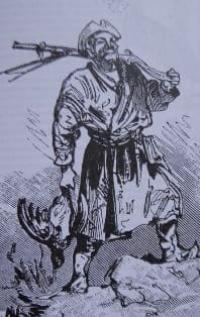
"Hunting with a golden eagle is found only among the Kyrgyz people who roam the mountainous southeastern terrain of the Turgai region; it is particularly well-developed among the so-called 'wild-stone' (mountain-dwelling) Kyrgyz who inhabit the spurs of the Alatau mountains. In this area, hunting with a golden eagle serves as a genuine trade, providing a significant supplement to the meager budget of a nomad. Golden eagles are used to hunt foxes, corsac foxes, hares, polecats, and ermines. The bird captures the latter three with ease - on a successful day, the hunter can barely keep up with securing all the prey to his saddle. Hunting foxes and corsac foxes, however, is an entirely different matter. These animals are exceptionally cunning and cautious; when cornered with no escape, they become vicious, ferocious, and desperate - posing a real danger even to the hunter himself."
Ya. Ya. Polferov, "Hunting in Turgai Region," 1896.
Fauna of Turgai Region.
By virtue of its geographical location, the Turgai region is the part of Asia closest to the borders of European Russia, occupying the northeastern section of the Aral-Caspian Lowland. It is bounded to the north by the Orenburg Governorate, to the west by the Ural region, to the south by the Aral Sea and the Syr-Darya region, and to the east by the Akmolinsk region.
The Turgai region spans an area of 400,830 sq. versts - a size comparable to that of the Caucasus and Transcaucasia combined. The region consists of an expansive plain, which, in its southeastern section, is intersected by spurs of the Guberlinsky and Mugodzhary mountains.
These mountains do not form a continuous range; rather, they comprise a series of isolated ridges and uplands covered in scrub, with numerous valleys through which mountain streams rush noisily. These uplands taper off into slopes blanketed in tall feather grass, with occasional thickets of forest.
To the south, the character of the terrain changes significantly, giving way to an unbroken lowland rich in barren, saline soil and shifting sands. Among the latter, the Bolshiye Barsuki (Great Barsuki) and Malyye Barsuki (Small Barsuki) are particularly notable for their vast extent.
Vegetation in this area is sparse, consisting almost exclusively of saltwort and wormwood - plants that manage to thrive only along the banks of rivers and lakes. The Turgay region is watered by an extensive network of rivers and lakes. Notable rivers include the Ural, Tobol, Turgay, Dzhalanchik, Irgiz, Ilek, Khobda, and Or.
With the exception of the Ural and the Tobol, these are typical steppe rivers - characterized by a close dependence on atmospheric precipitation, which leads to sharp fluctuations in water levels. In the spring, during the snowmelt, and in the summer, during periods of heavy rain, these rivers overflow their banks, spreading across vast areas often becoming so turbulent that all travel and movement are brought to a standstill for weeks at a time.
Yet, once the spring floodwaters recede - and after just a month without rain - these once-broad, full-flowing rivers shrink into pathetic, meager streams, broken in many places by small sandy islets. The lakes are vast bodies of water that both feed and receive numerous rivers and streams.
Their gently sloping shores are overgrown with tall reeds and dense thickets of willow, while further up, they are bordered by broad-stemmed sedge, forming what looks like a green fringe. Near the banks, the water collects in shallow pools and marshy hollows, but toward the center, it opens up into an expansive, deep basin, with aquatic vegetation reaching all the way to the bottom.
The primary inhabitants of the Turgai region are the Kyrgyz a nomadic, Turkic-speaking people though, more recently, Russian settlers have also arrived, engaging in agriculture. The Turgai region is one of the most faunally rich areas in Central Asia. Its boundless feather-grass steppes provide lush pastures for countless herds of kulans and saiga antelopes.
The reed beds and thickets are home to wild boars, corsac foxes, ermines, weasels, common foxes, hares, wolves, and polecats, while across the sandy dunes and salt flats, the constant, shrill whistling of marmots and ground squirrels fills the steppe.
Rivers, lakes, marshes, and pools - teeming with fish, worms, algae, and lush wetland vegetation, and sheltered on all sides by dense thickets of willow, reeds, and sedge - are blanketed with ducks, geese, common snipes, great snipes, jack snipes, moorhens, coots, and a wide variety of other waders.
The elevated, hilly terrain - covered in tall grasses, dwarf almond, pea-shrub, and various meadow grasses abounds with great bustards, flamingos, plovers, little bustards, ruffs, partridges, and curlews bustards, flamingos, plovers, little bustards, ruffs, partridges, and curlews.
Forests with large clearings overgrown with young willows, aspens, and alders provide shelter for black grouse, capercaillie, wood pigeons, grey partridges, turtle doves, and woodcocks. In the lushly vegetated meadows, a true symphony unfolds: the corncrake calls out with spirited, rhythmic rasps sounding as if a comb were being drawn across a hard surface while flocks of oystercatchers and curlews dart through the air, letting out plaintive cries.
The passionate, urgent call of the male quail is met with a languid, tender response from the female. Thus, the Turgai region characterized both by its physical landscape which alternates between monotonous, uniform plains covered in tall feather grass and dense thickets, and chains of hills and mountain ridges broken by valleys and by its rich and abundant fauna, stands as an ideal territory for hunting, whether pursued as a passionate pastime or as a livelihood.
Before the arrival of the Kyrgyz people, the Turgai steppes were sparsely inhabited; the Kalmyk tribes that roamed the area did not venture deep into the southern reaches, preferring instead to remain closer to their kin who lived within the borders of the Astrakhan, Don, and Stavropol provinces.
The vast expanses south of the Ural River, characterized by dense forests, remained unoccupied; their profound silence was rarely broken by the sounds of human activity, and these areas served as natural sanctuaries for wildlife. Moreover, the Kalmyks both by virtue of their religious beliefs and their way of life were not particularly devoted to the cult of the hunt; the passion for hunting that gripped other Mongol tribes at the time appears to have been foreign to them.
At the very least, there is no evidence neither in historical records nor in contemporary observations of Kalmyk life to suggest that such a tradition ever flourished among them.
While it is true that graves and ruins found in the Turgai steppe contain inscriptions indicating that the cult of the hunt was indeed practiced during the period of Kalmyk dominance, these instances appear to be either incidental or, as the noted steppe researcher Meer put it, "imported" (introduced from elsewhere).
The Bashkirs the indigenous inhabitants of the neighboring mountainous region, long renowned as passionate hunters could not help but take notice of the boundless steppes stretching toward the Aral Sea, which teemed with valuable game such as the saiga antelope and the argali (mountain sheep).
They would descend into the Turgai steppes, venture deep into their forests, and in areas particularly rich in game settle with entire “auls” (villages), remaining in place for several years at a time. It was these Bashkir hunters who left behind traces of the cult of the hunt that have survived to the present day.
This is corroborated by the etymology of the place names, the nature of the inscriptions and drawings, and the legends surrounding two Bashkir hunters known as "Kos Istek." When the steppe stretching from the Aral Sea to the Ural Mountains was occupied by a new people the Kyrgyz tribes a cult of hunting, practiced by these free and mobile nomads, rose to great prominence.
It became one of the central aspects of life for the Kyrgyz nomads of the Turgai region. From this period onward, we frequently encounter evidence in Kyrgyz historical sites indicating that hunting was highly developed among the population. For instance, the walls of burial structures located near forests are often adorned with depictions of coursing hounds and birds of prey.
On one of the stone slabs at the Bai-Tam burial site, one can still discern the image of a Kyrgyz hunter, a golden eagle perched on his arm and a quiver full of arrows slung across his back. The most common methods of hunting at that time involved the use of birds of prey and coursing hounds, while the primary weapons were arrows tipped with bone or iron points.
According to oral tradition and later, the accounts of various researchers of the steppe hunting with birds of prey was an essential feature of any festive celebration. All their spare time of which the nomads of the past had a great deal was spent on hunting expeditions, and their songs and folktales revolved almost exclusively around the hunt.
In those days, the Kyrgyz lived in complete independence. The feather-grass steppes they inhabited, stretching for thousands of versts in every direction, teemed with vast herds of cattle, horses, and sheep; their lives were filled with a variety of pastimes, the most cherished of which was hunting with falcons and hawks.
But as centuries passed, a careless attitude toward life entrenched by the rigid chains of stagnation and fanaticism, as well as by sloth and shortsightedness, all sanctioned by custom and Islam gradually eroded the nomad’s contentment. This son of the open steppe was reduced to destitution, and his once-joyful existence faded into the realm of pleasant legends, recounted to new generations by folk bards.
The life of the modern Kyrgyz is consumed by the struggle for daily bread; it presents a stark picture of an unsophisticated people engaged in an unequal battle against a harsh, unforgiving, and truly harrowing state of deprivation. Under such circumstances, there can be no talk of entertainment.
For the modern nomad, the hunting cult has completely shed its former character once a form of amusement, entertainment, or a noble passion and has instead taken on the nature of a trade and a means of self-defense. Naturally, this has brought to the fore hunting methods and techniques that prioritize a large catch over aesthetic appeal or the simple pleasure of the pursuit.
This decline is particularly evident in the practice of hunting with birds of prey a pursuit that can serve only as a form of recreation, never as a source of income. Today, this type of hunting is the province of the affluent nomad, serving as a benchmark for wealth, prosperity, and social standing.
Authority:
Ya. Ya. Polferov, “Hunting in Turgai Region” (illustrated). Published by Turgai Statistical Committee. Orenburg: N. N. Zharinov’s Printing and Lithography House, 1896.