






You are here
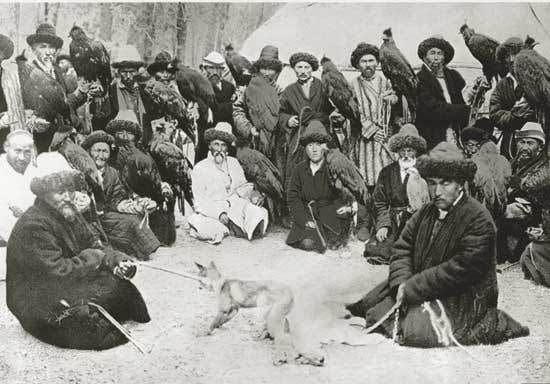
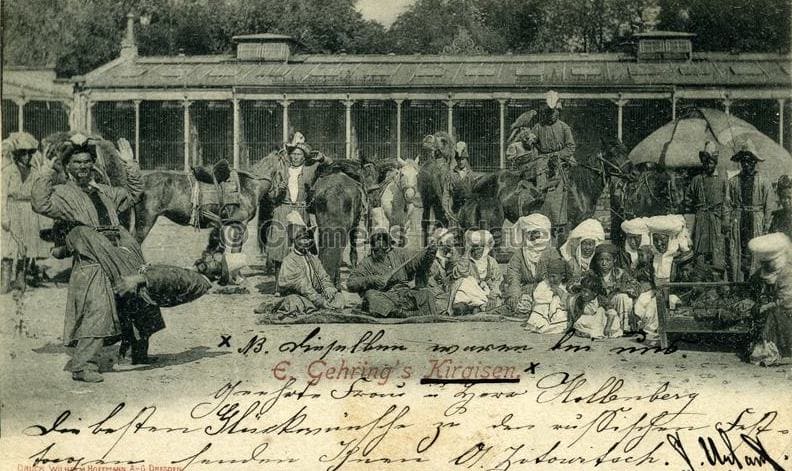
Hunting with birds of prey in Turgai Region.
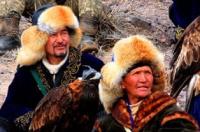
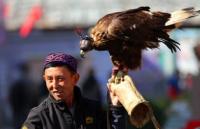
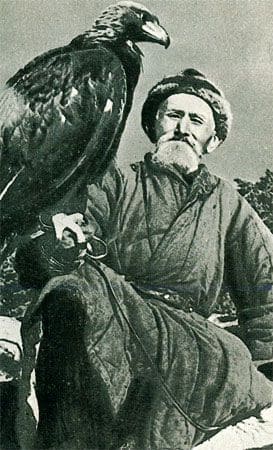
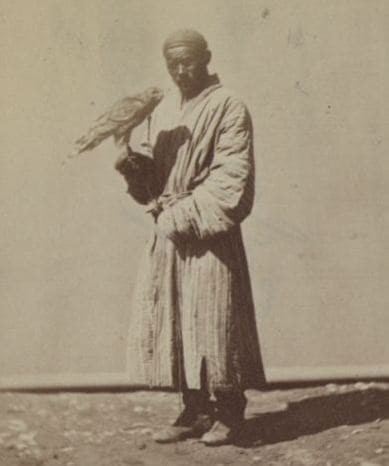
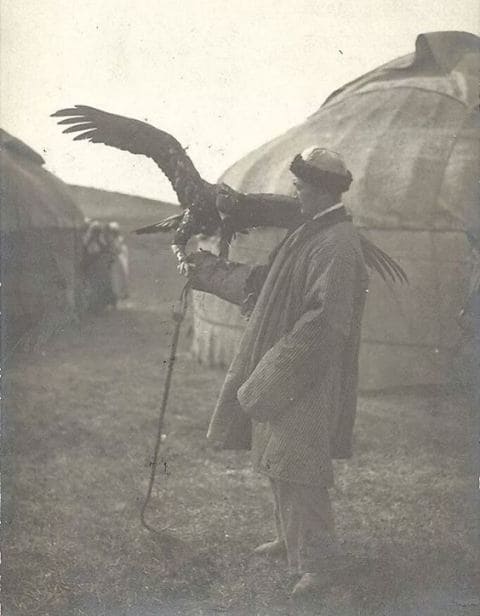
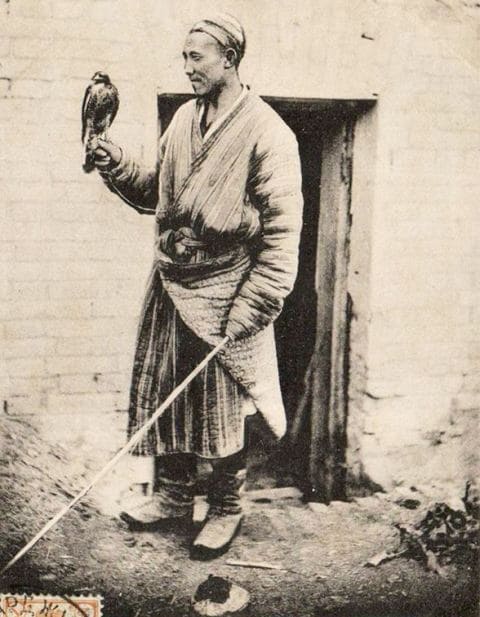
Birds of prey used by Kyrgyz people include falcon, hawk, gyrfalcon, and golden eagle.
"The region consists of an expansive plain, intersected in its southeastern section by spurs of the Guberlinsky and Mugodzhary mountains. These mountains do not form a continuous range; rather, they comprise a series of separate ridges and uplands covered in scrub, with numerous valleys through which mountain streams rush noisily. These uplands slope downward into terrain covered with tall feather grass, and in some places, dense thickets of forest. To the south, the character of the landscape changes significantly, giving way to a vast lowland rich in barren, saline soil and shifting sands. Among the latter, the 'Big and Small Barsuki' (sands) are particularly notable for the sheer area they cover; vegetation in this part is sparse, consisting almost exclusively of saltwort and wormwood plants that manage to thrive only along the banks of rivers and lakes."
Ya. Ya. Polferov, "Hunting in the Turgai Region," 1896.
Specifics of hunting with birds of prey.
Hunting with birds of prey - if not the very first and oldest method of procuring game birds - certainly has a history that reaches back into the distant past, long before the advent of Christianity. For instance, the well-known Greek historians Ctesias and Aelian, who lived 400 years before the birth of Christ, mention the practice of hunting with birds of prey among the peoples of India.
From there, this form of hunting spread to Persia, and subsequently reached the Balkan Peninsula. The first mention of falconry among the Greeks comes from Aristotle, who records that during the reign of Alexander the Great, the Thracians used birds of prey for hunting.
According to Gen, the Celts - the oldest and most hunting-oriented of all European tribes - adopted the practice from the Thracians. Sidonius Apollinaris (430-489 AD) makes a passing reference to falconry among the Romans, noting that "no one was more skilled than my friend Vectius in the training of dogs and falcons.
During the Migration Period - the IVth and Vth centuries - hunting with birds of prey spread across the entire European continent. In Russia, the practice of hunting with birds of prey was introduced by the South Slavs and was likely also adopted from the Polovtsians (Cumans) and Pechenegs - a detail supported by references in ancient “byliny” (epic folk poems).
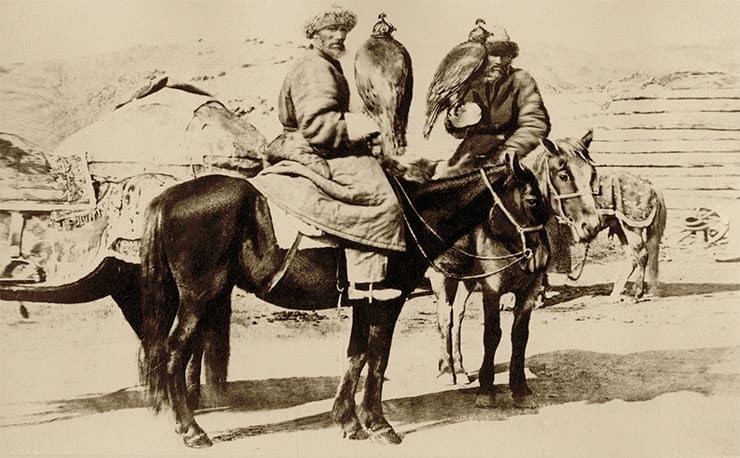
However, the first written accounts of falconry appear only during the time of Vladimir Monomakh, who mentions falcons and hawks in his testament. Among the Kyrgyz people, the birds used for hunting include various falcons, hawks, gyrfalcons, and golden eagles.
A hunter’s primary concern is first to capture these predators, and subsequently to tame and train them. Capturing the first three types of birds is quite straightforward. An open area covered with low grass or small shrubs is selected, where a small, four-sided net is stretched out and secured to the ground with four pegs.
Beneath the net, a small bird - a choice morsel for these avian predators - is tethered to a shrub or the grass. Hawks, falcons, and gyrfalcons, upon spotting prey, will dive headlong and become entangled in nets. Capturing a golden eagle is far more difficult.
While it is quite easy to catch a young eagle just beginning to take flight, such a bird will quickly wither in captivity and die before reaching maturity. For this reason, nomads avoid taming very young golden eagles for hunting, preferring instead to capture them at one or two years of age.
To do this, they weave a circular net from thick woolen yarn, secure it firmly to several stakes near a spot favored by the eagles, and place a dead hare or ground squirrel beneath it. Even then, it often happens that the net cannot withstand the desperate struggles of this powerful predator; before the bird-catcher can rush over, the eagle lets out a sharp cry and soars high into the sky.
Once a bird of prey has been captured, the hunter’s first and most important task is to train it to bond exclusively with him. To achieve this, the hunter takes full responsibility for the bird’s care - feeding it by hand and keeping curious onlookers away - while repeatedly calling it by a specific name whenever he offers food.
During the first week, the bird’s diet consists solely of meat that has been soaked in hot water for twenty-four hours and stripped of as much fat as possible. This process turns the meat completely white and gives it a fibrous, stringy appearance, though it also strips away many of its essential nutrients.
Day by day, the portion is gradually reduced until it reaches just two “zolotniks” (approximately 8.5 grams). Following this, the bird is forcibly fed between one and three *zolotniks* of salt to induce vomiting. Complete exhaustion sets in, and the predator, tormented by hunger, is ready to tear apart even its own master just to find some slight relief from the terrible pangs of starvation; yet, light taps on its beak and a stern command from its master keep the captive in check.
Driven to a state of frenzy in this manner, the bird is tested in the field.
A leather hood is placed over the predator’s head, covering its eyes to prevent it from lunging at the very first bird it might spot - which would only serve to intensify its hunger-driven agony to no avail. Game is flushed out often with the help of a drum attached to the saddle - at which point the hood is instantly removed, and the predator is swiftly launched into the air upward.
With fierce intensity, the bird pounces on its quarry, kills it instantly, and prepares to feast on the succulent meat - but the hunter arrives, unceremoniously pulls the bird away from its prize, and secures the kill to his saddle. He then offers the raptor a small piece of the slain bird’s brain before continuing on his way.
How delicious, how exquisite this morsel must seem to a predator exhausted from a diet of bland, unpalatable meat! The bird swallows the brain in an instant and waits for more, but the quarry has already been stowed away, leaving its appetite merely whetted.
Soon, however, new game appears, and the predator seizes it with the same ferocious zeal. This first lesson in the field is more than enough to reconcile a bird of prey to its life of captivity.
Hunting with a Falcon in Turgai Region.
Among the Kyrgyz, the falcon is the favored bird of prey; it adapts more quickly, excels at capturing small game, and is remarkably agile in flight. The Kyrgyz hunter cautiously approaches a stretch of open water - perhaps a pool in a steppe river or a lake - nestled amidst green reed beds. Rising in his stirrups, he scans the area intently for game.
The moment he spots it, he strikes a drum and removes the hood from the falcon’s head. The waterfowl are startled into a clamor - quacking and rustling - as they reluctantly take flight from the water. The hunter, mounted on his swift “argamak” (steed), quickly draws level with the flock and deftly tosses the falcon upward.
Like an arrow, the bird soars into the air, locks onto its target. Having spotted its prey, the falcon begins to circle rapidly above it, slicing through the air with a whistling sound from its beautiful, long wings. At this moment, the Kyrgyz hunter who is witnessing the scene - experiences a complex, intense range of emotions.
He senses a heroic, conscious power a bold challenge to a duel - yet, simultaneously, he perceives the pathetic terror of the frightened bird and its naive, desperate attempts to evade the strike. The falcon gradually tightens the diameter of its aerial circles, climbing ever higher.
Throughout this process, the targeted bird appears as if spellbound; it cannot break free from these enchanted rings, nor can it descend into the reeds to take cover. Some unseen force holds it aloft, leaving it at the mercy of its powerful adversar
Finally, the falcon soars into the misty heights, shrinking to a mere speck before vanishing into the clouds but only for an instant. Like a bolt of lightning, it plunges downward toward its prey -which, in that fleeting moment, seems to freeze, its wings trembling nervously and strikes it with its mighty chest and powerful talons.
The stricken bird falls with a plaintive cry; the falcon, letting out a low, triumphant sound, lands upon it and, piercing its neck with its specialized, tooth-like notch, puts an end to the victim’s convulsive movements. The falcon hunts exclusively for smaller game ducks, geese, shorebirds, and partridges.
It rarely succeeds in taking down larger prey, as it tires quickly from the exertion of its flight and the force of its chest-first strikes. Such impacts often result in a fractured collarbone for the falcon a risk that is particularly high if it strikes a sturdy-boned bird like a bustard.
Hunting with a Hawk in Turgai Region.
Although not as agile in flight as a falcon, a hawk is highly effective at taking down large game - most notably the great bustard. Upon spotting a flock of bustards, the hunter approaches them cautiously, taking a wide detour. The wary birds, however, notice the maneuver well in advance and turn their long necks in alarm.
As soon as the distance between the hunter and the quarry closes to 200-300 paces, the hunter spurs his horse into a full gallop. Before the startled birds can take flight, the hawk - launched by the hunter while at a gallop - streaks toward them like an arrow.
The predator sinks its sharp talons deep into the bird’s breast, tearing through the skin, while simultaneously striking its head with its beak. With its wings splayed, the bustard collapses to the ground; it remains there, staring blankly, making not the slightest attempt to escape.
The hawk immediately descends upon its prey, delivering a final blow that extinguishes the last flicker of life.
Hunting with a Gyrfalcon in Turgai Region.
Hunting with a gyrfalcon is even rarer than the aforementioned practice of hunting with falcons or hawks. This is primarily due to the extreme scarcity of the gyrfalcon, which makes the bird exceptionally expensive (costing 150-200 rubles). At the same time, the gyrfalcon is the only bird of prey capable of bringing down a steppe goose a highly prized and valuable quarry.
With an anxious, angry honk, the goose takes flight, keeping a sharp eye on the approaching hunter. The gyrfalcon beats its supple wings, tracing an arc through the air; it hurtles toward its prey with a whistling sound, its lethal talons poised for the strike. But the goose is no easy target.
Just as the falcon closes in ready to pounce the goose abruptly shifts its flight path at a sharp angle, striking the predator with a stiff wing as it misses its mark. Enraged, the gyrfalcon beats its short wings, thrusts its talons forward, and instantly catches up to the goose once more.
The goose attempts the same maneuver again, but the falcon having learned from its previous miss - anticipates the turn; like a bolt of lightning, it veers in the opposite direction and sinks its talons straight into the goose’s breast. Down, feathers, and adversaries fly through the air; the latter strike the ground like stones.
A wounded goose beats its wings and cries out, pinching the gyrfalcon painfully with its strong beak, while the predator, growling fiercely, tears at its victim’s breast. Because of such vigorous resistance from the goose, young and inexperienced birds of prey especially hawks and falcons are frequently left injured. For this reason, Kyrgyz hunters never send these birds after geese; only the gyrfalcon is capable of taking one, and even then, the victory often comes at a high cost.
It is not uncommon to see gyrfalcons with dislocated talons, bruised wings, or battered breasts, their bodies covered in welts from the goose’s stinging pinches. An experienced hunter will never set a gyrfalcon upon several geese in a single outing it will take one, or at most two as the struggle consumes a vast amount of the predator’s energy and strength.
Hunting with Golden Eagle in Turgai Region.
Hunting with the golden eagle is found exclusively among the Kyrgyz people who roam the mountainous southeastern regions of the Turgai Oblast; it is particularly well-developed among the so-called "Dikokamenny" (or "wild-stone") Kyrgyz, who inhabit the foothills of the Ala-Tau mountain range.
In this region, hunting with the golden eagle serves as a genuine trade, providing a significant supplement to the meager budget of the nomad. Golden eagles are used to hunt foxes, corsac foxes, hares, polecats, and ermines. The predator captures the latter three with ease; on a successful day, the hunter can barely keep up with securing the catch to his saddle.
Hunting foxes and corsac foxes is an entirely different matter. First and foremost, these animals are exceptionally cunning and cautious; when cornered with no escape, they become fierce, vicious, and desperate posing a genuine danger to the hunter himself.
Hunting with a golden eagle is never a solitary endeavor; it involves a whole cavalcade of hunters, accompanied by gamekeepers and beaters. Once a small ravine or valley where foxes or corsac foxes have been spotted is identified, the hunters take up vantage points, while the beaters fan out across the valley.
The wait is never long: startled by the beaters, the animals bolt into the open, drawing ever closer to the hunters lying in wait on the surrounding hills. At this point, the golden eagle begins to grow restless stretching out its neck to listen intently to the distant commotion of the beaters, or casting a sidelong glance downward while twitching its wings nervously.
The hunter watches the eagle’s every move, peering keenly in the direction where the predator has fixed its sharp gaze. From these subtle cues, the hunter can gauge not only the presence of an animal within the cordoned-off valley but also how close it has drawn.
Suddenly, the eagle perched on the hunter’s arm crouches slightly, unfurls its magnificent wings, and stirs its beak; down at the foot of the hill, an animal is creeping along, hoping to elude the bird’s watchful eye. The hunter releases the golden eagle from his arm and immediately sets off in pursuit.
The animal recoils and begins to spin across the valley, darting in zigzags; yet the golden eagle is not fooled. Seizing the perfect moment, it plunges like an arrow toward its prey, sinking the talons of one foot into an eye and the other into its flank, while raining down ferocious blows upon its head and neck.
A desperate struggle ensues, but the eagle’s firm grip prevents the animal from shaking it off, allowing the hunter who has arrived on the scene to strike the beast dead with a heavy riding whip. Such hunts, however, rarely come without a price for the Kyrgyz hunter.
Carried away by the thrill of the chase, he may lose all sense of caution, racing at full gallop along a narrow cliff ledge, leaping across ravines and through thickets toward the abyss. Clinging to his horse’s mane, he scrambles up steep slopes, only to dash forward again at breakneck speed risking a collision with jagged rock formations that could disembowel his mount or shatter its legs.
The hunter himself may be thrown from the saddle at full speed, crashing onto the stony ground and losing consciousness. At times, a bold golden eagle will swoop down upon a wolf, striking its head and gouging out its eyes, pinning the predator in place so that the approaching hunter can easily finish it off.
Hunting with hawks, falcons, and gyrfalcons begins in mid-October when birds of prey often gather in small flocks, preparing for their long migration and continues until the first snowfall. Hunting with a golden eagle, by contrast, begins once the snow has fallen roughly from the end of November and lasts until February, provided the snow is not too deep.
Among the Kyrgyz people who roam the southeastern part of the region and the southern wetlands, the practice of hunting with birds of prey takes on a somewhat different character. Here, we encounter a method that was once quite widespread among Russian hunters of the steppes: hunting with birds of prey in conjunction with dogs.
While training a falcon or hawk, the hunter ensures the bird becomes accustomed to his hunting dogs by keeping them in constant proximity at times, even placing the bird upon a dog’s back. The birds quickly grow comfortable with the dogs; when put to the test, they work together harmoniously and boldly to take hares, foxes, wolves, and game birds.
The hunting dog’s role is to locate and flush out the quarry, while the bird of prey depending on the target either holds larger animals like foxes and wolves at bay or kills game birds. A dog used in this type of falconry must conduct a "short" search, staying close to the hunter; furthermore, it must not give chase to the flushed game with the exception of foxes and wolves - lest it interfere with the bird of prey.
Hunting with birds of prey assisted by dogs is almost always highly successful, effectively clearing the hunted terrain of game. Among the Kyrgyz who dwell near wetlands and lakes choked with dense reeds, however, dogs are replaced by “kayuks” - simple, primitive boats.
The Kyrgyz, holding birds of prey, position themselves around a stretch of open water, while beaters take to boats and begin striking drums, making noise, and whistling; in this way, they flush all the game from the water, which is then seized by the falcons, hawks, and gyrfalcons.
Authority:
Ya. Ya. Polferov, *Hunting in Turgai Region* (illustrated). Published by Turgai Statistical Committee. Orenburg: N. N. Zharinov’s Printing and Lithography House, 1896.