




You are here
Phototour for Tarda and ostrowskiana tulips.
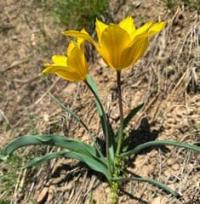
Trip to Kastek Gorge in Almaty region.
"Today I overtook the pine forest
On every road.
Today I grabbed a tulip -
Like a child by the chin."
Marina Tsvetaeva. August 16-17, 1936.
Sightseeing tours in Zhambyl district.
Tour route length: 222 km.
Season: from late March to third ten days of April.
Photo tour duration: 1 day.
Active tour distance: 1-15 km.
Best time to plan an excursion: early or late spring.
Brief description of excursion to Kastek Gorge:
Almaty – Akzhar village – Kyrgauldy – Zhandosov – Kargaly – Uzun-Agach – Karakastek – Suranshi Batyr – Kastek – Almaty.
Excursion to Kastek Gorge: in footsteps of rare tulips.
Kastek Gorge is one of the little-known, yet very impressive places in the spurs of the western part of the Zailiskiy Alatau, located in the Northern Tien-Shan mountains. In spring, it turns into a veritable natural garden, where rare and protected tulip species bloom among the steppe slopes, including the tarda tulip and ostrowskiana tulip.
Detailed description and photo of excursion to see Tarda tulips and Tulipa ostrowskiana tulips.
Transfer: Almaty – Kastek village (105 km).
From Almaty, our route takes us to the Upper Kaskelen Highway, which runs through the "counters" of the northern slope of the Zailiskiy Alatau mountain range. We pass numerous villages and, after the administrative center of the Zhambyl district, the village of Uzun-Agach, which in ancient times was called Urung-Ardzh, a name found in the works of the medieval author Khudud al-Alam.
This name appears on ancient maps of travelers and chroniclers.
Our next destination: village of Kastek – beginning of gorge of same name (6 km).
We pass the village, the paved road ends, and a dirt road begins, stretching along the left bank of the Kastek River and gradually ascending low hills. 3.4 kilometers from Kastek, to the left of the road, on a hill, lies the Kastek settlement. Our route leads into the gorge of the same name.
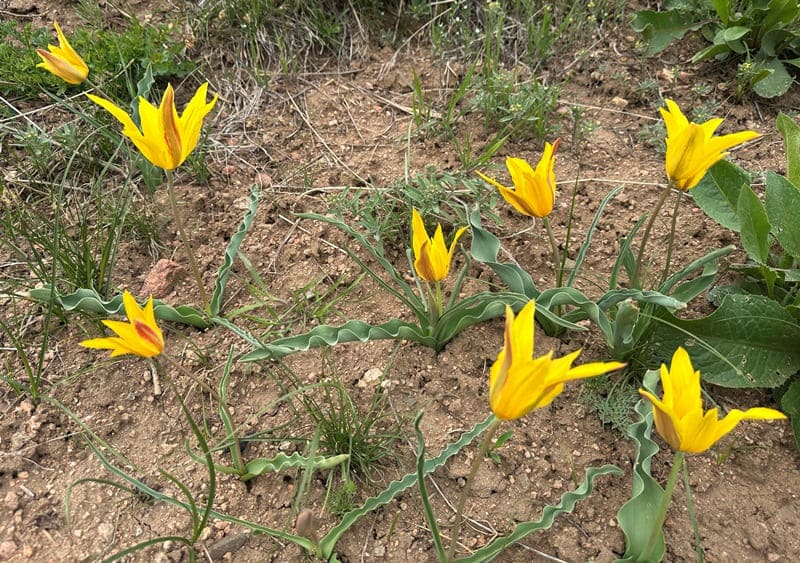
Gradually, the open space and hills begin to close in, and the road gradually and smoothly enters the gorge. A river murmurs below to the left. The road runs along the left bank of the river for its entire length. We travel a short distance, and soon yellow Tulipa ostrowskiana begin to appear on the eastern slope of the gorge, growing in open spaces among rosehips, barberries, honeysuckle (Lonicera), and meadowsweet (Spiraea) bushes.
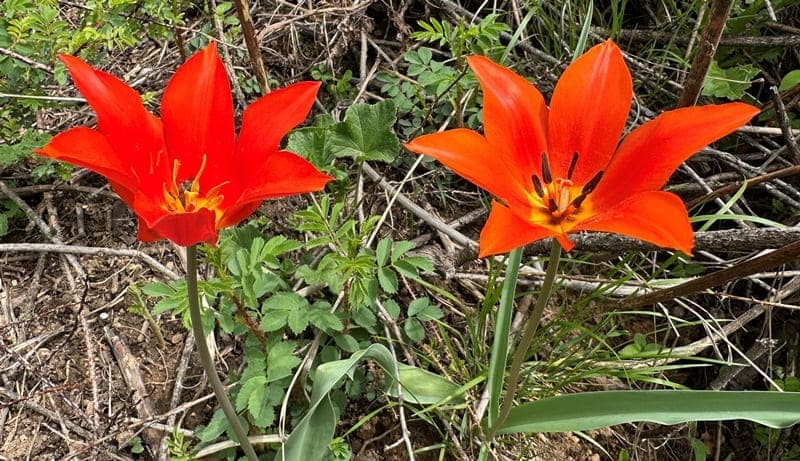
The Tulipa ostrowskiana was described by E.L. Regel in 1884 from the vicinity of Verny (Almaty). It grows on slopes among shrubs in the lower and middle belts of the Trans-Ili Alatau, the southern Chu-Ili Mountains, and the eastern Kyrgyz Range.
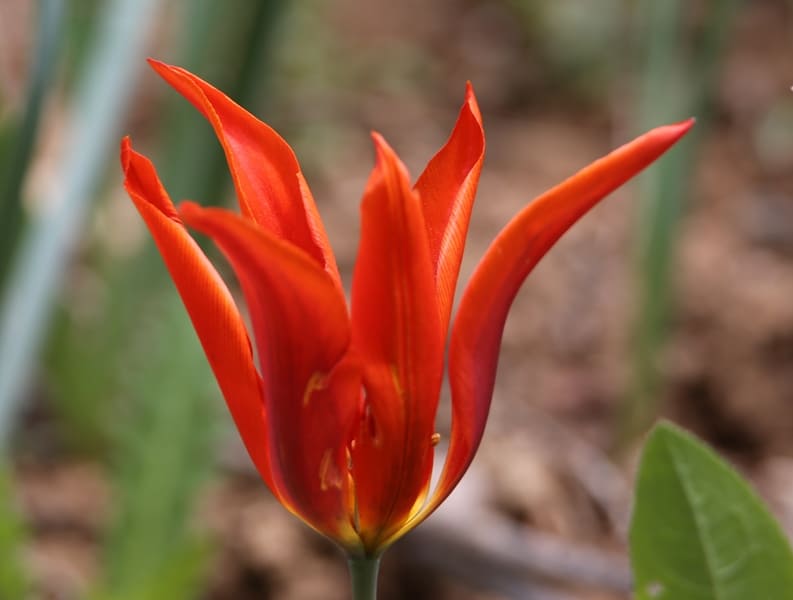
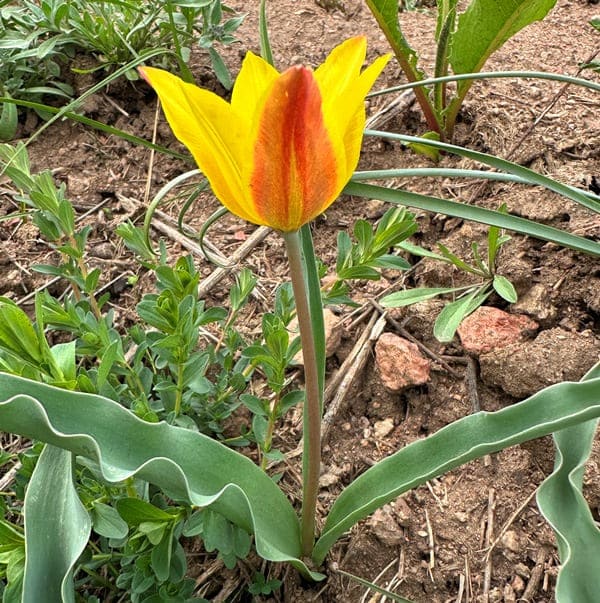
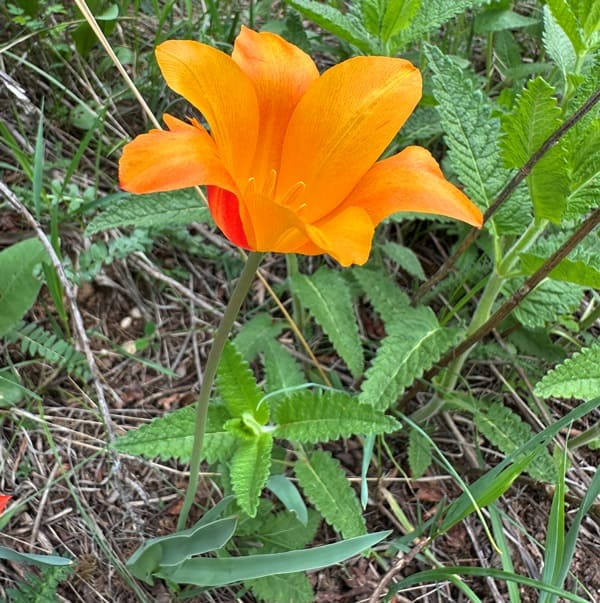
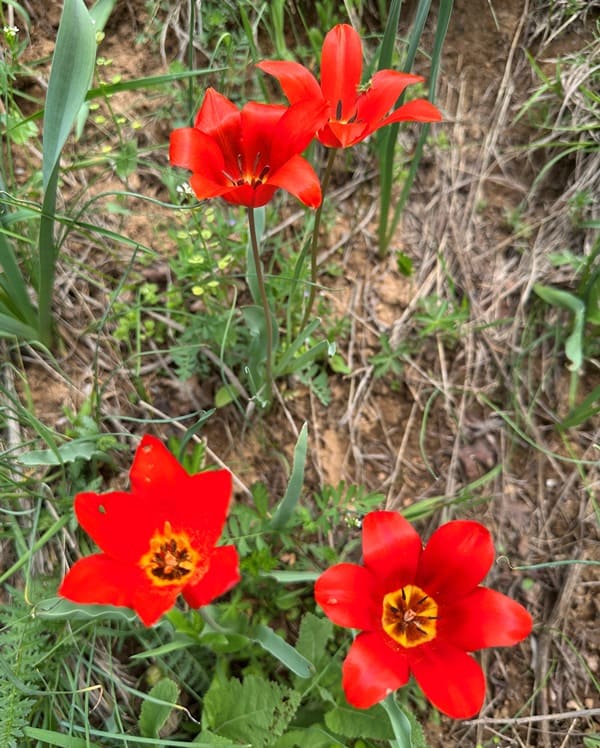
It is distinguished by a tall stem, up to 25-40 cm, with three closely spaced grooved leaves and a large, graceful flower of bright red, or rarely orange, color with a black or yellow spot in the center. Sometimes the flowers are pure yellow. It blooms from late April to mid-May.
It often crosses with Kolpakovsky's tulip, forming hybrid populations with a colossal variety of color variations. These hybrid "thickets" are especially colorful on the Kurdai Pass. Their population is declining due to mass collection for bouquets, as well as the development of mountain slopes for summer cottages.
It is protected in the Almaty Nature Reserve, Ile-Alatau National Nature Park, and the Karakunuz Botanical Reserve. Dense thickets of Albert's irises (Iris albertii Regel) can be found on the western slopes. The Kastek Gorge is distinguished by its diverse vegetation, primarily shrubs typical of the low and mid-mountain areas of the Zailiskiy Alatau mountains.
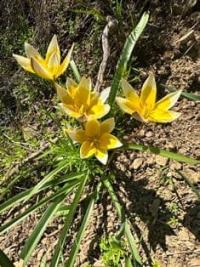
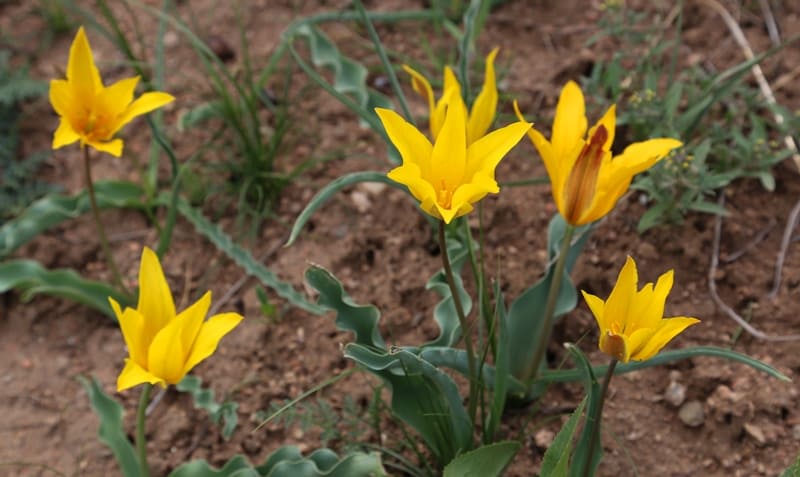
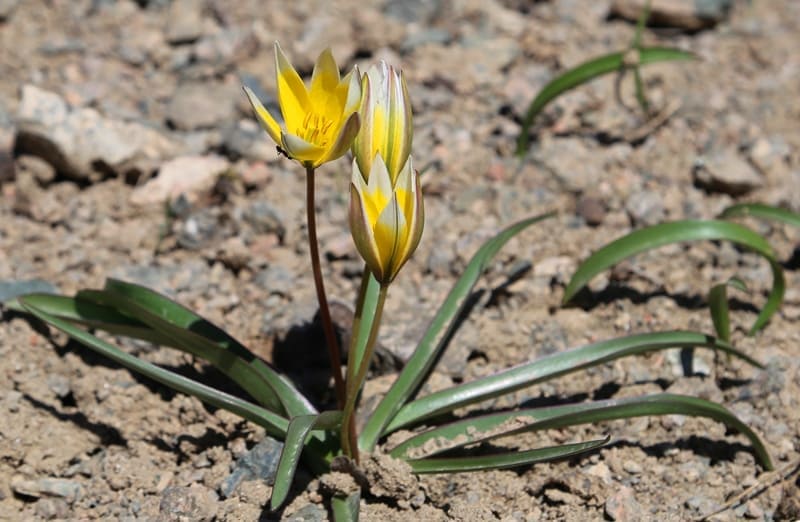
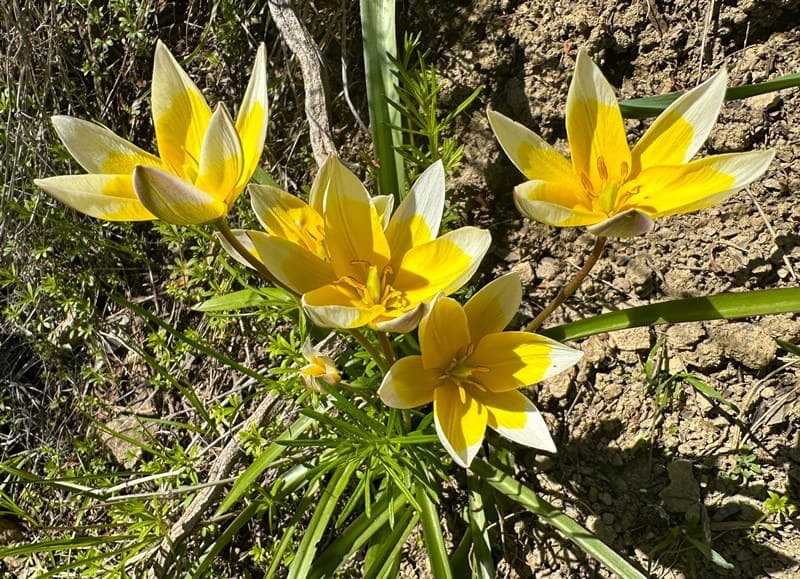
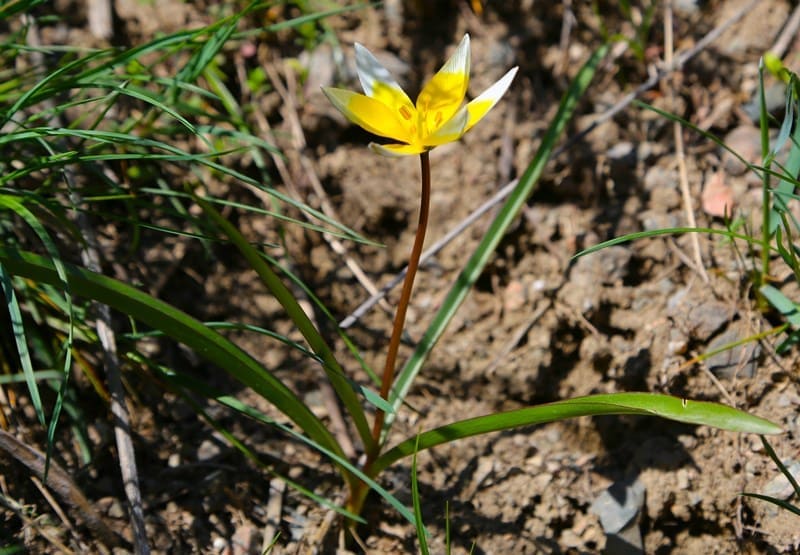
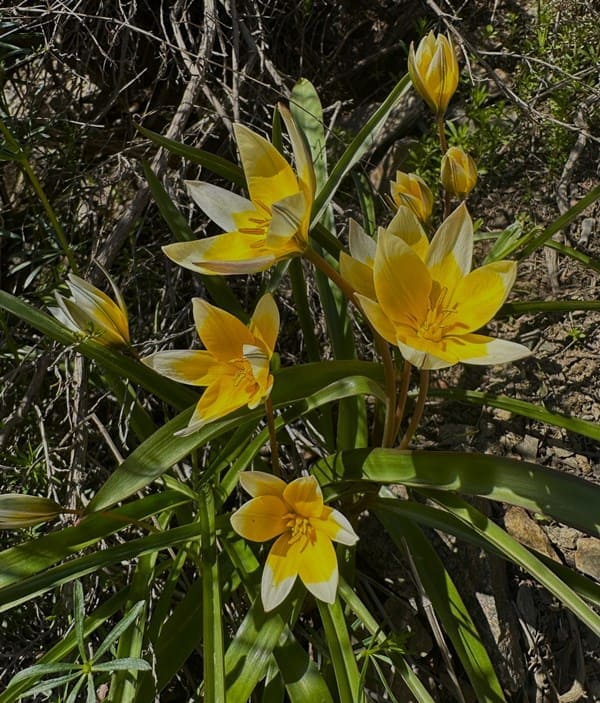
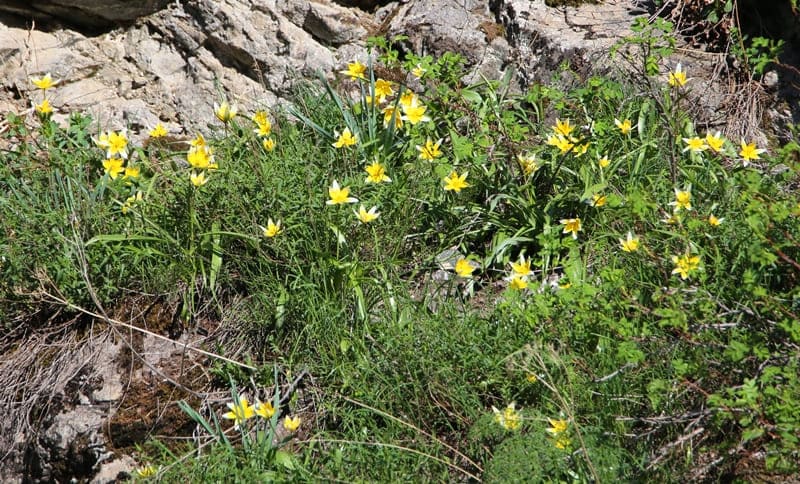
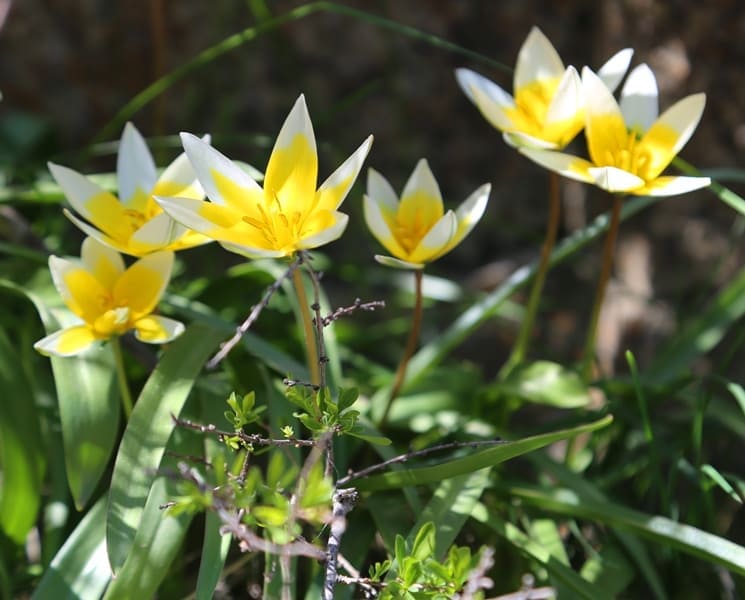
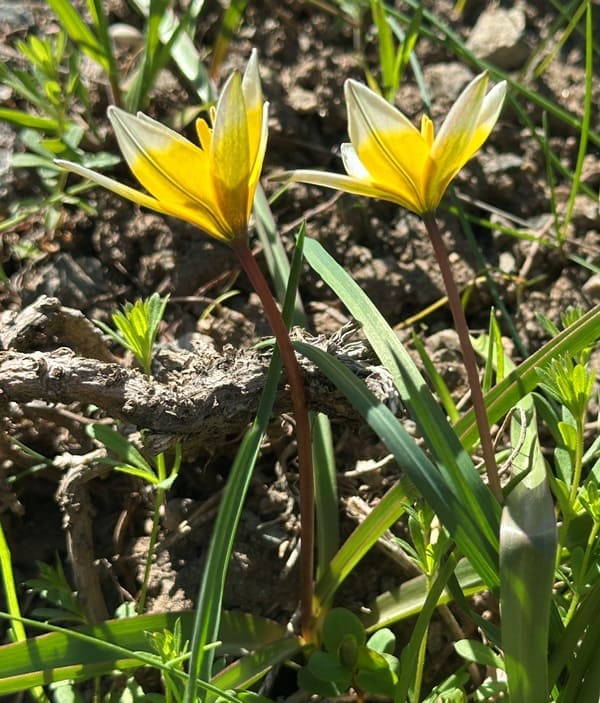
Moving south along the slope, we soon encounter a late tulip among the spirea bushes. The Tulipa tarda is a species of perennial, bulbous, herbaceous plant of the genus Tulipa in the Liliaceae family. The Kazakh name is kesh kyzgaldaq. The literal translation corresponds to the Russian name - late tulip. It is attractive for its abundant early flowering and high rate of vegetative propagation.
Described in 1933 by the Austrian botanist Otto Stapf. The type specimens are thought to be from Turkestan. The species may have been described from plants grown in cultivation. Herbarium specimens from the vicinity of Verny (now Almaty), collected by V.V. Sapozhnikov (May 20, 1902) and N.I. Kolpakovsky (April 21, 1903), are housed in St. Petersburg.
On the opposite (western) slope of the gorge, large and small communities of late tulips also grow among the spirea bushes. The western slope of the gorge is steeper and more rugged, making accessing the tulips quite difficult.
Picnic in nature. Interesting walks.
Return to Almaty (111 km).
General characteristics of route for Tarda tulips and Tulipa ostrowskiana tulips.
This excursion is educational and nature-based and is especially relevant in the spring – from late March to mid-April, when the tulips begin to bloom. The route passes through foothill and low-mountain areas, combining elements of the steppe and mountain landscape.
The journey typically begins with a drive to the gorge, after which participants begin the walking portion of the route. The road runs through gently rolling terrain, gradually descending into the gorge, offering picturesque views of the slopes covered with spring vegetation.
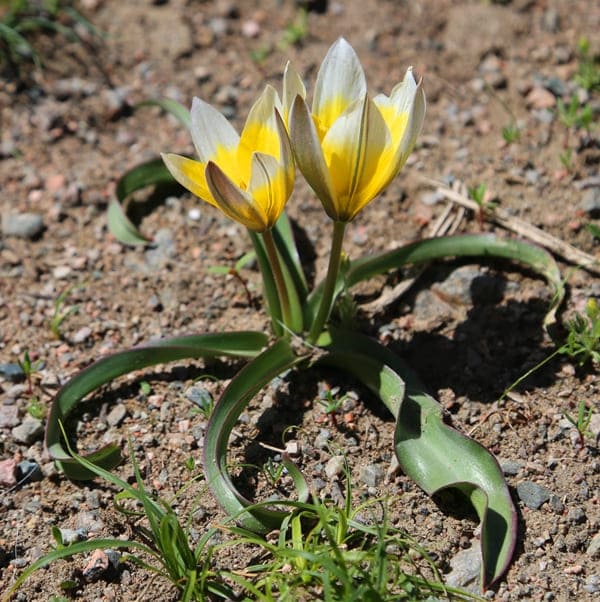
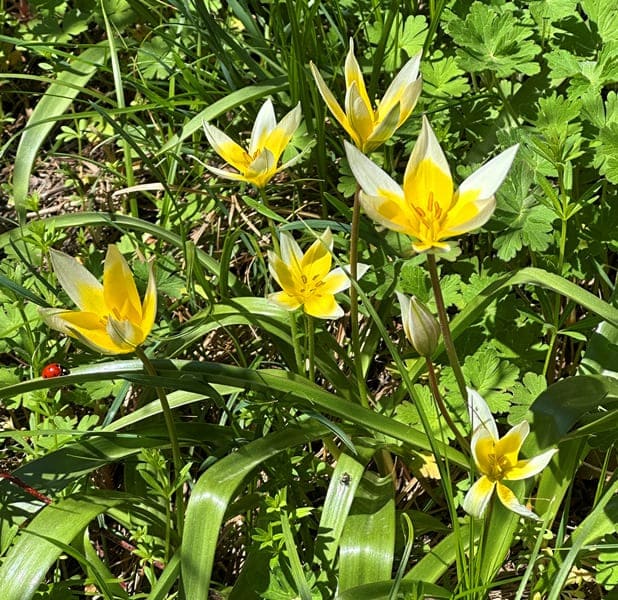
Tarda tulip is a harbinger of spring.
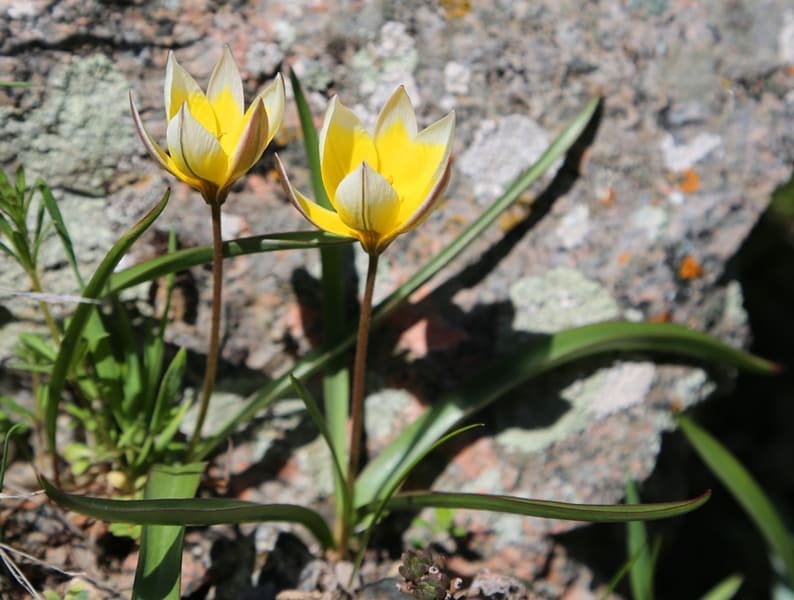
One of the main goals of the excursion is to become acquainted with the rare and endemic late tulip – an elegant and relatively short plant with bright, star-shaped flowers. Its petals are usually white with a yellow center, creating a contrasting and very expressive appearance.
This species is resilient to harsh conditions and is often found on rocky slopes. The blooming of the late tulip is one of the first signs of spring in the region.
Ostrowskiana tulip is a rare gem of flora of Southern Kazakhstan.
The excursion pays special attention to the ostrowskiana tulip – a rare and spectacular species. It is distinguished by its rich coloring - ranging from bright red, yellow, and orange, sometimes with a dark base to the petals. The flowers are larger and more prominent than those of the late tulip, making it particularly attractive to photographers and botanists.
This species is listed in the Red Book, so the need for careful handling is emphasized during the tour: flowers should not be picked, and care should be taken when moving around to avoid damaging the plants.
Landscapes and natural environment of Kastek and Suyktobe mountains.
Kastek Gorge is a typical transitional landscape between the steppe and the mountains.
Here you can observe:
rocky slopes with sparse shrub vegetation;
spring ephemerals covering the ground with a bright carpet;
small streams fed by meltwater.
In spring, the gorge is especially picturesque: the contrast between the still gray slopes and the bright spots of flowering plants creates a unique scene.
Historical context of the photo excursion for tulips by Tarda and ostrowskiana.
The Kastek area also has historical significance. An ancient route passed through the gorge and then through the Novo-Kastek Pass, which, at 2,463 meters above sea level, connected the western part of Zhetysu with the western regions. 3.4 kilometers south of the village of Kastek is a settlement of the same name, which was designated Urung-Ardzh on ancient maps.
Situated on the high left bank of the Kastek River, opposite the entrance to the gorge, this site is strategically important, as it is located at the exit of one of the key rivers. The Great Silk Road passed through the passes of the Trans-Ili Alatau, connecting the Chui Valley with the Ili River.
Kastek served as the center of a network of medieval settlements guarding this route. It also maintained contact with Balasagun, one of the capitals of the Karakhanid state. The Ili/Trans-Ili Alatau begins south of the Ili River. The western part, between the right bank of the Chu River and the sands bordering the lower reaches of the Ili River, is called the Chu-Ili Mountains, with individual sections known as Kulzhabasy, Khantau, and Kozybasy.
They have numerous passes convenient for wheeled transport. A road connecting the Ili and Chui valleys passes through the Kordai Pass. Another route passes through the Kastek Pass, connecting the Ili Valley with the Issyk-Kul Basin and the Chu Valley.
The Kastek Pass has historically served as a link between the Chu and Ili valleys (7, p. 38). This pass is mentioned in XVth-century sources describing Timur's campaign. In 1375, Timur's army marched from the Ili Valley to Atbash through the Kara-Kasman (Kastek) Pass (7, pp. 81-83).
This adds additional depth to the excursion, allowing us to explore not only nature but also the movement of people, cultures, and trade routes.
Practical information for photo excursion for Tarda and ostrowskiana tulips.
Best time: late March - early April (depending on weather conditions and early or late spring. 2026 - April 14).
Duration: 1 day (short and extended routes are possible).
Difficulty: easy to moderate, accessible to most participants.
Recommendations: comfortable shoes, sun and wind protection, and plenty of water.
It is important to remember that this area requires careful handling, as it is home to rare plants. Impressions from the photo excursion for Late and Ostrovsky tulips. A tour of the Kastek Gorge is more than just a stroll; it's an encounter with the fragile beauty of springtime nature.
The tulips bloom briefly here, but that's precisely what makes them so special. This is the moment when the steppe comes alive, and the mountain slopes become a living canvas on which nature paints its most subtle and graceful patterns.
Note:
Special tour by Alexander Petrov.
Photos by:
Alexander Petrov.