




You are here
N. Palgov on Sary-Arka Steppe.
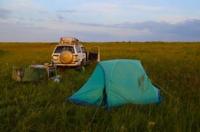
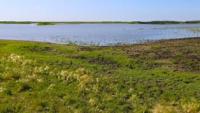
Ancient Mountain Landscape of Kazakhstan.
"The name 'steppe,' which we give to the country occupied by the Kirghiz-Cossack hordes, might suggest that these steppes have a level surface throughout and form a single, vast plain. In fact, they are intersected by many mountain ranges and do not present to the traveler's eyes the smooth, continuous plains found in some other countries. The surface of most of the Kirghiz-Cossack steppes is undulating and dotted with small hills with rounded tops. However, since these elevations are not large and not covered with forest, the name 'steppe' is quite appropriate for the country we are describing. "Add to this that, being dry, poor in vegetation, and uniform, it becomes tiring to the eye. This does not apply to the mountains, whose appearance, size, and properties vary, which is why we intend to describe them in more detail."
Levshin, A.I., "Description of the Kyrgyz-Cossack or Kyrgyz-Kaisak Mountains and Steppes." 1832.
A Trip from Almaty to Khromtau.
Imagine a panorama, most of which consists of hills, ridges, basins, and flat, wide fields. Its hills and ridges are strewn with rubble and piles of stone, and the fields are cut by narrow riverbeds bordered by green reeds. Alternating in its elements, this panorama stretches for tens and hundreds of kilometers, spreading from the Turan Lowland in the west to the Turksib in the east, from Lake Balkhash in the south to the Ishim and Irtysh plains in the north.
This is the Kazakh folded country, or Kazakh steppe, known to the indigenous population as "Sary-Arka." (The Kazakh word "Sary-Arka" means "Yellow Upland," reflecting the watershed position of this near-plain between the Irtysh River basin and the Aral-Balkhash Lowland, covered in a yellow blanket of steppe grass.)
Its modern relief is the remnants of an ancient mountain landscape. Most of these remnants bear so little resemblance to true mountains and are so unimpressive in size that the landscape they comprise is called "small hills." The Kazakh folded land rises on average 400-500 meters above the surrounding lowlands.
Its lowest parts lie at an altitude of 100-200 meters, while the highest rise to 1200-1400 m. a. s. l. The peaks of the ridges and hills are usually bare. The rest of the landscape is covered with vegetation, sometimes dense, sometimes sparse. This steppe is striking in its grandeur.
It is not suited to gentle lyrical poetry, but to a powerful, heroic epic, enduring through time and resonating with the wild, rocky, boundless horizons. In early spring, the Kazakh steppe is covered in multicolored carpets of short-lived ephemeral plants.
After these wither, the drab, coarse grasses, accustomed to the dry climate and hot sun, emerge. Among these tough grasses, various wormwoods occupy the lion's share of the space, giving the earth a gray, dreary appearance and filling the air with a pungent, pungent odor. In places, the wormwood is supplanted by large tracts of scrawny, rough kokpek, which makes the surface even more unattractive.
In the lowlands of basins, where the soil is swollen or whitened by salt, fleshy, knobbly saltworts bristle - leafless plants soaked in a sap that spurts when pressed by hand. Occasionally, the monotonous gray flora of the country is interrupted by swaying waves of feather grass, with fluffy plumes spreading in the wind.
Nearby, thin, low stems of typha, the richest source of pasture here, cling to the soil. At times, the country's flora smells of the exotic Mongolian steppes, giving way to vast thickets of chia, their strong, flexible stems rising high like twine. Exceptionally, in the area of Karkaralinsk, Bayanaul, and other neighboring areas, steppe vegetation alternates with forest vegetation.
Here, the mountains are covered with dense pine groves, from behind whose branches the mirror-like waters of lakes and cascades of ringing streams sparkle. The waters of three major basins flow through Kazakhstan's folded country: the Arctic Ocean, the Aral Sea, and Lake Balkhash.
But it also contains many lakes that form independent inland basins. One of the country's major rivers, the Nura, flows into a similar inland lake, Kurgaldzhin, and another, almost parallel to it, the Kon River, carries its waters into Lake Teniz. During high-water years, the Nura River flows from Lake Kurgaldzhin through short channels into Lake Teniz, the largest lake in the Kazakh folded country.
Unlike Lake Kurgaldzhin, its waters are brackish River. The typical and largest river in the country is the Sarysu. About 900 kilometers long, it cuts almost through the middle of the Kazakh steppe from east to west. In its lower reaches, the Sarysu turns south and approaches the outskirts of the Betpak-Вala clay desert.
Kazakhstan's folded country has many rivers, but they are not the rivers we are accustomed to in humid climates. The rivers of this country are fed exclusively by winter snows. They are deep and impressive only during the spring floods. By early summer, many of them dry up completely, and the larger ones become very shallow, lose their continuity of flow, and break up into reaches.
At this time of year, it is impossible to navigate a river like the Sarysu by boat for more than 4-5 kilometers, which is the typical length of its longest reaches. Losing their waters, the rivers become highly mineralized, even noticeably saline. Good fresh water is rare here.
The population makes extensive use of wells, but even there, the water quality is not always satisfactory. Previously, the Kazakh folded country was exclusively a region of nomadic pastoralism. Livestock was the population's sole wealth. The country served as a source of livestock raw materials and a profitable market for manufactured goods.
Camel caravans traveled along its numerous roads with their merchandise. Kazakh cattle herders paid double the price for the goods they bought, and were forced to sell their products at the same fraction of the price. Exploited by traders, the population often suffered from natural disasters.
The most terrible disaster was the jute - a cattle plague caused by icy conditions. It could sometimes kill more than half a herd in a single winter. Meanwhile, the country held colossal mineral deposits within its depths. Its indigenous population knew of almost all the deposits that surfaced.
Some of them were mined using artisanal methods for their own needs. The Kazakhs mined ochre for painting wooden objects, gypsum for whitewashing walls, lead, and silver for jewelry. Word of the country's ore riches reached the ears of astute traders, and the steppe was covered with claim posts from various merchant firms.
But very few of the claimed deposits were exploited. Thus, small factories emerged: Uspensky, Spassky, and others. To provide them with fuel, some coal mines were developed. However, the miners cared only for their own profits, while the country continued to stagnate in ancient, backward ways of life.
Only in the last 25 years has Kazakhstan acquired true economic significance and become a rich storehouse of minerals; a simple listing of the mineral deposits explored here would take dozens of pages. The largest deposits of the metals most essential to the national economy are of national significance here.
The earliest known to be developed is the Karaganda coal deposit. This deposit was discovered in 1833 by the Kazakh shepherd Appak Bazhanov. In 1854, the deposit was acquired for a fabulously low price by Russian merchants, who subsequently resold it to English concessionaires.
But neither knew its true value. The Karaganda coal deposit received recognition after exploration by Professor A. Gapeyev, who discovered its enormous reserves. This occurred in the first year of the formation of the Kazakh Republic. Afterwards, a number of scientists, led by N. Kassin, Kazakhstan's oldest and most renowned geologist, explored the deposit in even greater detail.
A huge copper mine, Kounrad, emerged in the south of Kazakhstan's folded land. The Balkhash copper smelter was built to process Kounrad ore. Nearby, the city of Balkhash emerged, with its multi-story buildings and a beautiful beach on the lakeshore.
Merchant caravans ceased to circulate in Kazakhstan's folded land. Instead of the jingle of camel bells, the rhythmic roar of Soviet automobiles began to hum along the roads, transporting parties of explorers, builders, and its new settlers - industrial workers - across the steppe.
A railway stretched from north to south of Balkhash, past hills and ridges. The ever-intensifying search and exploration for minerals led to ever more remarkable successes. Industrialization was entering the country with its heavy, metal-ringing tread.
The crowning achievement of remarkable human tenacity and the art of scientific exploration was the revival of the Dzhezkazgan copper mine in the steppe. This mine, located in the very center of Kazakhstan, 400 km from the nearest railway, was considered unpromising in authoritative circles.
But now it is known as one of the largest in the Union. The transformation of the Dzhezkazgan deposit from an insignificant entity into a colossal base for the Soviet copper industry is due to the renowned Soviet geologist and Stalin Prize laureate K. I. Satpayev.
For several years, the will, persistence, and experience of the Kazakh scientist overcame daily obstacles from a host of people who, consciously or mistakenly, failed to cooperate with his efforts. Kazakhstan, which raised this victorious geologist, is proud of him and his achievements.
With the inclusion of the Dzhezkazgan mine and the Karsakpai copper smelter operating from its raw materials among the giants of the USSR's mining industry, a new railway line appeared across the steppe, connecting the mine with the Karaganda-Balkhash railway.
In 1940, another railway was built along the northern edge of the country – from Akmola to Kartaly. It brought coal delivery from Karaganda to Magnitogorsk 500 km closer. The country was transformed. Fertile arable lands wedged into the fragrant fields of its pastures.
Haystacks, stored for the winter, stretch along the river valleys. Cattle don't know jute. In new towns, where there wasn't a single tree, gardens and parks were grown on artificial soil. At the same time, these towns acquired melon and vegetable garden bases where varietal watermelons, vegetables, and melons ripen.
In the former wilderness of the hills and mountains, rest homes for miners and collective farmers were established. Vast expanses of pastureland were occupied by livestock state farms with advanced farming equipment. Trucks loaded with dairy products travel from villages and state farms to mines and factories.
Former nomads are establishing sedentary settlements. Among the latter, administrative district centers stand out. These are populated areas with straight streets and well-built houses. To understand the significance of such a place for the steppe, one must first travel several hundred kilometers across it.
After such a route, during which fields of kokpek and wormwood, the still waves of ridges and hills, the salt-marsh bottoms of dried-up lakes loom before one's eyes, and it seems as if the blue expanses of the steppe are endless, and that there, ahead, will be more kokpek and wormwood, more hills and hills - after such a route, suddenly, without warning, the road is blocked by a brand-new, clean settlement with a post office, telegraph, electric light, shops, and the most essential cultural amenities.
This will be the district center, built where previously there were no roads, no housing, no people. The Kazakh folded country is still deserted in most of its territory, but it is no longer the country that dictated its laws to the population, but rather a complex of agricultural and mountain resources that are being developed by man in a planned manner.
Geographic coordinates of Sary-Arka steppe: N51°01'48 E66°13'45
Authority:
"The Nature of Kazakhstan in Essays and Pictures." N.N. Palgov. Publishing House of the Academy of Sciences of the Kazakh SSR. Alma-Ata. 1950.
Photos by:
Alexander Petrov.