




You are here
Ulughbeg madrasah.
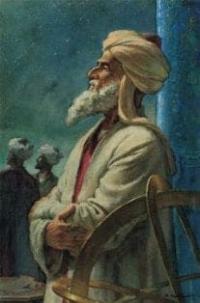
Monuments in Central Asia and Uzbekistan.
"This house can be said: it is a multifaceted illumination for people, a direct path, a mercy for people with true vision. The worthy sultan, the son of the sultan, the founder of this edifice of science and prosperity, the sufficiency of peace and faith – Ulugh Beg Gurgan. May Allah protect the palace of his reign and strengthen its foundation until the end of his state. It is truly good to live in this majestic madrasah: Peace be upon you! You have been kind, so enter it, remaining in it forever. The year is 820*. Let it be known: this building is the most excellent and highest of places in the world, the most perfect of structures in art and workmanship, it indicates the foundations of science and guides on the path to salvation; those who live in it are people of Sharia and fatwa; therefore, this great school is called "scholars live in it."
Inscription in Arabic on the portal of the Ulugh Beg Madrasah.
Gastro tourism in Samarkand.
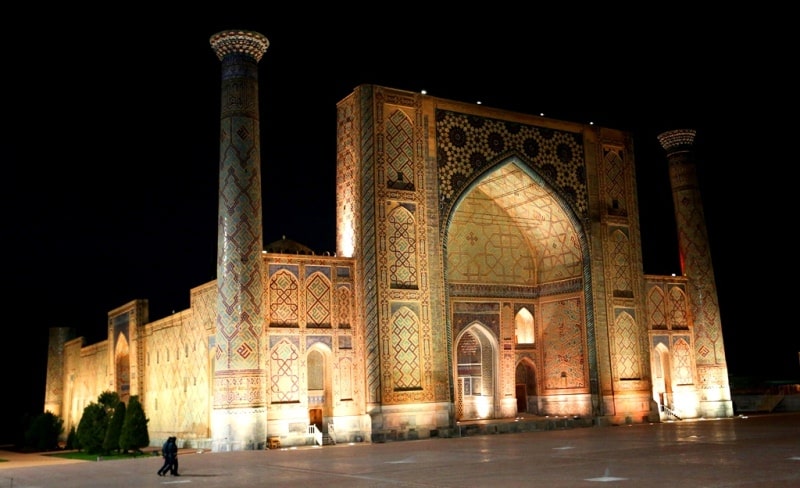
Ulughbeg Madrasah (Uzbek: Ulugʻbek madrasasi - Ulugbek madrasasi) is a XVth-century Muslim spiritual, educational, and religious building located at an altitude of 716 m. a. s. l. in western part of Registan Square, in southern part of Yalangtush Bahadur Square in city of Smarakand.
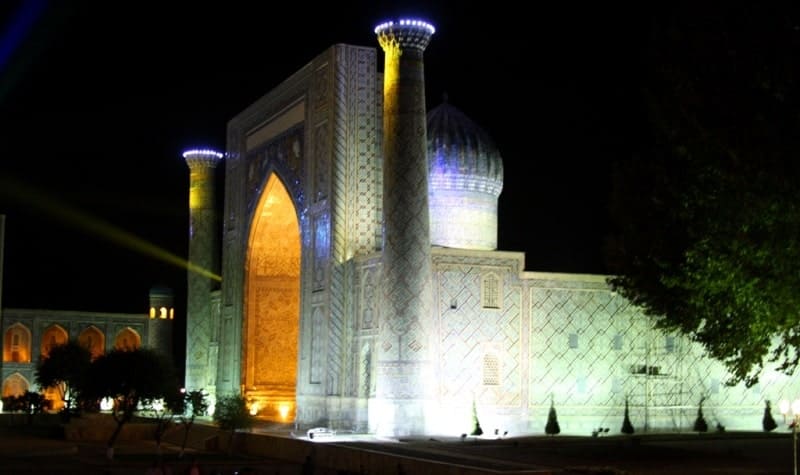
The construction of architectural monuments on Registan Square began during the reign of Ulugh Beg. It is the oldest madrasah in the architectural complex of Registan Square, built by the Timurid ruler and astronomer Ulughbeg. Together with the Sherdor and Tillya-Kari Madrasahs, it forms a complete architectural ensemble.
History of Ulughbeg Madrasah.
"Year 820 (1417). Let it be known: this building is most excellent and "The highest place in the world, the most perfect of buildings in art and workmanship..."
Inscription in the niche of the entrance portal.
Since the time of Amir Timur, Registan was the main market square and social center of medieval Samarkand. Numerous shops, caravanserais, and covered shopping arcades (tims) were located here, the largest of which was the Tilpak-Furushon tim.
During the reign of Timur's grandson, Ulughbeg, the square's appearance gradually began to change. Ulughbeg began his reconstruction of Registan with the construction of the largest Islamic university in Central Asia. The exact date of the start of construction of the madrasah on Registan Square is unknown.
This suggests that the madrasah building was already under construction in 1417. At the highest construction rates, the construction of similar structures in Maverannahr took at least 5-6 years. Considering that the main work was completed in 1420, it can be assumed that construction began no later than 1415.
Project author The madrassa is usually attributed to the Persian court architect of Emir Shahrukh, Qavam al-Din Shirazi. However, the medieval historian Wasifi, a contemporary of Ulugh Beg, names the architect as Kazi-zade al-Rumi's student Kamal al-Din Muhandis.
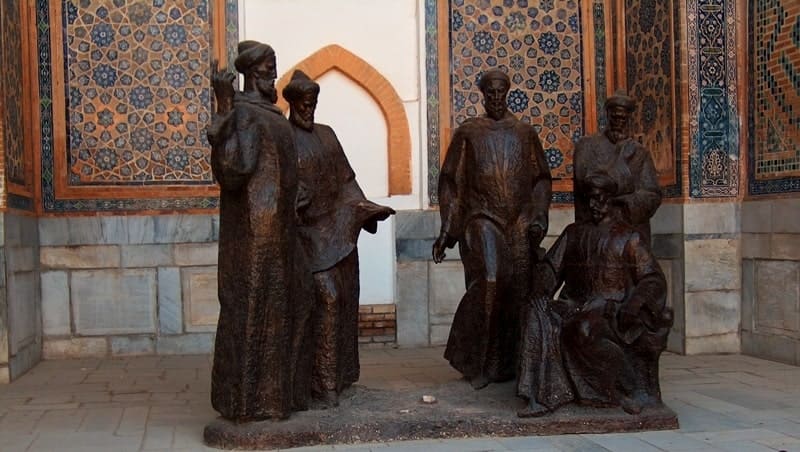
Soon after the completion of the Ulughbeg madrassa, it became one of the most prestigious universities in the Muslim East in the XVth century. According to legend, the famous poet, scholar, and philosopher Abdurrahman Jami studied here. His students included the Naqshbandi sheikh Khoja Ahrar and the poet Alisher Navoi.
The educational institution offered lectures on mathematics, geometry, logic, natural sciences, theology, and theories of man and the world soul. These lectures were given by such renowned scholars as Kazi-zade al-Rumi, Jamshid Ghiyath al-Din al-Kashi, al-Kushchi, and even Navoi himself.
Ulughbeg Maulana Muhammad Khavafi, a wandering dervish of common origin but possessing profound scholarly knowledge, was appointed the university's first mudarris (rector). In 1533, the Uzbek Khan Ubaidullah came to power in Transoxiana and soon moved the capital of his state to Bukhara.
Having lost its status as the capital, Samarkand gradually fell into decline. However, the Ulughbeg Madrasah continued to maintain its status as one of the finest educational institutions. Central Asian institutions. During the reign of Yalangtush Bahadur, who radically rebuilt Registan Square, the madrassa building underwent extensive renovations.
Its graceful proportions formed the basis for the new madrassa built by the appanage ruler of Samarkand, later named Sher-Dor. During the feudal wars and civil unrest that accompanied the reign of the last Bukhara khan of the Ashtarkhanid dynasty, Abulfeyz, the exterior of the Ulughbeg Madrassa was severely damaged.
According to the XVIIIth-century Samarkand historian Abu Tahir Khoja, the Bukharan governor ordered the demolition of the second floor of the building out of fear that rebels could fire upon his residence from the madrassa's high walls. In the first half of the XIXth century, the Ulugh Beg Madrassa was destroyed by a powerful earthquake (1817-1818).
Restoration of the madrassa began under Emir Haidar. By order of the emir, the southwestern rooms - the mosque and two darskhanas at the corners - were roofed with massive beams and vassas. The earthquake of 1897 transformed the "well-preserved ruins" into raouins.
Restoration of the Ulughbeg Madrassa began in the 1920s and continued for over seventy years. The first stage involved urgent work to preserve the surviving fragments of the building. In 1932, a unique operation to straighten the northeastern minaret, designed by architects V.G. Shukhov and M.F. Mauer, resonated worldwide.
The main restoration work was carried out in the 1950s and 1960s: the ground level was lowered by 2 meters, and the portal and decorative elements of the building were restored. In 1965, engineers E. M. Gendel and E. O. Nelle straightened and restored the southeastern minaret.
In the 1990s, the second floor of the hujras was rebuilt. Currently, the building's original elements are missing the outer domes over the corner auditoriums and the southwestern minaret. The northwestern minaret remains partially intact. In the 1960s, Academician I. Muminov, with the support of the leader of the Uzbek SSR, Sh. Rashidov, developed the idea of a comprehensive study of the history of higher education – the madrasah system in Samarkand. Plans were made to restore the education system at the Mirzo Ulugh Beg Madrasah and celebrate its 550th anniversary in 1970, but the initiative was not supported by higher authorities.
Only after Uzbekistan gained independence in 2000 did Academician B. Valikhodjaev attempt to revive this idea in a different format. In 1992, repair and restoration work began on the monument, timed to coincide with Ulugh Beg's anniversary. It was carried out according to a project developed by the UzNIIPI Restoration Institute.
The project included a complete reconstruction of the second floor, restoration of architectural ceramics, and replacement of damaged plaster and stalactites in the southwestern rooms.
Construction of Ulughbeg Madrasah.
The construction of architectural monuments in the Registan began during the reign of Ulugh Beg. The Ulughbeg Madrasah was built between 1417 and 1420. In terms of artistic merit, it was comparable to Tamerlane's buildings, while significantly surpassing them in terms of durability.
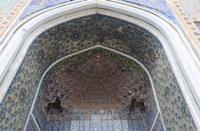
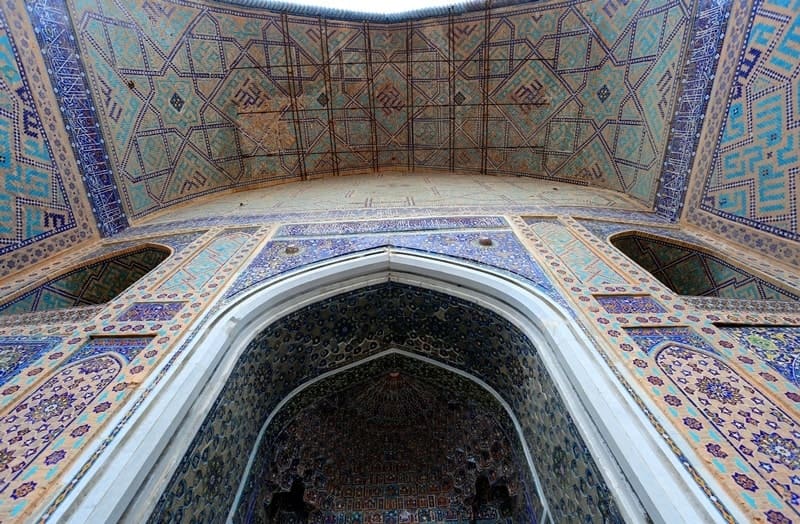
The architect of this building is unknown. Its main entrance is constructed as a huge portal and is covered by a pointed arch with a span of 15 meters. Above the arch is a mosaic panel symbolically depicting the starry sky with five- and ten-pointed stars.
Before the construction of the Ulughbeg Observatory, the madrasah's grounds housed a platform for astronomical observations. Initially, the madrasah had 50 cells, housing over 100 students. Prominent students of the madrasah included Sheikh Khoja Akhrar and the poet Jami.
In the XXth century, the madrasah's northeastern and southwestern minaret were straightened, the domes were rebuilt, and the vault of the main portal and the tympanum above it were rebuilt. Its four-iwan courtyard was enclosed by two stories of khujras (hujras). Audiences (dars-khanas) were located in the corners, a mosque in the western wing, and four slender minarets at the corners.
The main façade, facing the square, is highlighted by a majestic portal of very graceful proportions. The decoration of the exterior and courtyard facades (especially the portal and iwans) features rich facings: ornamental sets of glazed bricks, carved Kashin mosaics, majolica, and carved marble.
Architecture of Ulughbeg Madrasah.
"Registan Square is a beautiful quadrangle... On three sides of the square rise the well-preserved ruins of three 'madrasahs', where 'mullahs' gave religious instruction to children." "Education. The leaning minarets seem about to fall, but they never do, fortunately for their enamel cladding."
J. Verne. Claudius Bombarnac. Reporter's Notebook on the Opening of the Great Trans-Asian Highway (From Russia to Beijing) 1893.
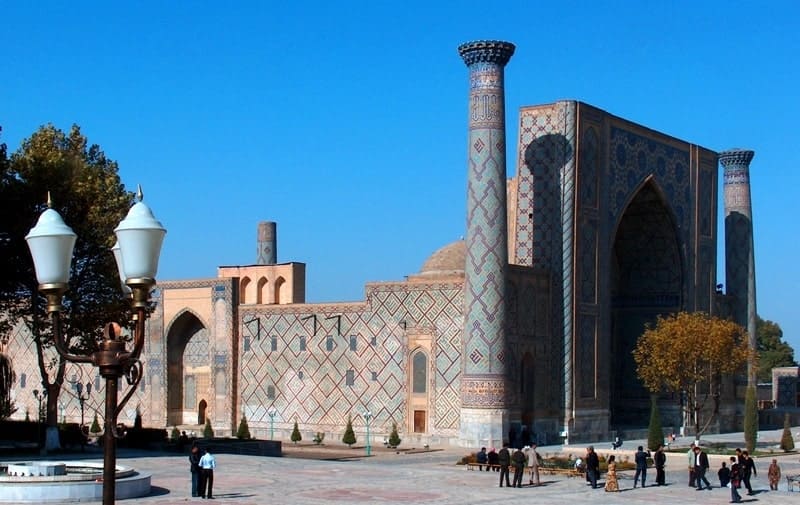
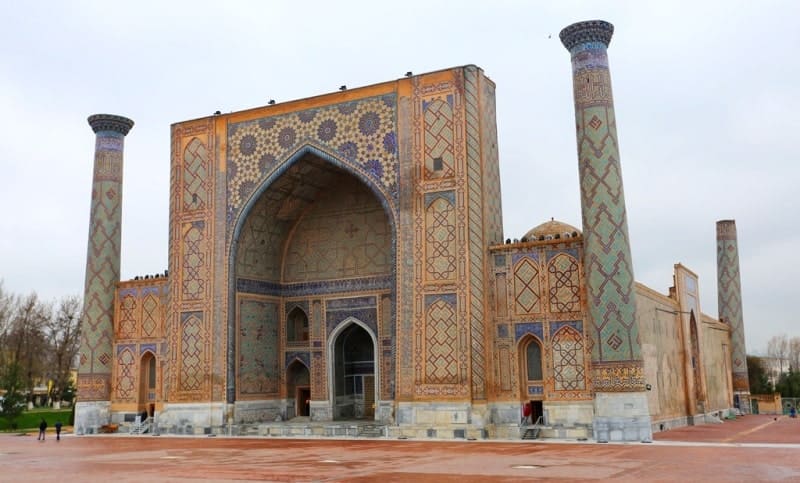
The Ulugh Beg Madrasah was built according to Muslim canon and fully met the requirements of its era. It is a classic example of a theological educational institution in Central Asia and the Middle East. The madrasah is a rectangular structure with a total area of 81 x 56 meters. Its main eastern façade faces Registan Square.
The main element of the main façade is the powerful entrance portal, the peshtak. Within the portal are three entrances, the central one, framed by an exaggeratedly large pointed arch, is closed by an openwork panjara. The other two entrances are also decorated with pointed arches, but smaller.
Above each of them is a single loggia overlooking the hujras. Four 33-meter-tall minarets once towered at the corners of the madrasah, of which only the eastern ones remain fully preserved. Spacious auditoriums (darskhanas) are located at the corners of the building, once covered with double domes.
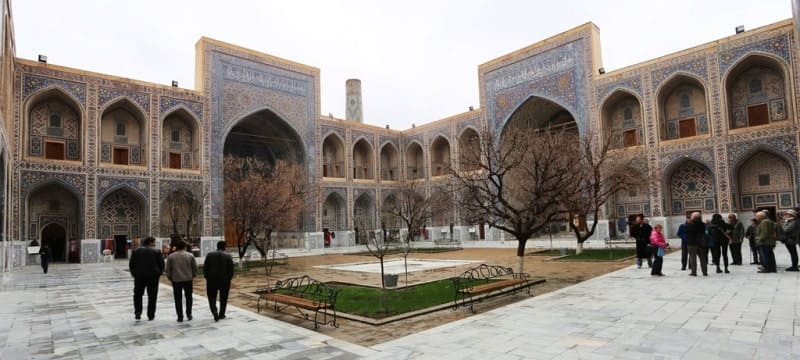
The square courtyard, with four iwans and an area of 30 by 30 meters, is paved with large stone slabs and framed by two stories of one- and two-room hujras. The iwans are located on the axes of the building and are decorated with portals. Each iwan divides the hujras in half, with six hujras on each side, two stories high.
The northern and southern iwans are blind and previously served as summer auditoriums. The western iwan contains the entrance to the winter mosque, which occupies the entire central part of the western wing. The madrasah's decoration utilized the full range of materials available at the time: glazed bricks, carved kashin mosaics, majolica, and carved marble.
The combination of white, blue, light blue, and manganese-black tiles with terracotta facing bricks creates a richness of geometric, floral, and epigraphic patterns. The madrasah portals and the tympanums of the hujras are decorated with multicolored kashin mosaics.
The main portal is particularly luxurious. Mosaic stars on its tympanum form a pattern symbolizing the starry sky, and the pylons are decorated with mosaic panels with geometric patterns. The architectural merits of the Ulugh Beg Madrasah, emphasized by its highly artistic decorative design, place it on a par with other masterpieces of Muslim medieval architecture.
600th Anniversary of Ulughbeg Madrasah.
In July 2020, the administration of Samarkand State University, together with Russian scholars from Kazan Federal University, held an international conference dedicated to the 600th anniversary of the opening of the Ulughbeg Madrasah.Unfortunately, this initiative was not supported by any higher education institution in the capital of Uzbekistan, Tashkent, including the National University of Uzbekistan, which bears the name of Mirzo Ulugh Beg.
In 2001, it was added to the UNESCO World Heritage List, along with other landmarks of Samarkand.
Restoration of Ulughbeg Madrasah.
By the end of the XVIth century, many buildings in the Registan had fallen into disrepair, and in the XVIIth century, by order of Yalangtush Bahadur, the ruler of the Samarkand principality, it was completely reconstructed. Only the Ulugh Beg Madrasah remains, and a madrasah was built opposite it.
According to legend, Ulugh Beg himself taught at the madrasah. The building had two stories, four high domes over the corner auditoriums (darskhana), and four minarets at the corners. A gigantic portal (introduced in Central Asian construction in the XIth century), occupying two-thirds of the length of the main façade, faces the square with a huge, wide, and deep pointed arch.
The Ulugh Beg Madrasah suffered considerable damage during the civil wars of the 1720s. The outer domes and most of the rooms on the second floor were destroyed. Soon after the establishment of Soviet power in Samarkand, it was decided to save the northeastern minaret of this madrasah, whose top had deviated from the vertical by 1.8 meters (the total height of the minaret is approximately 33 meters).
After a long break, work on the madrasah resumed in 1952. Restored Courtyard facades; the vault and exterior walls of the northern facade were rebuilt, the pylons of the main portal were added; the tympanum and cord-shaped archivolt were reconstructed, and the courtyard iwans were reinforced; the carved majolica mosaics and mosaic inserts in the madrasah portal were restored.
In the more than five centuries since the madrasah's construction, the level of Registan Square has risen significantly. Between 1958 and 1959, a cultural layer up to 3 meters thick was excavated between the southern and western facades of the building.
Restoration work on the southern facade of the madrasah, clad in glazed tiles, was completed. Between 1958 and 1960, the tympanums and pilasters in the courtyard were clad in carved mosaics; the floor was paved with concrete slabs. In 1961-1962, the marble panels on the southern and western facades of the madrasah and the 14-meter-tall southwestern corner minaret, which collapsed in 1870, were restored.
Legends of Ulughbeg Madrasah.
Since Ulugh Beg was both a great scholar and ruler, many legends are known about him. When the madrasah was almost completed, Ulugh Beg was asked who would be the first mudarris (teacher) of this madrasah.
Ulug Beg replied:
"The most knowledgeable person in all sciences."
At that point, a ragged man - a certain Khavafi - rose from the crowd and began laying claim to the position. After speaking with him, Ulugh Beg entrusted him with delivering a lecture at the opening of the madrassa, which was attended by 90 scholars.
Two people understood the lecture: Kazy-Zade Rumi (Ulug Beg's teacher) and Ulugh Beg himself.
Geographic coordinates of Ulugh Beg Madrassa are: N39°39'16 E66°58'29
Authority:
https://ru.wikipedia.org
Photos by:
Alexander Petrov.