




You are here
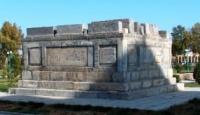
Dakhma of Shaybanids.
Great monuments of antiquities of Uzbekistan.
"Allah Almighty raised the luminary of Fortune to the constellations of the Turks,
He placed their kingdom among the heavenly spheres,
He called them at-Turk
And endowed them with power, made them Rulers of the Age
And placed the reins of the world in their hands,
He elevated them above (other) people,
He strengthened those who were close and devoted to them, and guided them to the truth."
Mahmud of Kashgar. "Divan lugat at-Turk" ("Collection of Turkic Dialects"). 1072–1074.
Guided walking tour in Samarkand.
Shaybanid Dakhma is located at an altitude of 718 m. a. s. l., is located 10 meters from southeastern part of Tillya-Kari Madrasah and 10 meters from northern side of Sher-Dor Madrasah on Registan Square in Samarkand.
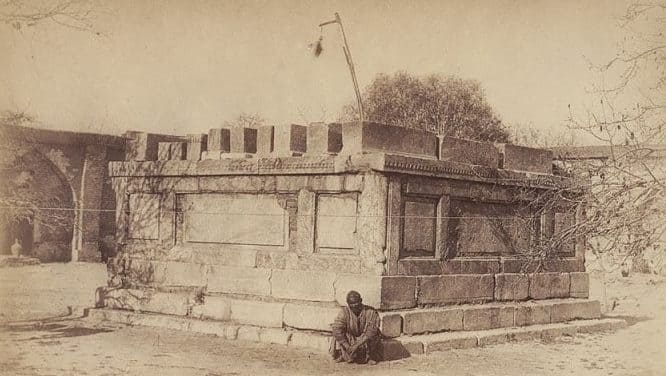
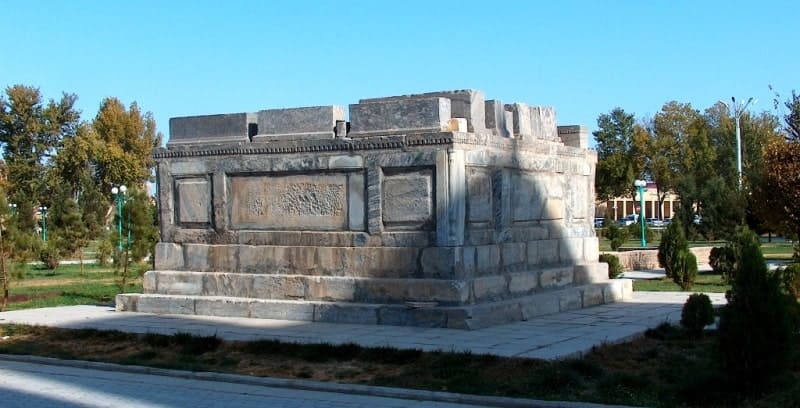
Shaybanid Dakhma is an Uzbek medieval architectural monument, where members of the Uzbek Shaybanid dynasty were buried. It is a marble sufa. It was erected in the XVIth century. Each side of the dakhma was 10-11 meters long and contained 36 tombstones.
Initially, on the orders of Princess Mehr Sultan Khanum, the graves located in the middle of the courtyard of the Shaybani Khan Madrasah were converted into a separate family dakhma - a tall marble sufa. When the road leading to the Bibi Khanum Mosque was opened, the dakhma was moved 70-80 meters to the southeast.
The dakhma was moved several times, reaching its current position only in the XXth century. To the east of Tillya-Kari stands the Shaybanid dakhma (early XVIth century, moved here from its original location when the street was straightened).
It is a tall, rectangular stylobate, faced with marble, on which tombstones once stood over the graves of Samarkand representatives of the Shaybanid dynasty. In the XVIth century, Samarkand belonged to the Chingizids of the Shaybanid dynasty.
The only monument remaining in the city from this period is the Shaybanid dakhma. It is a marble-faced elevation located between the Tillya-Kari and Sher-Dor madrassas. The area it occupied was reduced. During the city's reconstruction in 1960-1962, the dakhma was moved a second time to Registan Square.
Other Shaybanids were later buried here. The first to be buried here was Mahmud Sultan, who died in 1504. In 1509, the body of Muhammad Shaybani's mother was buried here. In 1510, the founder of the dynasty, Shaybani Khan, was buried in the dakhma. The tombstones of the Shaybanid sultans remain there: Mahmud (died 1503-1504), Mahdiya and Hamza (died 1511), Qutlugh Muhammad (died 1545), Abdulakhair (died 1517), Edgar (died 1523), and Suyung Muhammad (died 1586). In 1511, the sultans Mahdi, Hamza, and Abulkhair; in 1514, Muhammad Timur Sultan; in 1526, Sultan Yodgor; in 1530, Shah Sultan Khonim; in 1535, Shahribonu Khonim; in 1545, Sultan Kutlug Muhammad; in 1586, Sultan Suyunch Muhammad; and other representatives of the Shaybanid house.
The Shaybanid dakhma is included in the national list of immovable property objects of material and cultural heritage of Uzbekistan and is under state protection.
Vasily Vyatkin on sufa of Shaybani Khan.
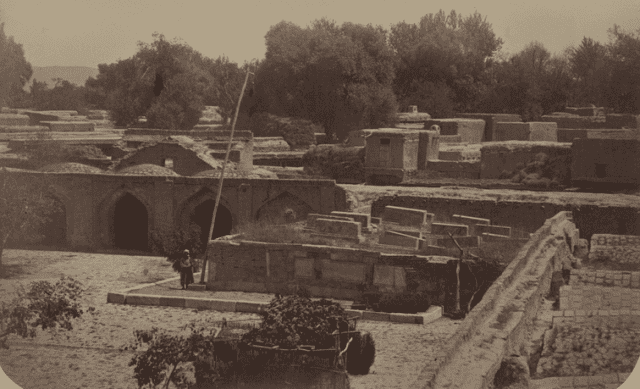
In the center of a modest, recently built madrasah named after Shaybani Khan, the Uzbek conqueror of Central Asia, stands a tall, polished stone slab and beam platform, flanked by stone columns at the corners. On this platform lie rows of tombstones, densely covered with inscriptions, and beneath them lie the graves of Shaybani Khan, his relatives, and members of their families.
On the site of the present madrasah and to the east of it, two adjoining madrasas were built, one by Shaybani Khan and the other by his wife, with portals facing in opposite directions. They have long since fallen into ruin, but the aforementioned platform with its tombstones remains in the courtyard of the first.
When a straight street was constructed, under the Russians, it was necessary to move it west and place it where it stands today. It's impossible to ignore the artistic aspect of tombstones, which were typically shaped as prisms with a square base and the height of a man.
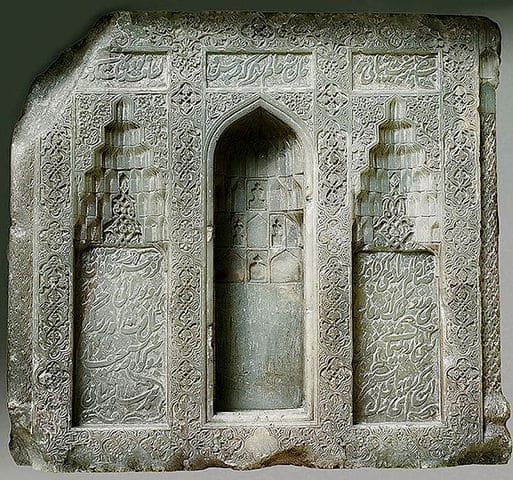
Local rocks - marble, limestone, sandstone, and others - were used for making tombstones and slabs. In Samarkand, it was only during the time of Timur that such dressed stone began to be widely used as tombstones. Before that, under the Mongols, brick alabaster tombstones faced with tiles were made, and earlier, from the first centuries of Islam, river pebbles covered with writing were used.
Large stones received artistic treatment from the time of Timur. These stones are covered with calligraphic inscriptions, decorated with linear and floral ornaments, columns and niches, and covered with bouquets of flowers in vases, often on the upper surface.
Stone carving in general, and tombstone carving in particular, reached significant perfection between the end of the Mongol and the Shaybanid periods. The flexibility of the carving tool, the precision, and the inventiveness of the ornamentation captivate the viewer.
Geographical coordinates of Shaybanid dakhma: N39°39'19 E66°58'34
Authority:
Alexey Arapov. Samarkand. Masterpieces of Central Asia. Tashkent, Sanat. 2004
Photos
Alexander Petrov.