




You are here
Аksu-Zhabagly reserve.

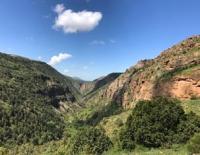
Tours over reserves of Southern Kazakhstan.
"The world is filled with blessed joy
Endlessly adorned by its Creator!
The earth has nourished with its mother's breast
All that the father-sky conceived in it with the sun."
Abai Kunanbayev. "Spring." Translated by L. Shubin.
Tours & holidays in Kazakhstan.
Location, size, and accessibility of Aksu-Dzhabagly State Nature Reserve.
Aksu-Dzhabagly State Nature Reserve is located at western end of Talas Alatau ridge in Western Tien-Shan, within Tolebi and Tyulkubas districts of South Kazakhstan region and Zhualinsky district of Zhambyl region.
The reserve's territory extends 53 kilometers meridionally (from 70:18' to 70:57' east longitude) and 41 kilometers latitudinal (42:08' to 42:30' north latitude according to the 1942 coordinate system). The total area of the reserve is 128,118.1 hectares. Most of the reserve's territory is located in the Turkestan region.
Government agencies of the Zhambyl region have much less influence on the reserve's activities.The reserve's central estate is located 17 kilometers from the Tyulkubas railway station and 19 kilometers from the district center of Turar Ryskulov.
The reserve has the status of a legal entity in the form of a state institution – a state nature reserve. The authorized body for specially protected natural areas, including reserves, is the Forestry and Hunting Committee of the Ministry of Agriculture of the Republic of Kazakhstan.
Physical and Geographical Features of Aksu-Zhabagly Reserve.
Orography of Aksu-Zhabagly Reserve.
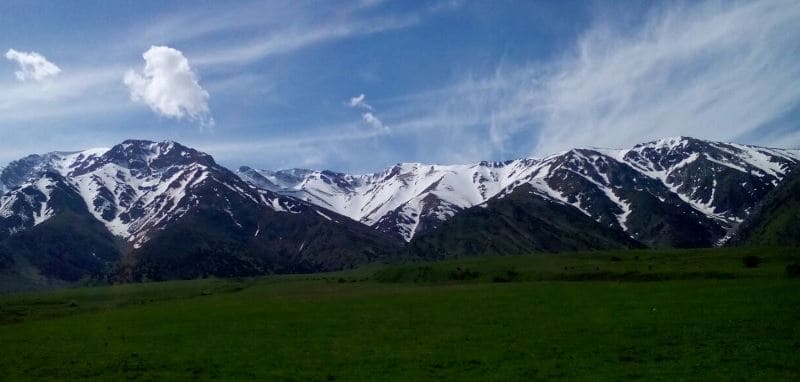
Aksu-Dzhabagly State Nature Reserve occupies the northwestern end of the Talas Alatau, with its latitudinally elongated western and partially northern spurs, and the northeastern slopes of the Ugam Range adjacent to the main ridge. The reserve's altitudinal boundaries here range from 1,300 to 4,200 meters above sea level.
The spurs constitute separate watershed ridges of considerable elevation. To the east, the reserve is bounded by a lateral spur separating the Arabiik and Koksay River basins. Slightly further west, from the peaks of the main ridge, Sarytau (3,657.2 meters above sea level) and Aksuat (4,027.4 meters above sea level), spurs branch off, forming the watersheds of the Koksay, Aksay, and Dzhabagly Rivers.
The highest absolute elevations along the lateral watershed ridges vary from 3,401.1 to 3,977.1 meters above sea level. The gorges of the Koksay and Aksay rivers have a meridional (south-north) trend throughout their entire length and form steep, V-shaped valleys.
Koksay and Aksay rivers are the only ones in the reserve that belong to the Talas River basin. A series of spurs extend from the mountain range near Aksuat Peak: the Alatau, dominated by Kaskabulak Peak at 3,831.9 meters above sea level; Bugulutor at 3,926.3 meters above sea level; and Aksuysky at 3,795.8 meters above sea level.
All of these spurs have a predominantly latitudinal direction and form watershed ridges of the Arys River basin, a major right-bank tributary of the Syr Darya. Zhabagly-Tau ridge, which borders the reserve from the north, has a relatively low highest point of 2913.1 meters above sea level and is adjacent to the plateau-like Topshak section of the Aksai watershed.
A large spur, the Ugamsky spur, extends southwest from the southern slope of the Talas Alatau, bordering the Maidantal River valley, a tributary of the Pskem River, to the north. The highest point of the Ugamsky ridge, Sairamsky Peak, at 4,238.6 meters above sea level, is the southwesternmost point of the reserve.
Geological structure of Aksu-Zhabagly Reserve.
Geology of the area is very complex, as it is located at the junction of two structural-formational zones: the North Tien-Shan and the Karatau - Naryn, separated by the Talas-Karatau deep fault. Structurally and tectonically, the reserve is located within the Boroldai-Zhabagly anticlinorium, which dips monoclinally to the south.
The axis of the anticlinorium lies to the north, outside the reserve, and the Ugamsky synclinorium lies to the south. In the northeast lies a small section of the Kishisu (Chiger-Mogol) horst uplift. The reserve's territory is located southwest of the sublatitudinal Talas-Fergana deep first-order fault, the immediate continuation of which is the Main Karatau Fault.
It is characterized as the most important structural line of the Tien Shan, delimiting the Northern and Southern Tien-Shan (Nikolaev V.P. 1924). The direction of these faults determined the northwesterly strike of the ranges and the end-face junction of the Talas Alatau with the Chatkal, Ugam, and other ranges, which form long spurs of its southern slope.
Another major fault zone is the Zhabagly fault zone of lower order, which also strikes the same direction and divides the horst-anticline morphostructure into a number of separate blocks.
Paleontology of Aksu-Zhabagly Nature Reserve.
Located 120 kilometers northwest of the main reserve, in the spurs of the Karatau Range in the Algabas District of the Turkestan Region, are two separate paleontological sites of the reserve - Auliye and Karabastau - with a total area of 220 hectares.
Located 60 kilometers northwest of the main reserve, in the spurs of the Karatau Range, are two paleontological sites of the reserve - Auliye and Karabastau (with a total area of 226 hectares). The Karabastau paleontological site is located on the southwestern slope of the Karatau Range, on the plateau-like watershed of the Koshkar ata and Bala-Bugun Rivers, five kilometers south of the village of Baidybek-Ata (formerly Kitaevka) at an altitude of 800 meters above sea level. The second paleontological site, Aulie, is located on the northern slope of the Alakushuk Range - the watershed of the Koshkarata and Boraldai Rivers. The two paleontological sites of the reserve, located in the Karatau Mountains, are unique in their richness.
The first Upper Jurassic fauna and flora site in the Karatau Mountains was discovered in 1921. In 1923 - 1925, new burial sites were discovered near the village of Aulie, in the Karabastau and Chugurchak valleys. This is one of the few places on earth where the remains of animals and plants from 145 - 150 million years ago have been preserved in exceptionally thin-layered carbonate rocks, known as "paper" or "fish" shales.
According to R.F. Gekker (1948), the remains of animals and plants were buried in the sediments of the Upper Jurassic Karatau Lake. The Upper Jurassic flora of Karatau was rich and diverse: ferns and Caytoniaceae, bennettites and cycads with thick, leathery leaves, and numerous conifers with tough, scaly or needle-like leaves.
90% of this flora consisted of typical xerophytes. Nowhere in the world is there such a rich and interesting repository of Mesozoic insects as in Karatau, and in many cases these are so well preserved that the structure of ancient insects can be seen almost as clearly as that of modern ones.
Soils of Aksu-Zhabagly Nature Reserve.
Following mountain soil types and subtypes are distinguished in the reserve:
1. High-mountain meadow-steppe alpine and subalpine;
2. Mountain-meadow alpine hydromorphic;
3. High-mountain dark-colored (elfin juniper);
4. Mountain forest dark brown (arborescent juniper): dark brown, light brown, and brown;
5. Mountain gray-brown on southern slopes; (Tethys Biodiversity Research, 2002).
Justification for existence of Aksu-Zhabagly Nature Reserve.
The reserve is home to 14 of the 16 vegetation types identified for the Western Tien-Shan. With the exception of deserts and gypsophilous subshrub communities, almost all landscape types and subtypes of the Western Tien Shan are represented in the reserve.
The reserve has been preserving the natural complexes of the Talas Alatau for almost 75 years.
Over the past 30 years, the reserve has stabilized its full reserve status, which is the highest category of specially protected natural areas:
- protection of the river systems' catchment areas, which are the main sources of water supply and irrigation in the region;
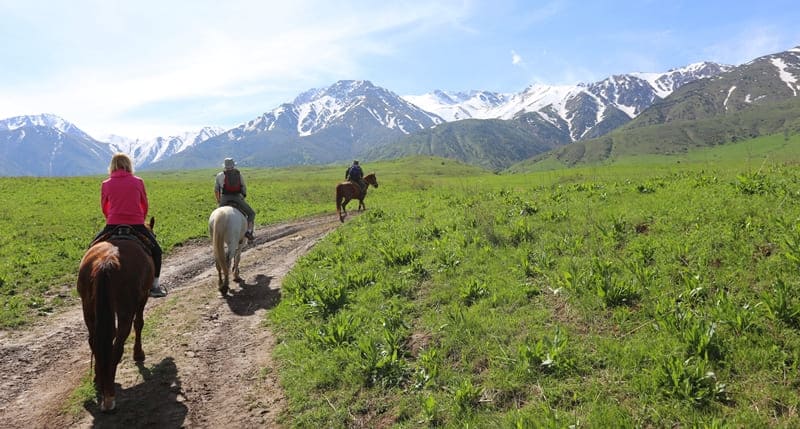
- spectacular mountain landscape offers great potential for the development of various forms of ecotourism;
- strict protection of the natural landscapes of the Talas Alatau;
The reserve's flora is fairly representative of the Western Tien-Shan, comprising approximately 50% of the regional flora (the Western Tien-Shan territory excluding Karatau) and 25% of the flora of all of Central Asia. Reserve's flora is characterized by a high degree of endemism.
Twenty endemic genera (out of 64 genera endemic to the mountainous Central Asian province) are found within the Aksu-Dzhabagly State Nature Reserve and its immediate surroundings.
Proportion of endemic and diverse species is approximately 10%, including:
- 28 species endemic to the Karatau District,
- 25 species endemic to the Ugamo-Chatkal District,
- 35 species endemic to the Kyrgyz District;
- about 72 species of wild relatives of cultivated plants grow here;
- reserve contains 57 rare species listed in the Red Data Books of Uzbekistan, Kazakhstan, and Kyrgyzstan;
- reserve is rich in medicinal plants: more than 200 species possess healing properties to varying degrees;
- representatives of 24 vertebrate species and subspecies listed in the latest, third edition of the Red Data Book of Kazakhstan live in the reserve;
- 24 insect species and 1 annelid species listed in the second edition of the Red Data Book of Kazakhstan (1991) have been recorded here;
- approximately 60% of the invertebrate fauna of the Western Tien-Shan is represented in the reserve.
- most representative insect groups are ground beetles (62%), scarab beetles (66%), and horseflies (91%);
- proportion of Central Asian endemic and subendemic beetles accounts for approximately half (47%) of the total beetle fauna of the reserve;
- mollusk fauna of the reserve accounts for approximately 60% of the regional fauna;
- 7 of the 31 fish species of the Western Tien-Shan have been recorded in the reserve, which accounts for more than 20% of the regional ichthyofauna;
- reptiles and amphibians in the reserve are represented by 14 species (11 species of reptiles and 3 species of amphibians), which make up more than 70% of the herpetofauna of the Western Tien-Shan;
- birds are represented in the reserve by 267 species, of which 130 species have been recorded as nesting (approximately 90% of all nesting avifauna of the Western Tien-Shan).
The reserve's mammals comprise 52 species, or approximately 80% of the entire regional theriofauna. The snow leopard (listed on the IUCN Red List), argali, and brown bear, all of which are particularly noteworthy, are found in the reserve area.
Authority:
Kerteshev, Vagapov, Yashchenko, 2001).
Main Threats in Aksu-Zhabagly Reserve.
The protected status of the Aksu-Zhabagly State Nature Reserve, established over 80 years, has ensured the preservation of typical, rare, and unique natural complexes with all their components in their natural state. However, various types of threats to the reserve's natural complexes exist.
One of the most dangerous threats contributes to the decline of invertebrate populations, environmental degradation, changes in soil composition, increased erosion, changes in plant communities, and the reduction of juniper and other forests.
Since the reserve's establishment, the following fires have been recorded. As a result of fires in previous years, tall juniper forests alone decreased by 8,696.4 hectares; in 1986, the deciduous forest of Pontic hawthorn and Semenov maple in Aulie and Karabastau completely burned down.
Unlike deciduous forest burns, which can be regenerated by regrowth, juniper burns do not fully recover; they typically become overgrown with shrubs within 20 years. According to forest inventory data from 1984, 3,325 hectares of burnt areas had been replaced by shrubs, 5,278 hectares by herbaceous vegetation, and 202 hectares had not recovered at all by this time.
Poaching in Aksu-Zhabagly Nature Reserve.
Topshaksaz tract (argali females with young), the Aksu River Canyon (wintering ibex, wild boar, red deer, bear, and partridge), and Kazan-Chukur (ibex, bear, and snowcock) have always been vulnerable. The increasing number of rifled weapons among the wealthy population, along with the presence of a road penetrating deep into the reserve from the eastern side (the Arabik River valley) and inadequate monitoring along the southern border, pose a serious threat to animal populations in the poorly protected part of the reserve.
Cattle grazing in Aksu-Zhabagly Reserve.
Cattle grazing contributes to environmental degradation and the spread of diseases to wild animals, while overgrazing promotes the introduction of weeds. Particularly significant is the outbreak of mange among argali sheep and ibex following the coercive decisions of the executive authorities, which allowed large numbers of cattle to graze during the drought of 1974 - 1975.
Following this invasion, the argali population declined by almost 2.5 times. Beginning in 1946, cattle from neighboring collective farms began grazing within the reserve. Over the next 20 years (1946–1966), only three (1958–1960) were free of grazing. In the remaining years, the meadows and steppes were overgrazed by livestock.
After 1975, no official grazing took place. However, illegal grazing currently frequently affects the outlying areas, especially in the southwestern and western parts of the reserve, due to the lack of boundary markings and unsupervised grazing of livestock in adjacent areas.
Illegal logging in Aksu-Zhabagly Reserve.
Among the most significant factors affecting the reserve's ecosystem, both historically and currently, by the local population are logging and the removal of dead wood. Logging in mountainous areas contributes to erosion, changes in the hydrological regime, and the reduction of habitat for other animal species.
Until 1935, deadwood removal was conducted only for the needs of reserve staff. However, firewood harvesting in the juniper forests gradually increased, reaching up to 580 m3 per year. Officially, logging continued until 1954. Currently, illegal logging affects the outskirts of the mountains, where trees are cut annually for Christmas trees, and less frequently for building materials or firewood.
The demand for wood is driven by a shortage of energy resources in the region and a decline in the population's standard of living.
Haymaking in Aksu-Zhabagly Reserve.
Haymaking contributes to changes in the structure of plant communities and negatively impacts the natural regeneration of juniper forests. Several hundred hectares of meadows in the reserve were mown annually, and only the lack of roads in the interior areas beyond the mountain passes saved these areas from haymaking.
Haymaking was carried out in the reserve from 1946 to 1984. The Chuuldak, Kshi-Kaindy, Ulken-Kaindy, and Tayaksaldy valleys were particularly affected. Since 1984, haymaking has been virtually nonexistent. Currently, only irregular haymaking is observed in small sections of the reserve in the border areas due to the lack of boundary markings.
Unorganized tourism in Aksu-Zhabagly Reserve.
Mass tourism reached its peak in the 1960s. Unorganized tourists destroyed flowers, cut juniper branches, caused fires, and left numerous campsites in their wake. Since 1973, tourists have not been allowed into the reserve. Organized visitor groups are led along a special ecological trail built right along the reserve's borders.
However, due to weak territorial control in the northeastern and southern parts of the reserve, unorganized tourists can enter the reserve. This is largely due to insufficient boundary markings, poor public awareness (lack of information signs), and security monitoring at the eastern and southern borders.
Biotechnical measures (animal population control). Widely used predator control methods in the 1960s (particularly wolves) using poisoned bait eliminated virtually all predators. Such measures had a negative impact on the natural development of the reserve's fauna.
Air pollution from industrial enterprises. Regional air pollution is caused by large chemical and energy industries in the cities of Shymkent and Taraz. In 1989, in the Chuuldak valley on the southwestern edge of the reserve, massive damage to juniper stands was observed due to accidental emissions from the Shymkent Phosphorus Plant.
This damage resulted in the drying of needles and fruit loss. The estimated damaged area is approximately 3,000 hectares, with some stands completely destroyed. Some juniper stands were left lopsided: the western parts of these trees' crowns, facing Shymkent, appeared scorched, with the needles turning brown and falling off, while those on the eastern part of the crown remained green.
Introduction of new plant species in Aksu-Zhabagly Reserve.
Environmentally inept decisions by executive authorities, which degraded protected areas with forestry and hunting grounds in the 1950s and 1960s, led to the introduction of alien plant species (yellow and white acacia, apricot, cherry plum, amorpha, and smoke tree).
The introduction of these plant species can cause changes in natural plant communities and disrupt the natural course of biological processes. Research is needed to determine the extent of their impact on the natural course of biological processes.
Representativeness of Aksu-Zhabagly Nature Reserve.
Reserve's territory is highly representative of the entire Western Tien-Shan region:
- Almost all Western Tien Shan landscape types and subtypes are represented in the reserve. Fourteen of the 16 vegetation types identified for the Western Tien Shan (Pavlov, 1980) are found within the reserve; the only exceptions are deserts and gypsophilous subshrub communities, which are located significantly lower (Karmysheva, 1973).
- All Western Tien Shan landscape types and subtypes are found in the Aksu-Zhabagly Reserve.
The geodynamic processes observed in the reserve are typical of the entire region. Approximately 75% of the Western Tien Shan's biodiversity is represented in Aksu-Dzhabagly: 48% of the region's total bird diversity, 72.5% of vertebrates, 221 of the region's 254 fungal species, and 63 of the 80 moss species are found here.
The reserve also contains 15 of the Western Tien-Shan's 17 plant types and 114 of its 180 plant formations. An analysis of the higher plant flora, representing 483 genera and 91 families, demonstrates its typicality and representativeness for both the Western Tien-Shan and the Mountainous Central Asian Province as defined by R.V. Kamelin (1973).
This is evidenced by its representativeness – 51.3% of the Western Tien Shan flora (2,538 species) and approximately 25% of the flora of the Central Asian province, estimated by R.V. Kamelin (1973) at 6,000 species. Its typicality for these subdivisions is confirmed by its taxonomic structure, in particular the ratio of the 10 leading families (Asteraceae, Fabaceae, Poaceae, Lamiaceae, Rosaceae, Apiaceae, Brassicaceae, Caryophyllaceae, Ranunculaceae, Liliaceae – in the old volume), which together comprise 882 species, i.e., 67.2% of the total floristic diversity (Ivaschenko, 2002).
The reserve's flora is also quite representative at the family level. Most of them represent approximately 50% or more of their species diversity for the Western Tien-Shan region. A similar pattern is observed at the genus level, the leading ones being the following: Astragalus (60 species), Gagea (24), Carex, Allium (22 each), Oxytropis (20), Veronica (19), Cousinia, Polygonum, Potentilla, Silene and Artemisia (15-17 species each) (Ivaschenko, 2002).
The typicality of the flora of the Aksu-Dzhabagly reserve and its immediate surroundings for the Central Asian province is also evidenced by the presence of Central Asian endemic genera (Korolkowia, Rhaphidophyton, Pseudoclausia, Hyalolena, Mediasia, Oedibasis, Pilopleura, Schrenkia, Schtschurowskia, Sphaenolobium, Pseuderemostachys, Stephanocaryum, Lepechiniella, Cylindrocarpa, Sergia, Trichanthemis, Ugamia, Lepidolpha, Kosopoljanskia) (Ivaschenko, 2002).
The reserve's flora includes common species that play a significant role in the vegetation cover and are the edificators of individual plant communities (Juniperus semiglobosa, J. seravschanica, J. turkestanica, Alopecurus pratensis, Bromopsis inermis, Ferula tenuisecta, Prangospabularia, Festuca valesiaca, Potentilla hololeuca, Allium fedtschenkoanum, etc.). There are approximately 100 such species (Ivaschenko, 2002).
Overall, it is clear that to increase the reserve's representativeness at the regional level, its area should be expanded by incorporating adjacent territories.
Geographic coordinates of Aksu-Zhabagly Reserve are: N42°21'01 E70°41'38







Authority:
"Nature Reserves of Central Asia and Kazakhstan." Edited by R.V. Yashchenko. "Protected Natural Areas of Central Asia and Kazakhstan, Issue 1. Tethys, Almaty."
Photos by:
Alexander Petrov.