



You are here
Archaeology of Kumkeshu.
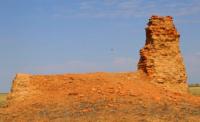
Monuments of Kumkeshu.
“The river of time, in its relentless flow,
Sweeps away all the deeds of men,
And drowns in the abyss of oblivion
Nations, kingdoms, and kings.”
“Rriver of time, in its relentless flow…” (known by title “On Transience”). Gavriil Romanovich Derzhavin, 1816.
Torgay Region of Kazakhstan.
Archaeology of Kumkeshu: Traces of Ancient Humans by Torgay River.
The uniqueness of Kumkeshu lies in more than just its sandy landscape. The area surrounding the village is also of significant archaeological interest. Within this relatively small territory, a complex of sites has been identified, spanning several historical epochs from the Eneolithic (Copper Age) to the Middle Ages.
It is particularly noteworthy that these ancient sites are situated in close proximity to the modern-day village and the valley of the Torgay River. Thus, a territory perceived today primarily as a distinctive sandy corner of the Torgay steppe actually possesses a history of human habitation stretching back thousands of years.
Kumkeshu I: A Site from Eneolithic Era.
The most prominent archaeological site is the Kumkeshu I settlement, located on the southwestern outskirts of the village, on the right bank of the Torgay River. The site was discovered in 1982 by a survey team from the Torgay Archaeological Expedition.
Subsequent research revealed that the site is an Eneolithic-era settlement associated with the Tersek culture. The location of the settlement is quite logical: the ancient site was situated by the river, on a low terrace overlooking the modern-day floodplain.
For the ancient inhabitants of the Torgay Basin, the combination of water, open steppe expanses, and land suitable for economic activity created favorable conditions for either long-term or seasonal settlement. Archaeological investigations have uncovered the remains of dwellings and storage pits at the site. In some places, the cultural layer reaches a thickness of several tens of centimeters, with a significant portion of the artifacts concentrated in its lower half.
The materials from Kumkeshu I offer insight into the daily lives of the people who inhabited the Torgay region several millennia ago. Finds include scrapers, knives, projectile points, axes, discoidal tools, and fragments of pottery. Of particular interest are vessels with pointed bases, decorated with patterns created using a notched stamp.
These discoveries reveal a world far removed from the modern steppe landscape a world of Eneolithic settlements, where the inhabitants of the Torgay Basin already possessed a sophisticated tradition of crafting stone tools and ceramic vessels.
Tersek Culture.
Kumkeshu I is of particular significance for the study of the Tersek culture an Eneolithic archaeological culture with sites that are especially well-represented throughout the Torgay Valley. These sites generally date from the 3rd millennium to the beginning of the IInd millennium BCE.
|Characteristic finds include stone tools, projectile points, knives, scrapers, and pottery featuring distinctive ornamentation. Animals played a notable role in the economy of this ancient population, with horse remains predominating among the faunal findings.
Kumkeshu I ranks among the most well-known sites associated with this culture. Therefore, its significance extends far beyond the confines of a single small settlement: the archaeological material found here helps researchers reconstruct the economic practices, daily life, and material culture of the ancient population of the Torgay region.
Comparing the archaeological data with the present-day landscape is particularly interesting. Today, a traveler here encounters sands, steppe, and the Torgay Valley. Several millennia ago, the ancient inhabitants of this site experienced a different though still closely river-linked steppe landscape.
Kumkeshu II and Kumkeshu III.
The archaeological heritage in the vicinity of the village is not limited to Kumkeshu I. The state register of historical and cultural monuments of local significance in the Kostanay Region officially includes the Kumkeshu II site, which dates to the Bronze Age, and the Kumkeshu III site, which spans the Eneolithic through the Bronze Age.
The former is located approximately three kilometers east of the village, while the latter lies about three kilometers to the northeast. Thus, we are dealing not with an isolated site, but with an entire archaeological zone. The current official approach to Kumkeshu III is particularly noteworthy.
In 2026, a protected zone, a development regulation zone, and a protected natural landscape zone were established for this site. The total area of the site, including its protected zones, encompasses 132,703.8 square meters. The documentation emphasizes that the surrounding landscape is a functionally integral part of the site.
This is a significant point. An archaeological site cannot be viewed merely as a plot of land containing a cultural layer; understanding an ancient settlement requires considering its natural environment the river, the terrain, water sources, and the overall character of the landscape.
Kumkeshu IV is a burial ground.
There is another important archaeological site in the vicinity of the village: the Kumkeshu IV burial ground, located approximately 700 meters to the southwest. It has a much broader chronological range, spanning from the Eneolithic era through the Middle Ages.
This extensive timeframe is especially interesting, as it testifies to the enduring historical significance of the area. A unique archaeological picture emerges here: settlements from various periods, along with burial sites, are clustered around a single modern-day landmark the small village (aul) of Kumkeshu, situated on the right bank of the Torgay River.
Today, it is difficult to imagine that, amidst the sands and vast steppes of Kumkeshu, small human settlements once existed in ancient times. However, archaeological evidence indicates that this area was already inhabited by humans in the distant past.
The Torgay River was likely a primary factor in the selection of these settlement sites. In an arid steppe environment, a permanent water source was of vital importance to both humans and animals, while the surrounding terrain offered opportunities for hunting, foraging, and other economic activities.
Consequently, the archaeological sites at Kumkeshu should be viewed in close connection with the natural history of the Torgay Basin. The sands, which today appear to be the most prominent natural feature of the area, are merely one element of a much older landscape.
Kumkeshu as a Natural-Historical Complex.
Thus, the small area surrounding the village of Kumkeshu is of interest for several reasons.
It encompasses:
a sandy expanse featuring contemporary aeolian (wind-formed) landforms;
the valley of the Torgay River;
the Kumkeshu I site, dating to the Eneolithic (Copper Age);
the Kumkeshu II site, dating to the Bronze Age;
the Kumkeshu III site, spanning the period from the Eneolithic to the Bronze Age;
and the Kumkeshu IV burial ground, which dates from the Eneolithic through the Middle Ages.
Therefore, Kumkeshu merits attention not only as a remarkable natural site but also as a natural-historical complex within the Torgay Basin. For a traveler, this is particularly intriguing: upon arriving to see the unusual golden sands, one finds oneself in a place where the history of several millennia lies hidden right beneath one’s feet and all around.
Modern sand ridges and ancient archaeological sites coexist here in the same space. It is precisely this blend of nature and human history that gives Kumkesh its special value, making it far more significant than just a picturesque spot for taking photographs.
Authority and photographs by:
Alexander Petrov.