





You are here
Samarkand Architecture.
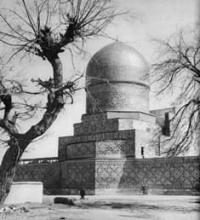
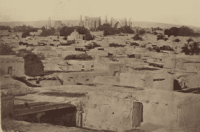
Central Asian Architecture of Late XIVth-XVth Centuries.
"A vast collection of artistic monuments has been preserved in Central Asia, primarily due to a number of unique reasons. The historical destinies of their creators - that is, the peoples who inhabited this region, who only emerged as modern nations in the XXth century - were so closely intertwined, and the landscape of political events, shifting borders, and ethnic conglomerations over the millennia was so varied that it is almost impossible to isolate the contribution of each of these peoples to the formation of this artistic heritage. Therefore, this book examines this heritage as a whole, rather than for each Central Asian republic.”
"Central Asia." A Guidebook. G. A. Pugachenkova. 1983.
Artistic Monuments of Central Asia.
The foundation for the flourishing of Central Asian architecture in the late XIVth century. After the decline associated with the Mongol invasion, Timur's powerful state emerged, uniting all the Central Asian lands and conquering several countries in the Near and Middle East.
The Golden Horde and Khorezm were the first to suffer devastating defeats. Caravan routes from east to west passed through Transoxiana. Campaigns in Iran, India, Azerbaijan, Armenia, and Turkey were carried out primarily for the purpose of plundering these territories and were accompanied by the sacking of subject cities.
Revenue from taxes on the conquered populations of the vast empire, trade duties, and military booty formed the economic basis for the scale of construction. During this period, construction took place primarily in Transoxiana, primarily in the imperial capital, Samarkand, and in the ruler's birthplace, Kesh (Shakhrisabz).
Wars provided not only resources but also skilled builders, architects, and artists, who were forcibly removed from the conquered lands. The strengthening of the country's economy and the accumulation of cultural resources ensured that architectural development in Central Asia continued to flourish even after Timur's death, when the empire he had founded was significantly reduced and effectively divided into two independent states with their capitals in Samarkand and Herat.
The architecture of Central Asia in the first half of the XVth century is associated with the name of Timur's grandson, Ulugh Beg. Formally considered the viceroy of his father, Shah Rukh, in Transoxiana, he was, in fact, the sole ruler of this part of the state.
Apparently due to his military failures, Ulugh Beg did not continue his grandfather's campaigns of conquest. Showing a keen interest in science and art, he gathered the best scholars of the East in Samarkand, which influenced the nature of construction.
A madrasah and an observatory, a major astronomical center where Ulugh Beg himself worked, were built. The second half of the XVth century, the reign of Abu Said (1451-1469), a protégé of the reactionary clergy of the Naqshbandi order, was marked by rampant obscurantism.
But these years of reaction could not halt the progressive development of architecture. However, this period left its mark on the scale and nature of construction. Only two royal tombs remain from this period in Transoxiana. Abu Said, wishing to contrast Samarkand with Herat and to aggrandize himself, built these structures, lavishly decorated and richly gilded.
The centralization of state power and the creation of a powerful empire under Timur contributed to the rise of trade and the flourishing of crafts. This led to the growth of large cities and their transformation into major economic centers. Architects faced new urban planning challenges: creating wide thoroughfares, large marketplaces, and the thoughtful placement of newly erected grand structures that would define the city's distinctive skyline. In the XIVth and XVth centuries, architectural ensembles began to emerge in the most important parts of the city, its squares and main streets.
Under Timur, significant urban development work was carried out in Samarkand. In 1370, the city was surrounded by walls, adjacent to the west by a citadel. Its adobe walls, up to 8 meters high, were double-walled in the outer western part. Two gates were located on the eastern and southern sides; in front of the former, there was a bridge leading to Registan Square.
To organize trade in Samarkand, Timur ordered the construction of a wide street amid the dense medieval buildings. This street was intended to cross the entire city from the Akhania Gate to the Bukhara Gate, serving as a continuation of the road from Bukhara to Fergana.
The completed section was lined with shops and covered with domes to protect from the scorching southern sun; light penetrated through window openings in the roof. This thoroughfare simultaneously became the city's compositional axis; at various points along it, previously existing architectural ensembles and market squares were recreated or revealed.
At the crossroads of roads leading to Bukhara, Fergana, and Shakhrisabz, a central square emerged. The trading square with its domed passage, the Tim-i-kulyakh Furushon, was built in the 1420s. In the 1420s, the ensemble of the city's main square, Registan, emerged on this site: the Ulugh Beg Madrasah stood on the western side of the square, the Mirzoya caravanserai on the northern side, and the khanaka on the eastern side, where the domed Tim once stood.
The square's architectural composition was preserved during construction in the XVIIth century, when some buildings were replaced.
At the turn of the XIVth and XVth centuries, the ensemble of the Bibi Khanum Cathedral Mosque and Madrasah was built at the northern end of the city's main thoroughfare, near the Akhania Gate. On the opposite side, the khanaka and madrasah complex of Muhammad Sultan, later supplemented by the Guri Emir Mausoleum, was built.
To develop crafts and trade, skilled artisans were brought to Samarkand from all conquered lands. The city's territory expanded. For ease of communication, artisans were housed in workshops in separate neighborhoods (guzar, or mahalla, in Central Asia).
There were guzars for coppersmiths, jewelers, saddlers, shoemakers, skullcap makers, tailors, gunsmiths, potters, and so on. This is evidenced by the street names that still exist today. People from other countries also made up the population of individual neighborhoods.
A mosque with a small minaret and a pond (khauz) was built in the center of the guzar. The level of its architectural embellishment depended on the income of the neighborhood's residents. Guzar development consisted of separate private estates, enclosed by a clay wall. In addition to the house, these estates included a courtyard, outbuildings, production facilities (in artisans' homes), and sometimes a garden.
The direction of the narrow streets within the guzar was determined by the shape of the homeowners' plots.
Authority:
https://8-sredizemnomor-afrika-aziya-6-19v.archisto.info/arh-srednej-azii-14-15v.html